Law & Courts

U.S. Supreme Court Is Asked to Take Up Harvard’s Consideration of Race in Admissions

By Mark Walsh — February 25, 2021 3 min read
Rowers paddle along the Charles River past the Harvard University campus in Cambridge, Mass. on March 7, 2017.
  • Save to favorites
  • Print

Challengers of Harvard University’s use of race in admissions on Thursday filed a much-anticipated appeal to the U.S. Supreme Court, urging the justices to overrule a key 2003 precedent that has allowed K-12 schools and colleges to sometimes consider race to achieve student body diversity.

“That Harvard engages in racial balancing and ignores race-neutral alternatives … proves that Harvard does not use race as a last resort,” says the appeal filed by Students for Fair Admissions, which argues that the Ivy League institution’s admissions policies penalize Asian-American applicants.

The group is appealing a November 2020 decision by a panel of the U.S. Court of Appeals for the 1st Circuit, in Boston, which agreed with a trial court that Harvard’s use of race was limited and was used to keep Black and Hispanic enrollment from “plummeting.”

In its appeal in Students for Fair Admissions v. President and Fellows of Harvard College, SFFA argues that Harvard is “obsessed with race” and its undergraduate admissions policies amount to “flagrant violations” of Title VI of the Civil Rights Act of 1964, which bars discrimination based on race and other factors in federally funded programs.

The group urges the high court to accept review in the case and use it to overrule its 2003 decision in Grutter v. Bollinger, which upheld the University of Michigan law school’s holistic use of race in admissions and reaffirmed that achieving racial diversity is a compelling governmental interest.

The group called on the court to accept review both because of Harvard’s place at the top of the American higher education system but also because of the nationwide importance of the debate over the use of race in education.

“[I]t isn’t just any university,” the appeal says. “It’s Harvard. Harvard has been at the center of the controversy over ethnic- and race-based admissions for nearly a century.”

The brief discusses Harvard’s restrictions on Jewish applicants in the 1920s and the attention the court gave to Harvard’s use of race in the 1970s when it decided the landmark Regents of the University of California v. Bakke case, which struck down racial quotas at UC-Davis but endorsed the diversity rationale for race in admissions.

More broadly, the appeal argues, the Grutter decision “sustains admissions programs that intentionally discriminate against historically oppressed minorities. Jewish students were the first victims of holistic admissions, and Asian-Americans are the main victims today.”

The appeal continues: “This discrimination is not news to Asian-American high-schoolers: An entire industry exists to help them appear ‘less Asian’ on their college applications.”

The Harvard case is being watched in the K-12 sector both because of its impact in the world of college counseling and admissions and because it may impact the relatively few remaining elementary and secondary programs that take race into account after the Supreme Court’s 2007 decision in Parents Involved in Community Schools v. Seattle School District. That ruling sharply curtailed the ways school districts could voluntarily take account of race in assigning students to schools.

In a statement, Harvard said that “as earlier court decisions have confirmed, our admissions policies are consistent with Supreme Court precedent. We will continue to vigorously defend the right of Harvard College, and every other college and university in the nation, to seek the educational benefits that come from bringing together a diverse group of students.”

Former-President Donald Trump’s administration supported SFFA’s challenge in the 1st Circuit, but President Joe Biden’s administration is not bound by that and would be more likely to support Harvard. In early February, the U.S. Department of Justice dropped a lawsuit against Yale University over the use of race in admissions that the Trump administration had filed.

On Thursday, SFFA filed its own lawsuit challenging Yale’s admissions policies as discriminatory against Asian-Americans. Yale has defended its admissions program.

But the Harvard case is much farther along, and the justices could decide by sometime this spring whether to take up the case.

Events

This content is provided by our sponsor. It is not written by and does not necessarily reflect the views of Education Week's editorial staff.
Sponsor
Artificial Intelligence Webinar
AI in Schools: What 1,000 Districts Reveal About Readiness and Risk
Move beyond “ban vs. embrace” with real-world AI data and practical guidance for a balanced, responsible district policy.
Content provided by Securly
This content is provided by our sponsor. It is not written by and does not necessarily reflect the views of Education Week's editorial staff.
Sponsor
Recruitment & Retention Webinar
K-12 Lens 2026: What New Staffing Data Reveals About District Operations
Explore national survey findings and hear how districts are navigating staffing changes that affect daily operations, workload, and planning.
Content provided by Frontline Education
Education Funding Webinar Congress Approved Next Year’s Federal School Funding. What’s Next?
Congress passed the budget, but uncertainty remains. Experts explain what districts should expect from federal education policy next.

EdWeek Top School Jobs

Teacher Jobs
Search over ten thousand teaching jobs nationwide — elementary, middle, high school and more.
View Jobs
Principal Jobs
Find hundreds of jobs for principals, assistant principals, and other school leadership roles.
View Jobs
Administrator Jobs
Over a thousand district-level jobs: superintendents, directors, more.
View Jobs
Support Staff Jobs
Search thousands of jobs, from paraprofessionals to counselors and more.
View Jobs

Read Next

Law & Courts Supreme Court’s Gender Identity Ruling Leaves Schools Seeking Clarity
Advocates say they would welcome more from the Supreme Court on gender-notification policies.
7 min read
The Supreme Court is photographed, Friday, Feb. 27, 2026, in Washington.
The Supreme Court is photographed, Friday, Feb. 27, 2026, in Washington. The high court recently ruled that California policies that sometimes limit or discourage schools from disclosing information to parents about children’s gender transitions and expressions at school likely violate parents’ constitutional rights
Rahmat Gul/AP
Law & Courts Supreme Court Backs Parents in School Gender Disclosure Fight
The Supreme Court restored an injunction blocking California policies on student gender transitions
8 min read
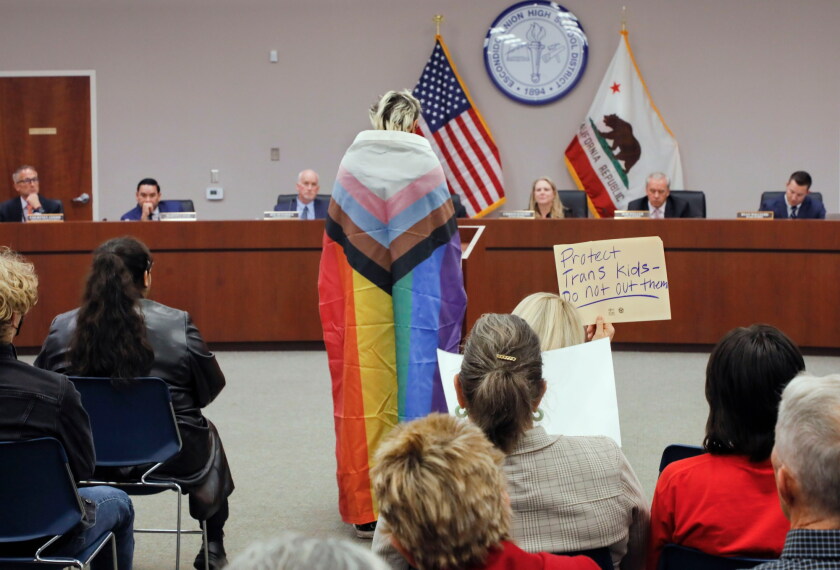
Teacher’s aide Amelia Mester, wrapped in a Pride flag, urges Escondido Union High School District not to have employees notify parents if they believe a student may be transgender in November 2025. A policy on the issue in the city’s elementary school district is the subject of a federal class-action lawsuit in which a judge just sided against the district.
Teacher’s aide Amelia Mester, wrapped in a Pride flag, urges Escondido Union High School District not to have employees notify parents if they believe a student may be transgender at a meeting in November 2025. Two parents and two teachers from the district sued in 2023, challenging California state guidance concerning student gender transitions and parental notification. The U.S. Supreme Court has now reinstated a lower-court decision overturning those state policies.
Charlie Neuman for The San Diego Union-Tribune/TNS
Law & Courts Appeals Court Allows Louisiana Ten Commandments Displays to Proceed
The court said it was premature to rule on the constitutionality of La. Ten Commandments displays.
3 min read
Students work under Ten Commandments and Bill of Rights posters on display in a classroom at Lehman High School in Kyle, Texas, Thursday, Oct. 16, 2025.
Students work under Ten Commandments and Bill of Rights posters on display in a classroom at Lehman High School in Kyle, Texas, Oct. 16, 2025. A federal appeals court has lifted a lower-court injunction blocking a Louisiana law that requires Ten Commandments displays, clearing the way for the law to take effect.
Eric Gay/AP
Law & Courts Social Media Companies Face Legal Reckoning Over Mental Health Harms to Children
Some of the biggest players from Meta to TikTok are getting a chance to make their case in courtrooms around the country.
6 min read
Social Media Kids Trial 26050035983057
Meta CEO Mark Zuckerberg leaves court after testifying in a landmark trial over whether social media platforms deliberately addict and harm children, on Feb. 18, 2026, in Los Angeles.
AP Photo/Damian Dovarganes
