

The U.S. Supreme Court on Monday, over the sharp dissent of three justices, granted a request by the Trump administration to allow the U.S. Department of Education to proceed with layoffs of roughly 1,400 employees.
The court’s order in McMahon v. New York is not a final ruling on the merits, but it removes a barrier that had blocked the administration from taking its first steps toward dismantling the department.
Justice Sonia Sotomayor, in a dissent joined by Justices Elena Kagan and Ketanji Brown Jackson, called the action “indefensible” and cast it as allowing President Donald Trump and Secretary of Education Linda McMahon to “gut” the department’s workforce.
“When the Executive publicly announces its intent to break the law, and then executes on that promise, it is the Judiciary’s duty to check that lawlessness, not expedite it,” Sotomayor said. “The majority is either willfully blind to the implications of its ruling or naive, but either way, the threat to our Constitution’s separation of powers is grave.”
A federal district judge’s injunction was at stake
The administration on June 6 asked the high court to undo a preliminary injunction by a federal district judge in Massachusetts ordering the Education Department to reverse the layoffs and reinstate the affected employees, who constitute about one-third of the department’s workforce, excluding 578 workers who accepted voluntary departure offers from the Trump administration.
“The injunction rests on the untenable assumption that every terminated employee is necessary to perform the Department of Education’s statutory functions,” U.S. Solicitor General D. John Sauer wrote in the filing.
The injunction came in a pair of lawsuits brought by New York and 20 other Democratic-led states, two Massachusetts school districts, and the American Federation of Teachers, who contend that the layoffs are a key step toward dismantling the department and severely obstructing it from carrying out its congressionally mandated duties.
U.S. District Judge Myong J. Joun of Boston, an appointee of former President Joe Biden, ruled on May 22 that the challengers would likely succeed in court in showing that the Trump administration is “effectively disabling the department from carrying out its statutory duties by firing half of its staff, transferring key programs out of the department, and eliminating entire offices and programs.”
A three-judge panel of the U.S. Court of Appeals for the 1st Circuit, in Boston, declined to block the injunction on June 4, leading the Trump administration to go to the Supreme Court.
Sauer insisted in his filing that the Trump administration has acknowledged only Congress can “eliminate” the Education Department. The lawsuits merely speculate that the department has effectively been “shut down,” he said.
The challengers “have not identified any actual losses of federal funds or financial aid,” and they “offer only rank speculation that an agency with over 2,000 remaining employees will abruptly halt its statutory functions,” Sauer said.
Challengers say administration aims to ‘diminish’ or ‘destroy’ the department
The challenging states, in a filing led by New York Attorney General Letitia James, a Democrat, said the layoff plan “has gutted the offices within the department tasked by Congress to collect, report, analyze, and disseminate statistical data related to education.”
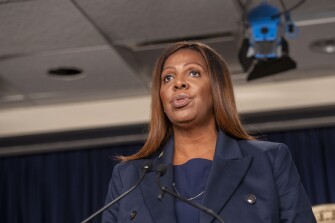
She cited Judge Joun’s factual findings, including that the department’s Office of Elementary and Secondary Education has failed to provide states with preliminary Title I compensatory education aid figures for the upcoming school year.
“The record belies [the administration’s] claim that the [reduction in force] was calculated to improve efficiency as opposed to simply diminishing the department,” James said.
A separate filing by the two Massachusetts districts, the AFT, and other parties, represented by the Democracy Forward Foundation, says that “instead of faithfully executing Congress’s laws, the leaders of the department have set out to destroy the agency by executive fiat.”
That has hardly been a secret, the challengers say, citing public comments by McMahon and the March 20 executive order and public statements by Trump that call for shutting down the department.
The brief noted that the administration has argued that its efforts do not technically amount to the elimination of the department because a skeleton crew remains.
But “both lower courts saw through this artifice and recognized that the government was not likely to succeed on its argument that it is faithfully carrying out Congress’s mission by tearing the department down to the plywood,” the brief said.
Dissenters say only Congress may eliminate the Education Department
As is customary with such emergency docket orders, there was no opinion explaining the reasoning of the court, only a short statement explaining that the injunction was “stayed pending the disposition of the appeal” in the 1st Circuit and any petition on the merits subsequently filed in the Supreme Court.
Justice Sotomayor, in her 19-page dissent, rejects the administration’s arguments to the court that the layoffs were merely a lawful effort to eliminate “bureaucratic bloat.”
“Undeterred by … limits on executive authority, President Trump has made clear that he intends to close the department without Congress’s involvement,” she said, citing among other things Trump’s directive to McMahon to “put herself out of a job.”
Internal developments leading up to the mass layoffs reflected a disregard for the department’s statutory duties, Sotomayor said. Certain units were asked to prepare lists of their statutorily required duties, but the due date was two days after the department carried out the layoffs.
“The terminations eliminated whole offices and teams within the department,” she added, citing the dismantling of the entire Office of English Language Acquisition, the layoffs of Office of General Counsel workers who dealt with K-12 and special education matters, and the closure of seven of the 12 regional offices of the Office for Civil Rights.
“The department did not explain how terminating half of the agency’s work force overnight would improve efficiency, nor how it would be able to continue carrying out its statutory functions,” Sotomayor said.
“The president … lacks unilateral authority to close a Cabinet-level agency,” she said. “Congress created the department, and only Congress can abolish it.”
She said the relative harms to the two sides of allowing the layoffs to proceed counseled in favor of the district court injunction.
“While the government will, no doubt, suffer pocketbook harms from having to pay employees that it sought to fire as the litigation proceeds, the harm to this Nation’s education system and individual students is of a far greater magnitude,” Sotomayor said.
High court also allows layoff plans in other agencies
The emergency request in the Education Department case was separate from another case involving layoff and restructuring plans for multiple other federal agencies, including every other Cabinet-level department except for Education.
On July 8, in Trump v. American Federation of Government Employees, the court granted the administration’s request to put on hold a preliminary injunction that a federal district judge in California had issued to block those other agencies’ layoff plans.
Only Justice Ketanji Brown Jackson publicly dissented from that action, saying that the relevant executive order from Trump “effects a massive restructuring of the federal government” without the consent of Congress. Jackson said the court majority was stepping in prematurely, while the merits of the case were being litigated, “to release the president’s wrecking ball.”


