When it comes to fixing the nation’s schools, policymakers who champion alternatives to traditional public education are out of sync with most Americans, the new edition of an annual poll suggests.
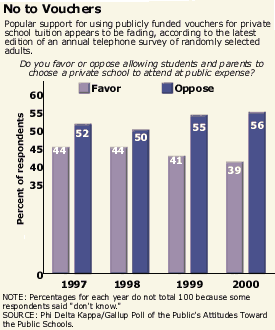
Support for publicly financed vouchers for private school tuition has declined over the past three years, from 44 percent of respondents in 1998 to 39 percent this year, in the survey conducted by the Gallup Organization for Phi Delta Kappa International, a Bloomington, Ind.-based professional education organization.
Only half of this year’s respondents said they had heard or read about charter schools, even though more than 2,000 such schools are now operating in 33 states and the District of Columbia. When told that charter schools are freed from many state regulations to operate independently, only 49 percent of the respondents said they favored the idea.
“What this poll has consistently shown is the supposed decline in support for public schools is basically a myth,” the poll’s director, Lowell C. Rose, said at an Aug. 22 press conference here. “You will not have radical change in the public schools until the public comes to believe the public schools are failing.”
Results of the Phi Delta Kappa/Gallup Poll of the Public’s Attitudes Toward the Public Schools were based on telephone interviews in June with 1,093 randomly selected adults; the margin of error is 4 percentage points.
Now in its 32nd year, the poll has generally shown a solid level of support for the traditional education system. The results of this year’s survey, however, coincide with a period of particularly intense national interest in K-12 schooling and divisions over the best course for the future.
Both the Democratic and Republican candidates for president have made school improvement a central part of their appeals to voters, some of whom will also be deciding the fate of ballot initiatives this November aimed at instituting vouchers or charter schools in three states. And state leaders are grappling with a host of pressing issues, from teacher shortages to high-stakes testing.
“This is really the first time I can stand here and say education is the number-one priority in the nation and the number-one priority in every state,” Mr. Rose said at the press conference. “I never thought I’d see that happen.”
Open to Interpretation
Democrats are viewed as the stronger of the two major parties on education, with 41 percent of those polled choosing them as the party most interested in improving public education, compared with the 29 percent who picked Republicans.
But Vice President Al Gore, the Democratic presidential nominee, and his Republican opponent, Texas Gov. George W. Bush, were in a dead heat when respondents were asked whom they would vote for based solely on a desire to strengthen public schools.
Groups on both sides of the school choice debate rushed to provide their own analyses of the poll’s results.
The Center for Education Reform, a Washington-based organization that supports such educational alternatives as vouchers and charter schools, argued that Phi Delta Kappa’s questions and its interpretations were skewed in favor of the status quo.
Jeanne Allen, the center’s president, specifically questioned the fairness of forcing respondents to choose between supporting improvements in the existing education system and finding alternatives to regular public schools, as did one question in the Phi Delta Kappa/Gallup poll.
“PDK wants to make an issue of reform as an either- or proposition,” Ms. Allen said. “There’s not one viable public policy today that asks people to choose one thing at the expense of something else.”
Phi Delta Kappa was also sharply criticized by the Black Alliance for Educational Options, a Milwaukee-based national group launched last month to push for educational choices for the children of low-income black families.
“I used to think PDK was unbiased, but it’s clear from this poll they’ve thrown away the cover of unbias,” said the alliance’s president, Howard L. Fuller, a former Milwaukee superintendent who also serves as the director of the Institute for the Transformation of Learning at Marquette University. “The way they ask these questions, they are clearly loaded to get a certain answer.”
Members of the group said the 129 blacks surveyed were not an adequate representation of that population. They also pointed to U.S. Department of Education statistics showing that people who are free to select their children’s schools are more likely to be satisfied with their choices. Other groups, however, said the poll results were on target.
“The American people overwhelmingly believe the public schools are what we should concentrate on, instead of searching for an alternative system,” said John F. Jennings, the director of the Washington- based Center for Education Policy. “In particular, the option of publicly funded vouchers for private schools seems to have peaked in public support and is now opposed by a majority.”
The National Education Association seized on the findings to bolster its repeated call to reject any policies that sap resources from the traditional public education system.
NEA President Bob Chase noted that when the respondents were asked to identify the biggest problem facing public schools, the largest proportion—18 percent—cited a lack of financial support.
“This is reliable evidence that Americans understand it will take additional resources to meet our nation’s goals in public education improvement,” Mr. Chase said.


