

A Midwesterner who taught high school social studies and coached football before he was elected to Congress and later as Minnesota’s governor will be Vice President Kamala Harris’ running mate in the 2024 presidential campaign.
Tim Walz, a Democrat serving his second term as the North Star State’s governor, is Harris’ pick, her campaign announced on Tuesday, Aug. 6. In his time as governor, he has negotiated increases to school funding and made Minnesota one of the handful of states with universal free school meals for students.
In choosing Walz, Harris passed over a number of alternatives who also have extensive K-12 policy records. Pennsylvania Gov. Josh Shapiro, a Democrat who has supported private school choice and drew objections from public school advocacy groups as a result, was another finalist.
In the lead-up to Harris’ decision, Walz went viral for cable news appearances in which he labeled former President Donald Trump and his 2024 running mate, Ohio Sen. JD Vance, as “just weird.”
In the July 23 interview on the MSNBC show “Morning Joe” that kicked off the trend of Democrats labeling the Republican ticket “weird,” Walz touched on public schools while saying that Republicans were “destroying” rural America and “telling us what books to read.”
“I think what Kamala Harris knows is bringing people together around the shared values—strong public schools, strong labor unions, health care that’s affordable and accessible,” Walz said.
From social studies teacher to VP hopeful
Walz worked as a high school teacher in Nebraska before moving to Minnesota and working as a social studies teacher and football coach at Mankato West High School in Mankato, Minn. His wife, Gwen Walz, also taught at the school before becoming a district administrator and, later, Minnesota’s first lady.
Before he was elected Minnesota’s governor in 2018, Tim Walz served six terms in the U.S. House of Representatives—a job he was elected to from his teaching position. In a 2007 interview with Education Week shortly after he took office in Congress, Walz said campaigning was a lot like teaching.
“The biggest thing is communicating an idea,” Walz said. “It’s trying to get people to be involved and to look at the facts. ... Teaching is the same way. You’re trying to present a system of facts; you’re trying to teach students what’s the best way to think about problems to solve them in a rational way.”
Walz criticized the No Child Left Behind Act in that interview, calling it a “bureaucratic nightmare.” He said the goal of the law—to close achievement gaps—is one that teachers share, but “the application of it has had very little impact on real student achievement.”
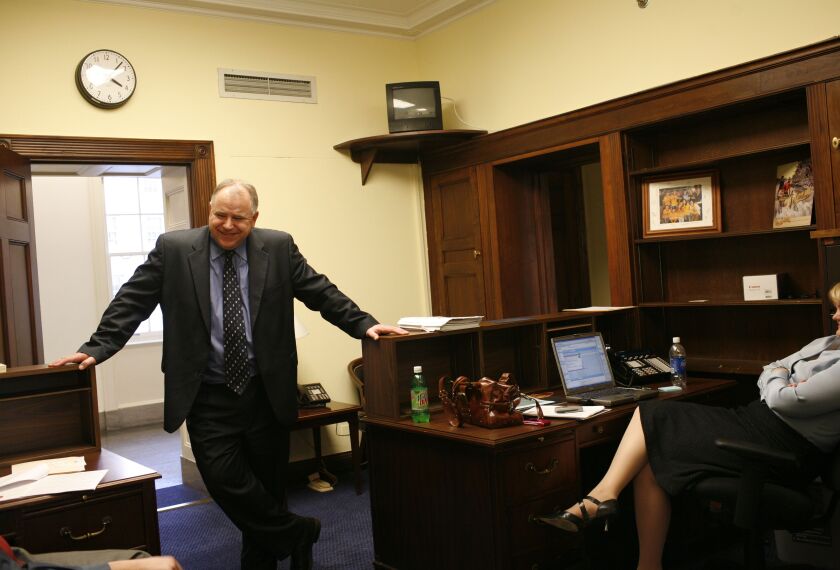
Walz’s track record as governor includes passing several policies of significance to the state’s K-12 schools. In 2023, he signed the Minnesota Free School Meals Law, making Minnesota one of the eight states where school breakfast and lunch are free for all students, according to the nonprofit Food Research and Action Center.
Last year, the Minnesota governor signed a sweeping education budget law to increase spending for K-12 schools by $2.3 billion. The law also made school employees eligible to collect unemployment benefits during the summer when schools are closed.
In recent interviews with the Washington Post, former students and teaching colleagues of Walz described Walz as passionate and upbeat. He was known for hosting “Jeopardy!”-style tournaments and inviting other teachers to debate him on current events. He offered to serve as the first faculty adviser to the newly formed gay-straight alliance at the southern Minnesota high school in the mid-1990s, the Post reported.
Walz’s background as a teacher makes him an attractive running mate for the Harris campaign, said David Bloomfield, an education law and policy professor at Brooklyn College and City University of New York Graduate Center.
While Minnesota is not considered a swing state—the last time it backed a Republican in a presidential race was 1972—Walz is a candidate who feels relatable to rural and blue-collar voters in states Harris needs to win to become president, Bloomfield said. The southern Minnesota district Walz represented in Congress is rural, and rural voters have largely drifted from Democrats in recent election cycles.
“His background as a teacher is consistent with his general attraction as a middle-class, common-sense politician,” he said. “The litmus test of him as a strong proponent of public education and a former teacher is a draw” for Harris’ team.
Vice president’s role is limited
Ultimately, Walz’s policy positions on public schools aren’t likely to be of major consequence, Bloomfield said.
“It’s going to be the Harris campaign that drives the education conversation and not the individual policy positions of the vice presidential nominee,” Bloomfield said.
But Walz’s background as a teacher could give him a more prominent voice on education issues and the selection of an education secretary, Bloomfield said. Otherwise, voters should expect Walz to fall in line with Harris.

In the two weeks since she launched her campaign, Harris hasn’t published a comprehensive policy agenda, but she has collected the endorsements of both major teachers’ unions.
In a speech to educators and other union members at the American Federation of Teachers convention in July, Harris positioned herself as an antidote to Trump, raising concerns about education proposals in Project 2025 and the 2024 GOP agenda. However, she didn’t introduce any policy proposals.
K-12 in a 2nd Trump Term: Project 2025, a detailed policy agenda assembled by allies of the former president, outlines plans to dramatically scale back the federal role in education. Here’s how.
Kamala Harris’ Education Record: The vice president has touched education policy since her days as a prosecutor. What she’s said and done on K-12.
The GOP’s 2024 Education Platform: We break down the party’s nine key education positions in its official platform. Here’s what the party has in mind.
‘God Knows We Don’t Pay You Enough': Kamala Harris rallied teachers in one of her first campaign speeches. Here’s what she said.


