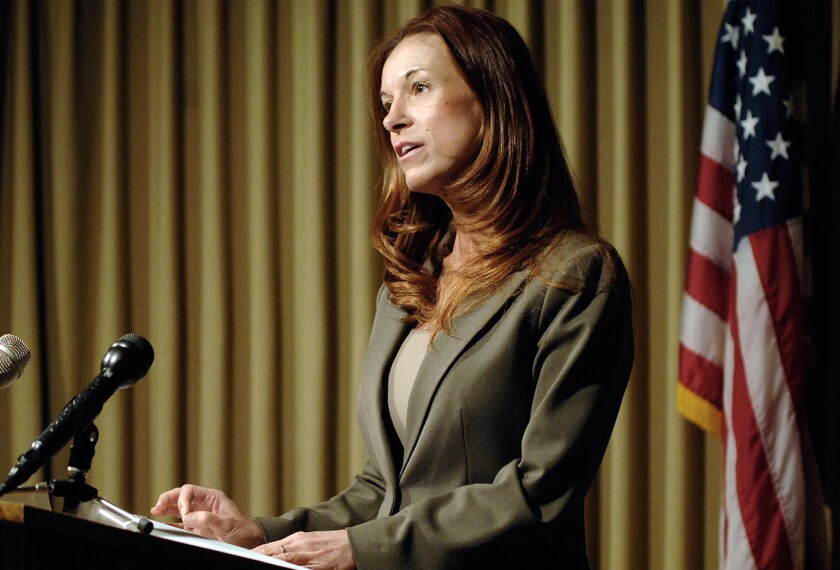
Citing a need for a more focused policy approach to education at the college and university level, Secretary of Education Margaret Spellings announced the formation of a commission last week to draw up a “comprehensive national strategy” on the future of higher education.
“I’m not advocating a bigger role for the federal government, but it’s time to examine how we can get the most out of our national investment,” Ms. Spellings said on Sept. 19 in Charlotte, N.C. “We have a responsibility to make sure our higher education system continues to meet our nation’s needs for an educated and competitive workforce in the 21st century.”
She outlined a broad mandate for the 19-member federal panel, which will have its first meeting next month. Its final report is due Aug. 1.
View the accompanying item,
Commission members include former North Carolina Gov. James B. Hunt Jr., the chairman of the board of the James B. Hunt Jr. Institute for Educational Leadership and Policy at the University of North Carolina; Kati Haycock, the director of the Education Trust, a Washington research and advocacy group; and David Ward, the president of the American Council on Education, a Washington-based umbrella organization of higher education groups. The chairman is Charles Miller, a former chairman of the University of Texas system’s board of regents.
Ms. Spellings has largely focused on K-12 education and the continued implementation of the No Child Left Behind Act during her first eight months in office. But she noted that the federal government contributes only about 10 percent of the nation’s total spending on K-12 education. In contrast, federal dollars make up about a third of the nation’s investment in higher education, she said.
The secretary said that the federal government was missing “valuable information to help guide policy to ensure that our system remains the finest in the world.”
Ms. Spellings also drew upon some of her personal experiences with the college world. Her daughter Mary started college this month.
“Unloading the car was the last step in a long college process, which started with me thumbing through college books at Barnes and Noble,” the secretary said, adding that she saw guides discussing college architecture, dining hall food, intramural sports, and even “Schools that Rock.”
“But I didn’t find much information on what courses to take, how long it takes the average student to graduate, and whether it’s a better deal to graduate from a less-expensive state school in six years or a private school in four,” Ms. Spellings said. “I learned just how confusing the college process can be for parents. And I’m the secretary of education!”
Parents have a tough time getting answers about the way it all works, she added in her speech to introduce the new panel, which will be called the Commission on the Future of Higher Education.
Taking Stock
Paul E. Lingenfelter, the executive director of the Boulder, Colo.-based State Higher Education Executive Officers organization, said that while U.S. higher education has a lot of diversity among institutions and the types of education they offer, a need to work toward common goals remains.
“There’s an enormous national need to increase educational attainment,” Mr. Lingenfelter said. Also, he said, a greater focus on alignment between K-12 and higher education is required.
“I’m not talking about creating one fully integrated, bureaucratic educational system,” he said, but he favors a greater emphasis on encouraging students to take the kinds of courses in secondary school that will prepare them for college.
Mr. Lingenfelter’s organization, known as SHEEO, formed its own commission last year to study higher education. That panel, the National Commission on Accountability in Higher Education, found that the accountability measures currently used by colleges and universities were “cumbersome, confusing, and inefficient.”
The SHEEO commission called for creating statewide data systems to help inform policy and budgetary decisions, and for making the transition from high school to college a focus of accountability.
“It’s time to review this work and take stock of where we stand,” Ms. Spellings said, referring to the accountability panel’s study and others.
Although the new federal commission has no specific orders or subjects it will be required to examine, Mr. Lingenfelter said that Ms. Spellings’ focus on higher education was useful.
“The secretary has been sensitive to the complexity of higher education,” he said.