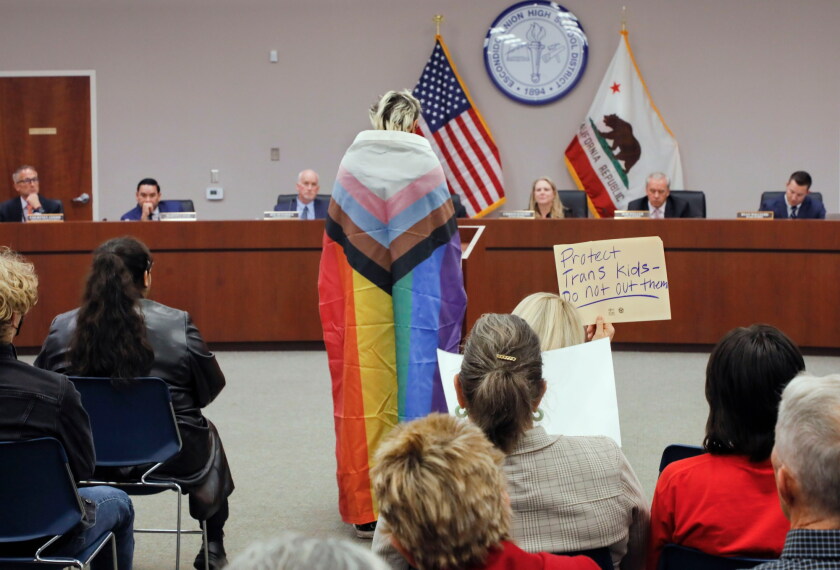
Two separate groups of Republican-led states on Monday filed lawsuits challenging the U.S. Department of Education’s final regulation on Title IX, focusing on the new rule’s protections for students’ gender identity.
The regulation is “a naked attempt to strong-arm our schools into molding our children in the current federal government’s preferred image of how a child should think, act, and speak,” says the lawsuit filed by Idaho, Louisiana, Mississippi, and Montana. “The Final Rule is an affront to the dignity of families and school administrators everywhere, and it is nowhere close to legal.”
Meanwhile, Alabama, Florida, Georgia, and South Carolina, joined by groups including Parents Defending Education, filed a suit calling the regulation “onerous” and saying it would increase costs and burdens on states.
Another lawsuit was filed separately by Texas, with that state’s Republican attorney general, Ken Paxton, calling the new rule “plainly illegal, undemocratic, and divorced from reality.”
The new rule, announced on April 19 (and published in the Federal Register on April 29), is the latest interpretation of Title IX, the 1972 federal statute that bars sex discrimination in federally funded educational programs. The regulation includes major sections on sexual harassment and assault, and pregnancy discrimination, among others, but it is the codification of protections for LGBTQ+ students that has prompted the most discussion.
Education officials in at least five states have advised schools to ignore the new regulation, as Education Week reported last week. And given the ferocity of the debate over transgender rights, and the willingness of Republican-led states and other parties to sue over Biden administration policies, it was all but inevitable that the new Title IX rule would face a legal challenge.
The regulation says a school would violate the law if it “denies a transgender student access to a sex-separate facility or activity consistent with that student’s gender identity.” However, the Education Department is still weighing a separate regulation that addresses how schools and colleges may deal with gender identity in athletics.
One case filed before a potentially sympathetic judge
The Louisiana-led lawsuit is backed by the Washington-based Defense of Freedom Institute and led by that state’s attorney general and its state education department. The suit contends that the new regulation flips the longstanding understanding of “sex” under Title IX to include discrimination based on sex stereotypes, sex characteristics, pregnancy or relation conditions, sexual orientation, or gender identity.
“These other grounds are not interchangeable with sex,” the lawsuit says. “A [federal funding] recipient that treats a person differently based on some of these grounds does not always discriminate against that person based on sex.”
The suit contends the rule would bar schools from requiring documentation of a diagnosis of gender dysphoria and “would compel students and teachers to use whatever pronouns a person demands.”
The suit also says that notwithstanding the pending separate regulation on transgender students’ participation in athletics, the broader Title IX rule would effectively require the states to permit transgender females to participate in female sports. That would interfere with state laws passed in Idaho, Louisiana, Mississippi, and Montana that define sex as “biological sex,” the suit says. Some 25 states have similar laws.
“These schools now have to change the way they behave and the way they speak, and whether they can have private spaces for little girls or women,” Louisiana Attorney General Elizabeth B. Murrill, a Republican, said in a statement. “It is enormously invasive, and it is much more than a suggestion; it is a mandate that well exceeds their statutory authority.”
The suit says the Education Department violated the Administrative Procedure Act and the spending clause in Article I of the U.S. Constitution, under which Congress attaches conditions to the receipt of federal funds. It asks a federal court to vacate the new regulation, and in the short term, to delay its Aug. 1 effective date.
The suit was filed in the U.S. District Court in Monroe, La., where it is likely to be assigned to Judge Terry A. Doughty, an appointee of President Donald Trump who has issued several rulings against the Biden administration, including blocking a rule on COVID-19 vaccinations, ordering the resumption of oil and gas leases on federal lands, and siding with Republican state attorneys general on claims that the Biden administration coerced social media platforms to suppress content about COVID-19 and claims of voter fraud in the 2020 election.
The Alabama led-suit, filed in U.S. district court for the northern division, criticizes the regulation’s harassment and assault procedures in addition to its language on sexual orientation and gender identity. The suit criticizes the Education Department’s reliance on a 2020 U.S. Supreme Court decision that found the main federal job discrimination law to cover gender identity and sexual orientation.
In Bostock v. Clayton County, the court ruled that Title VII of the Civil Rights Act of 1964 encompassed those two characteristics as included in its protections against sex discrimination. The Education Department relies on Bostock in finding that Title IX protects individuals on the basis of gender identity and sexual orientation.
“Title IX was enacted to create educational and athletic opportunities for women and girls, yet the Department’s understanding of Bostock would do the opposite: eliminate educational opportunities for women and girls, particularly in those areas where biological sex is most relevant,” the Alabama suit says.
The Texas suit was filed in the U.S. District Court in Amarillo, where another Trump appointee, Judge Matthew J. Kacsmaryk, has ruled frequently against the Biden administration, including a 2022 ruling that blocked administration guidance following Bostock that was meant to require employers to protect LGBTQ+ workers on matters such as pronouns, dress, and restrooms.
The Education Department said through a spokesman that it could not comment on pending litigation, but “the Department crafted the final Title IX regulations following a rigorous process to give complete effect to the Title IX statutory guarantee that no person experiences sex discrimination in federally-funded education.”
“As a condition of receiving federal funds, all federally-funded schools are obligated to comply with these final regulations and we look forward to working with school communities all across the country to ensure the Title IX guarantee of nondiscrimination in school is every student’s experience,” the statement added.
Last week, Education Week reported that education leaders in at least five states had urged schools to ignore the new regulation. The five states included four that have now sued—Florida, Louisiana, Montana, and South Carolina.