Federal

Project 2025 and the GOP Platform: What Each Says About K-12 in a 2nd Trump Term

A comparison of the two agendas for K-12 schools
By Libby Stanford — July 12, 2024 1 min read
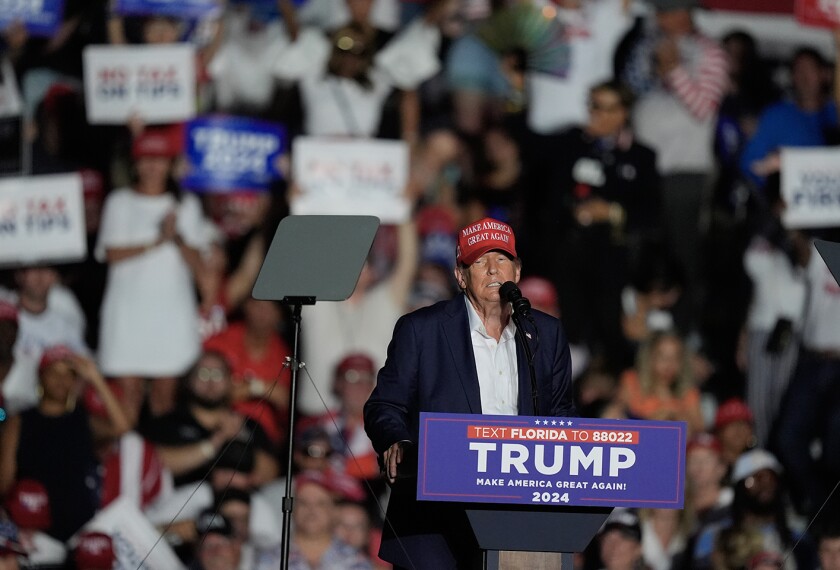
Republican presidential candidate former President Donald Trump speaks at a campaign rally at Trump National Doral Miami, Tuesday, July 9, 2024, in Doral, Fla.
  • Save to favorites
  • Print

K-12 education plays a prominent role in two conservative policy agendas that shed light on what could change for public education if former President Donald Trump wins the 2024 presidential election.

Project 2025, a 900-page policy document assembled by a number of former Trump administration officials and other allies of the former president and helmed by the conservative Heritage Foundation, lays out a conservative plan of action for virtually every corner of the federal government. The Republican National Committee’s 2024 policy platform, meanwhile, outlines a set of 20 “promises” for 2024, written in all caps, as well as the party’s official positions for this year’s elections, albeit in substantially less detail than Project 2025.

Trump has endorsed the GOP’s platform, which was released this week ahead of the start of the 2024 Republican National Convention on July 15. But he has distanced himself from Project 2025, saying that some of its proposals are “absolutely ridiculous and abysmal.”

See Also

Kevin Roberts, president of The Heritage Foundation, speaks before Republican presidential candidate former President Donald Trump at the National Religious Broadcasters convention at the Gaylord Opryland Resort and Convention Center on Feb. 22, 2024, in Nashville, Tenn.
Kevin Roberts, president of The Heritage Foundation, speaks before Republican presidential candidate former President Donald Trump at the National Religious Broadcasters convention at the Gaylord Opryland Resort and Convention Center on Feb. 22, 2024, in Nashville, Tenn. Democrats are using the Heritage Foundation's Project 2025 agenda to show what could happen in a Trump presidency while the former president distances himself from it.
George Walker IV/AP
Federal Project 2025: What It Is and What It Means for K-12 If Trump Wins
Libby Stanford, July 8, 2024
•
4 min read
Republican presidential candidate former President Donald Trump speaks at a campaign rally at Trump National Doral Miami, Tuesday, July 9, 2024, in Doral, Fla.
Former President Donald Trump speaks at a campaign rally at Trump National Doral Miami, Tuesday, July 9, 2024, in Doral, Fla.
Rebecca Blackwell/AP

When it comes to K-12 education, there are areas of clear alignment between the two documents.

Both propose eliminating the U.S. Department of Education, giving full oversight of schools to states. And they both endorse universal school choice, proposing an expansion of programs that allow families to access public dollars to pay for private school tuition and other education expenses outside of public schools.

The primary difference is that Project 2025 is much more extensive and outlines clear steps a conservative administration could take to achieve the goals it outlines.

Here’s a side-by-side look at what the two policy documents have to say on key education topics.

The U.S. Department of Education

  • Project 2025

    “Federal education policy should be limited, and ultimately, the federal Department of Education should be eliminated,” Project 2025 says, adding that states should be in charge of K-12 policy decisions and that the role of the federal government with respect to education policymaking should be limited to “that of a statistics-gathering agency that disseminates information to the states.”

    GOP Platform

    The federal government should “return education to the states” by closing the U.S. Department of Education and letting “the States run our educational system as it should be run,” according to the platform.

Private school choice

  • Project 2025

    The policy document supports universal school choice, though it doesn’t explicitly propose a program to attain that goal. The document says that “ultimately, every parent should have the option to direct his or her child’s share of education funding through an education savings account.” It proposes a handful of measures so federal education funds such as Title I and special education dollars can flow directly to families through education savings accounts. It also proposes allowing federal tax credits to encourage donations to organizations that provide K-12 education savings accounts.

    GOP Platform

    Universal school choice should be a reality “in every state in America,” the platform says. It proposes expanding 529 accounts, which are traditionally used to help families save for college, so they’re available to families to cover homeschooling expenses.

Teacher pay

  • Project 2025

    The document does not address teacher pay or teacher salaries.

    GOP Platform

    The platform voices Republican support for eliminating teacher tenure and adopting merit pay, in which teachers’ salaries or bonuses are informed in part by student academic performance.

School funding

  • Project 2025

    The initiative proposes converting key federal funding streams, namely Title I and IDEA, to “no-strings-attached” block grants that flow to states or districts, with the option of allowing the funding to flow directly to families to use for education expenses outside of public schools. In addition to turning these key funds into block grants, Project 2025 proposes that Title I, which supports schools with large populations of low-income students, be eliminated after 10 years.

    GOP Platform

    The platform does not directly address school funding other than through expanding school choice.

Parents’ rights

  • Project 2025

    The document says “parents’ rights as their children’s primary educators should be non-negotiable in American schools.” While Project 2025 doesn’t outline a specific policy initiative to achieve this, the agenda says “every parent should have the option to direct his or her child’s share of education funding through an education savings account.” The agenda advocates for the passage of a federal parents’ bill of rights to provide parents stronger standing in court “when the federal government enforces any policy against parents in a way that undermines their right and responsibility to raise, educate, and care for their children.”

      GOP Platform

      The platform says Republicans will “restore Parental Rights in Education,” but does not go into specifics.

      Curriculum

      • Project 2025

        “The noxious tenets of ‘critical race theory’ and ‘gender ideology’ should be excised from curricula in every public school in the country,” Heritage Foundation President Kevin Roberts writes in the Project 2025 foreword. The Education Department portion of the document doesn’t outline policy specifics with respect to curriculum.

          GOP Platform

          The platform says Republicans “will ensure children are taught fundamentals like Reading, History, Science, and Math, not Leftwing propaganda” and proposes defunding schools that “engage in inappropriate political indoctrination of our children.” It says that Republicans will “CUT FEDERAL FUNDING FOR ANY SCHOOL PUSHING CRITICAL RACE THEORY, RADICAL GENDER IDEOLOGY, AND OTHER INAPPROPRIATE RACIAL, SEXUAL, OR POLITICAL CONTENT ON OUR CHILDREN.” It also promotes teaching “Fair and Patriotic Civics Education.”

          Religion in schools

          • Project 2025

            The document does not directly address religion in schools. However, private school choice programs, which Project 2025 supports, have allowed public funds to flow to religious schools.

              GOP Platform

              The GOP platform states that “Republicans will champion the First Amendment Right to Pray and Read the Bible in school.”

            Student discipline

            • Project 2025

              The document argues the federal government should not promote or require “restorative justice,” which addresses student misbehavior by focusing on repairing harm rather than removing children from the classroom through suspension and expulsion. It also states that the office for civil rights within the Education Department should stop investigating schools for “disparate impact” in discipline—the idea that school discipline policies that disproportionately affect students in one racial or ethnic group might violate federal civil rights law, even if those policies are neutral on their face and applied evenhandedly.

              GOP Platform

              The platform proposes “overhauling standards on school discipline,” including by advocating for “immediate suspension of violent students” and supporting “hardening schools to help keep violence away.”

            Title IX

            • Project 2025

              The document was published before the Biden administration finalized its rewrite of Title IX regulations, but the new rules were in the works at the time and Project 2025 proposes immediately rescinding them. Through regulation, Project 2025 proposes defining “sex” under the federal landmark sex discrimination law to mean “only biological sex recognized at birth.”

              GOP Platform

              The platform states that Republicans will “KEEP MEN OUT OF WOMEN’S SPORTS,” which challenges the Biden administration’s proposed Title IX rewrite that would prohibit blanket bans on transgender youth playing on sports teams that align with their gender identity.

            See Also

            Republican presidential candidate and former President Donald Trump speaks at a campaign rally, March 9, 2024, in Rome Ga.
            Former President Donald Trump speaks at a campaign rally, March 9, 2024, in Rome, Ga. Allies of the former president have assembled a detailed policy agenda for every corner of the federal government with the idea that it would be ready for a conservative president to use at the start of a new term next year.
            Mike Stewart/AP

            Events

            This content is provided by our sponsor. It is not written by and does not necessarily reflect the views of Education Week's editorial staff.
            Sponsor
            Student Achievement Webinar
            The Relationship Advantage for Attendance, Engagement, and Achievement
            Relationship-building goes beyond back-to-school. Get practical ideas from district leaders and educators to strengthen student connections.
            School & District Management Webinar EdMarketer Quick Hit: Build Campaigns That Engage K-12 Leaders
            We’ll share what’s resonating with Education Week’s K-12 audience based on user behavior across platforms and other proprietary data.
            This content is provided by our sponsor. It is not written by and does not necessarily reflect the views of Education Week's editorial staff.
            Sponsor
            Assessment Webinar
            Measuring What Matters: How District Leaders Are Redefining Student Assessment
            In this panel discussion, district leaders and systems experts will examine the gap between the outcomes we want and the systems in place.
            Content provided by Otus

            EdWeek Top School Jobs

            Teacher Jobs
            Search over ten thousand teaching jobs nationwide — elementary, middle, high school and more.
            View Jobs
            Principal Jobs
            Find hundreds of jobs for principals, assistant principals, and other school leadership roles.
            View Jobs
            Administrator Jobs
            Over a thousand district-level jobs: superintendents, directors, more.
            View Jobs
            Support Staff Jobs
            Search thousands of jobs, from paraprofessionals to counselors and more.
            View Jobs

            Read Next

            Federal Q&A A Top Democrat Breaks Down His Party's Plans for K-12 in a House Majority
            If Democrats retake the House, Rep. Bobby Scott may be in a position to set his chamber’s K-12 agenda.
            5 min read
            Rep. Bobby Scott, D-Va., speaks during a prayer vigil held by the Chesapeake Coalition of Black Pastors at The Mount (Mount Lebanon Baptist Church) in Chesapeake, Va., Sunday, Nov. 27, 2022, for the six people killed at a Walmart in Chesapeake, Va., when a manager opened fire with a handgun before an employee meeting Tuesday night.
            Rep. Bobby Scott, D-Va., speaks during a prayer vigil in Chesapeake, Va., on Nov. 27, 2022. Scott is the ranking Democrat on the U.S. House of Representatives' education committee and will seek the panel's chairmanship if Democrats win a House majority in next month's elections.
            Carolyn Kaster/AP
            Federal What a Democratic Congress Could Mean for Trump's K-12 Agenda
            They may try to reverse—or at least investigate—the Trump admin.'s efforts to dismantle the Ed. Dept.
            9 min read
            House Minority Leader Hakeem Jeffries, D-N.Y., the top Democrat in the Republican-majority House, is joined by Rep. Pete Aguilar, D-Calif., chair of the House Democratic Caucus, as they criticize President Donald Trump and his policies while talking to reporters about the approaching midterm election, at the Capitol in Washington, Thursday, Sept. 17, 2026.
            House Democratic Leader Hakeem Jeffries speaks at the U.S. Capitol on Sept. 17, 2026. He's joined by Rep. Pete Aguilar, D-Calif., who chairs the House Democratic Caucus. If Democrats gain a majority of either chamber of Congress after next month's elections, they'll be able to hold oversight hearings on and launch investigations into the dismantling of the U.S. Department of Education.
            J. Scott Applewhite/AP
            Federal The Future of Education Research: More Partisan and Largely Left to States?
            As Trump administration works to change federal grants, outside researchers try to regroup.
            6 min read
            Image of file folders with tabs called "funding" "grants" "projects" and a blank note paper paperclipped to the outside.
            Collage by Laura Baker/Education Week + Getty
            Federal Bipartisan Bill in Congress Would Help Schools Put Cellphone Bans or Restrictions in Place
            The bill would establish a federal grant program to support state efforts to restrict cellphones.
            5 min read
            Sen. Tom Cotton, R-Ark., the chairman of the Senate Intelligence Committee, center, is joined from left by Sen. John Barrasso, R-Wyo., the GOP whip, and Senate Majority Leader John Thune, R-S.D., as he speaks to reporters ahead of a Wednesday meeting with President Donald Trump, at the Capitol in Washington, Tuesday, June 23, 2026. (AP Photo/J. Scott Applewhite) Senate Minority Leader Chuck Schumer, D-N.Y., speaks to reporters at the Capitol in Washington, Tuesday, June 23, 2026.
            Sen. Tom Cotton, R-Ark., speaks to reporters ahead of a meeting with President Donald Trump at the Capitol in Washington on June 23, 2026. Cotton is one of the sponsors of a bipartisan bill that would create a grant program for states to implement school cellphone bans or restrictions.
            J. Scott Applewhite/AP
