
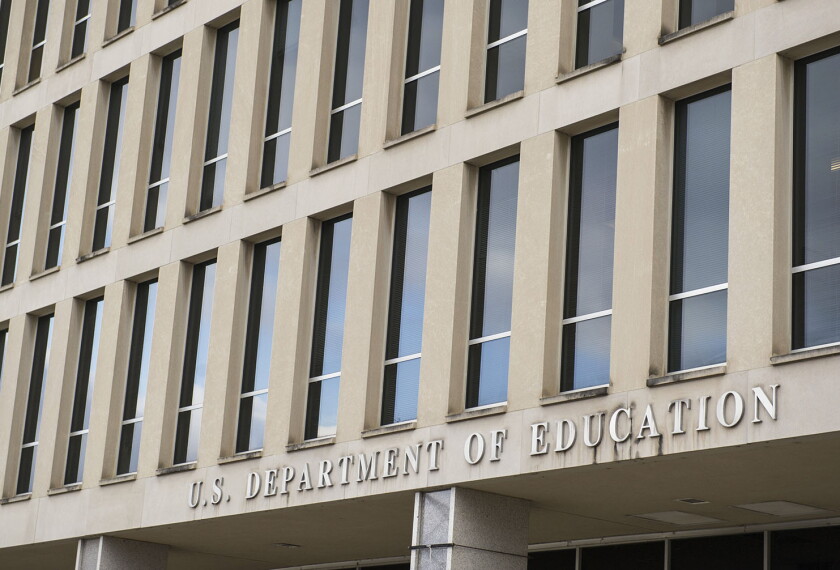
The U.S. Department of Education recently slashed its workforce by 50 percent as part of President Donald Trump’s directive to “send education back to the states.” This drastic reduction in staff has amplified the urgency around a critical question: What will it look like in practice when states are expected to assume greater control for K-12 education?
Although the federal government has contributed only about 10 cents to every dollar of school funding, Uncle Sam’s involvement has, over time, created a dependency. Federal policies and mandates have encouraged states to prioritize compliance above all else. Indeed, many state education agencies—the entities that are now charged with picking up the responsibilities Washington is shedding—tend to take a hands-off approach to school improvement, typically following rather than leading state-level reform efforts. The rapid pace of these federal changes raises fresh concerns about whether these agencies are truly prepared to handle the complexities ahead.
Handing over education to the states sounds simple—like pouring coffee into a cup. In practice, however, it’s more akin to pouring it onto a plate. State education departments have been shaped over decades to serve as regulatory monitors, not reform drivers. Most of their staff are supported by federal funds. They are also constrained by state civil service requirements, red tape, and often entrenched political interests. While some state agencies have taken more initiative in driving reform within their own states, most have historically adhered to federal mandates or followed the lead of governors and state legislators.
This dynamic has created a tension between compliance with federal requirements and the need for state-level innovation. Now, with Washington racing to pull back, these agencies may find themselves thrust into a more central role in shaping education policy—despite lacking the structure, know-how, or flexibility to do so. Instead of channeling efforts productively, this shift risks spilling out in all directions, creating confusion rather than progress.
This dilemma isn’t new. For years, experts have warned that simply adding more responsibility to state education departments without first redefining their role would be a mistake. Too often, policymakers assume that more funding, staffing, and expertise will solve the problem. But the real issue lies in the breadth of state agencies’ responsibilities. Instead of inflating the size and scope of the agencies, the focus should be on narrowing their mission to the areas where they can have the greatest impact. The challenge, then, is to help the agencies concentrate on their core functions and become better positioned to lead meaningful reforms—a task that might grow even harder with the potential loss of federal funding.
A shift to the states will likely involve mechanisms like block grants—federal funding with fewer restrictions, giving states more control over their education spending. However, simply shifting responsibility without ensuring accountability won’t be enough. As former Louisiana schools Superintendent John White recently observed, state education agencies must adopt “assertive K-12 oversight” to take ownership of outcomes and ensure that policies are not only implemented but evaluated for effectiveness. Without adopting such leadership, the agencies will remain trapped by the very frameworks we need them to transform.
The reality is that allowing each state to pursue its own education reforms without any meaningful federal guardrails is a risky bet.
That said, there are different ways to go about leading. In Louisiana and Mississippi, officials significantly overhauled reading instruction. In Indiana, where I once served as a top state education official, we took a different approach by focusing on clear goals and principles. The state’s former superintendent, Tony Bennett, challenged district leaders to meet his “90-25-90” goals—aiming for 90 percent of students passing the state test, 25 percent of high school graduates passing an Advanced Placement or International Baccalaureate exam or getting college credits in high school, and 90 percent of students graduating college- and career-ready. These ambitious goals were paired with three core principles: decisionmaking freedom for schools and parents, competition, and accountability. No matter what reforms we pursued—which included the state’s first-ever statewide reading test—these goals and principles served as our North Star for decisions.
To put a finer point on it, success is most likely when governors and state chiefs are on the same page. In Indiana, Gov. Mitch Daniels and Bennett exemplified this, working together to create a unified vision that gave education policies both political backing and clear direction.
However, the reality is that allowing each state to pursue its own education reforms without any meaningful federal guardrails is a risky bet, though it’s important to recognize that the history of American education policy has long been marked by pendulum swings between state authority and federal intervention. The Every Student Succeeds Act of 2015, for all its good intentions, proved that relinquishing federal control didn’t guarantee improved outcomes. In fact, when the federal government loosened its grip, student achievement took a nose dive. Pandemic-related school closures made matters worse: The bottom has fallen out on National Assessment of Educational Progress scores, and too many states are looking to lowering cutoff scores as a remedy to declining results on state tests.
For state education agencies to lead, they must set high expectations and hold schools accountable. When coordination is lacking, the education departments not only face political friction but also struggle with limited capacity for change. Historically, some of the most effective education reforms occurred when state leaders worked in concert with their education agencies. Former Govs. James Hunt of North Carolina and Jeb Bush of Florida led ambitious education reforms that became national models. Hunt championed early childhood education and teacher quality, while Bush expanded school choice and accountability measures. Their accomplishments underscored the importance of state leadership that actively shapes policy rather than merely reacting to federal mandates.
While high-performing state education agencies may differ in approach, they share a common thread: leaders who fully embrace their role as stewards of student success. That means not just holding authority but using it productively by establishing clear priorities, maintaining high standards and accountability, and working in tandem with governors and state legislators to drive academic improvements.
The president has suggested that when the federal government steps back from education and leaves more of it to the states, 30 to 40 of them will thrive. History and experience, however, suggests a more uneven reality. Strengthening education isn’t simply about shifting responsibility from the federal government to the states; it’s about ensuring there’s vision, capacity, and alignment to turn policy into lasting change for students. Without investment in these areas—whether from governors or Uncle Sam himself—the promise of a more effective, state-driven education system will remain elusive.
Editor’s Note: A previous version of this essay was published in the Flypaper blog of the Thomas B. Fordham Institute.


