The U.S. Supreme Court last month overruled a landmark 1984 decision that required courts to generally defer to federal agencies’ “reasonable interpretations” of federal law.
The decision in that case, Loper Bright Enterprises v. Raimondo, could have some major implications for regulations issued by the U.S. Department of Education, possibly leading to more challenges to such rules and giving judges greater power to interpret federal education laws.
Here is a closer look at what happened and what’s at stake.
What did the Supreme Court rule?
In its June 28 decision in Loper Bright, the court overruled a 1984 decision, Chevron U.S.A. Inc. v. Natural Resources Defense Council, that has had a significant impact on federal agencies and their many regulations interpreting ambiguous federal statutes.
Writing for a 6-3 court, Chief Justice John G. Roberts Jr. said courts must exercise their independent judgment in deciding whether a federal agency has acted within its statutory authority. He said Cabinet departments and other federal agencies “have no special competence in resolving statutory ambiguities. Courts do.”
How might this involve the U.S. Department of Education?
Like other federal agencies, the Education Department operates under numerous federal statutes and promulgates hundreds of pages of regulations building on those laws. One of the department’s most recent regulations seeks to update the department’s interpretation of Title IX of the Education Amendments of 1972—the landmark federal law that bars sex discrimination in federally funded schools and colleges.
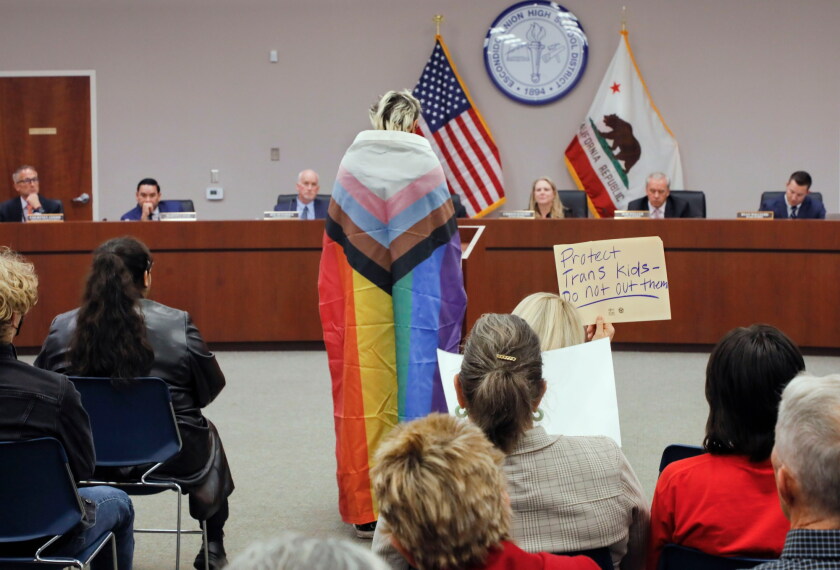
The new Title IX rule is set to take effect on Aug. 1 but has been blocked in 21 states and at some schools in other states by injunctions stemming from legal challenges. Most of those lawsuits focus on the regulation’s interpretation of Title IX as barring discrimination based on gender identity.
What effect has Loper Bright played regarding the new Title IX rule?
One prominent opponent of the Education Department regulation, Alliance Defending Freedom, cited the then-pending rule in a friend-of-the-court brief in Loper Bright. In the brief, the alliance said: “No court should be forced by Chevron to defer to the department’s claim that Title IX means the opposite of what it says. The statute deals with discrimination on the basis of sex, not gender identity, and Title IX’s direct reference to a male-female binary excludes any gender identity interpretation.”
The alliance is behind several of the legal challenges to the regulation, assisting several states, school districts, and groups such as Moms for Liberty in suing the department. Two federal district courts ruled on injunctions before the Supreme Court issued its Loper Bright decision.
Those courts did at least a minimal analysis about whether the new regulation merited deference under the Chevron rule. They concluded that the answer was no.
“An agency has no authority to promulgate a regulation that undoes the unambiguous language of the statute,” U.S. District Judge Danny C. Reeves of Lexington, Ky., said in a June 17 ruling. The Education Department was putting forth an unreasonable interpretation of Title IX’s prohibition on sex discrimination, he said.
What does the Biden administration and the challengers to the Title IX rule say about the effect of Loper Bright?
The U.S. Department of Justice, in an appeals court filing on behalf of U.S. Secretary of Education Miguel Cardona in response to one of the injunctions blocking the rule, said that the Loper Bright decision “does not affect the outcome of this case (or the validity of the [Title IX] rule) because neither the rule nor [the administration’s] arguments in defense of the rule rely on Chevron deference.”
The department’s recognition in the regulation “that discrimination on the basis of gender identity is necessarily sex discrimination prohibited by Title IX is based on the unambiguous text” of the statute, the filing said.
Alliance Defending Freedom takes a different view of the statute, of course, and it argues that if Loper Bright had gone the other way and preserved Chevron deference, the Education Department would have been quick to invoke such deference in defense of the Title IX rule.
“I think it would be pretty crazy to think the administration wouldn’t rely on Chevron if they had it at their disposal,” said Jonathan Scruggs, a senior counsel and vice president at ADF. “Taking out Chevron takes out a club in the department’s bag. It’s not the only club, but it’s an important one. Because it’s now gone, we can litigate the key issues, which is the meaning of the text.”
What other Education Department regulations might be affected?
A review of court decisions by Education Week found several in which the Chevron test was applied in challenges to Education Department regulations in the K-12 arena.
For example, in 1998, a federal appeals court deferred under Chevron to the Education Department’s interpretation of Title VI of the Civil Rights Act of 1964, which bars discrimination based on race (among other factors) in federally funded programs. The court deferred to the department’s 1994 regulation that a school district’s failure to respond to racial harassment of a student by her peers was a violation of Title VI.
In 2012, a federal appeals court deferred under Chevron to an Education Department regulation requiring state and local agencies to reimburse parents and guardians for an independent educational evaluation of their children with disabilities.
In 2020, however, a federal district court held that a department regulation about the distribution of funding among public and private schools under the pandemic-inspired CARES Act was not owed deference under Chevron. Several states challenged a Trump administration rule that allowed more money to go to private schools, and the district court ruled that the statute unambiguously took the opposite view of the administration’s reading.
“When Congress has spoken clearly, as it did in [the statute], ‘‘that is the end of the matter,’ the ruling stated.
Just last year, in another case involving the Individuals With Disabilities Education Act, a federal appeals court held that an Education Department regulation about who qualifies as a parent who can make educational decisions about a child with a disability was not entitled to deference under Chevron because the statute itself had spoken clearly that multiple persons could qualify for the role of parent in a particular case.
Is the Loper Bright decision likely to lead to fresh challenges of Education Department regulations?
That seems to be a distinct possibility.
“There’s just a new paradigm,” said Sonja Trainor, the executive director of the National School Attorneys Association. “Chevron is a big pillar of administrative law. It has always been assumed that if the statute is ambiguous, you do what the agency says.”
Trainor said some school districts around the country might be motivated to challenge certain Education Department interpretations of not just Title IX, but also laws affecting students with disabilities, including Section 504 of the Rehabilitation Act. That law bars discrimination based on disability in federally funded programs and sometimes imposes certain requirements on districts different from, or in addition to, the IDEA.
Other regulations, such as those addressing accountability under the Title I program of the Elementary and Secondary Education Act (and its descendants such as the No Child Left Behind Act), have been unpopular and could be ripe for challenges.
What does Congress think of all this?
On June 30, Sen. Bill Cassidy of Louisiana, the ranking Republican on the Senate education committee, sent a letter to Cardona asserting that the Education Department had repeatedly exceeded congressional authorization with its regulations. He alluded to the new Title IX rule among other issues.
Cassidy demanded that Cardona respond to a series of sharp questions, including, “How will the department change its current practices to enforce the laws as Congress writes them, and not to improperly legislate via agency action?”
An Education Department spokesperson said: “We have received the letter and are reviewing it.”
Francisco M. Negrón Jr., the founder of K12 Counsel, an education law consulting firm in Washington, said he thought the Cassidy letter was a bit over the top.
“Even in the evisceration of Chevron, the justices did not remove the ability of federal agencies to make regulations and promulgate them,” he said.
Meanwhile, on the other side of the aisle, Sen. Elizabeth Warren, D-Mass., and several of her colleagues this week introduced a bill that would essentially overturn Loper Bright by codifying the Chevron deference doctrine into law.
Reed D. Rubinstein, a former acting general counsel of the Education Department during the Trump administration, supports the Loper Bright decision (like many conservatives do), despite having served in a job where he helped write and defend education regulations.
“I think the court may have gotten it right,” said Rubinstein, now the senior vice president of the America First Legal Foundation in Washington. “There are times when Congress has done its job poorly, and [in the department] you are trying [to] figure out what Congress means with a new law and then implement it.”
Executive branch officials “are going to have to stick to their constitutional duties and adhere to the text of the laws,” he said. “Where they don’t, the courts are going to have to check them. But, also, judges can’t become policy czars.”