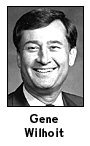
The Kentucky board of education has promoted Gene Wilhoit, one of the state’s three deputy education commissioners, to the state’s top schools post.
|
Mr. Wilhoit was Arkansas’ chief state school officer for the four years before he came to the Kentucky education department in 1997. The Kentucky board named the 57-year-old deputy commissioner for learning support services to the commissioner’s job on Sept. 8, after two days of deliberating over three finalists.
Mr. Wilhoit will be the third commissioner since passage of the 1990 Kentucky Education Reform Act, which completely overhauled the state education system and set student-achievement goals for local schools. Wilmer S. Cody, the most recent chief, left the post last December.
“This state has made the long-term commitment to improving education, and I will carry on that commitment,” Mr. Wilhoit said in a statement. “We have moved beyond reform. This is now our system of education.”
The new commissioner said he plans to address issues such as closing the achievement gap affecting minority students, reducing dropout rates, and using technology to provide instruction.
The board selected Mr. Wilhoit over Stuart M. Silberman, the superintendent of the Daviess County, Ky., schools, and Sammie Campbell Parrish, the dean of North Carolina Central University’s school of education in Durham.
Mr. Wilhoit is expected to begin his $175,000-a-year job around Oct. 1, state officials said.
—David J. Hoff
Bias in Ark. College Aid Alleged
A federal lawsuit filed by two black high school valedictorians in Arkansas claims that a state scholarship program effectively discriminates against African-American students because it relies solely on college-entrance-exam scores.
The lawsuit filed Sept. 5 in Little Rock says the Governor’s Distinguished Scholars program has had only four black winners among the 808 recipients since 1997. Students need to have minimum composite scores of 32 on the ACT or 1410 on the SAT, or be National Merit finalists, to win the scholarships, which fully cover tuition and room and board at state public and private institutions.
The scholarship program “has been a skillful and unique way of classifying only white students as having extraordinary academic ability,” the complaint contends. The suit, which seeks damages for students adversely affected by the program, says grade point average, class placement, leadership ability, and volunteer service should be included in the criteria.
In addition, the plaintiffs argue that the program “uses public funds to promote the interest of religion,” saying that more than 60 percent of the money disbursed through the program has gone to pay for students’ attendance at church-related institutions.
Lu Hardin, the director of the state’s higher education department, was quoted by The Associated Press as saying that the program was already under review for fairness, and that the cost of the lawsuit could pay for a number of scholarships.
—John Gehring
Nation’s Legislators Go to School
As many as 2,000 state legislators headed into elementary and secondary school classrooms across the country last week as part of the “National Back to School Day” sponsored by the National Conference of State Legislatures.
Following the success of a pilot program last year in six states, the bipartisan organization decided to roll out the event nationwide this time around.
The reaction from students, teachers, and legislators to last year’s program was “extremely positive,” said Gene Rose, a spokesman for the Denver-based NCSL. He added that the group hopes to sponsor the event annually from now on.
The program aims to promote civic education and participation to more than 100,000 students nationwide, Mr. Rose said. “A lot more needs to be done to educate citizens,” he said.
And if students discuss the lawmakers’ visits with their parents and drum up more interest in the coming elections among adults, he said, “that would be an added benefit.”
—Mark Walsh
Utah English-Only Plan Scrutinized
A ballot initiative that would make English the official language of Utah would not prevent school districts from communicating with students and parents in other languages, according to an advisory opinion from the state attorney general’s office.
Voters will decide Nov. 7 on a proposed law that would make English the “sole language of the government” in Utah. But the measure allows for several exceptions, including in education.
The attorney general’s office said in its Aug. 25 guidance that the state school board could adopt rules allowing districts to provide notices and forms in languages other than English. The measure also would not preclude foreign-language or English-as-a- second-language instruction in the schools, the opinion states.
“The state board’s constitutional authority is not impaired by the proposal because of the exceptions for education,” according to the opinion.
Under the ballot measure, however, rules adopted by the state board would have to encourage non- English-speaking students and parents to learn English “as quickly as possible.”
Carol Lear, the coordinator of school law and legislation in the Utah state education office, said she and other state education officials remained leery of the ballot measure despite the education exception.
“We do have some reservations about the public perception of it and how it might alienate people,” she said.
—Mark Walsh