Federal

Negotiations Continue On Ed. Dept. Budget

By Erik W. Robelen — December 13, 2000 3 min read
  • Save to favorites
  • Print

A dramatic funding increase proposed for the Department of Education was still in question late last week, as the White House and Republican leaders in Congress struggled to reach agreement on four unfinished spending bills.

Republicans were signaling that they would insist on lower spending levels than had been negotiated before the November elections by congressional appropriators and the Clinton administration for the budget bill that covers the Education Department.

At press time last Friday, that department and several other government agencies operating without final fiscal 2001 spending plans were kept running by a continuing budget resolution set to expire Friday night. If a deal was not reached by then, another such resolution was expected to be approved to carry the agencies through Dec. 11. President Clinton met twice last week with congressional leaders to discuss budget matters and other unfinished legislation, but both sides were still unable to find a meeting of the minds.

“They discussed a full range of budget issues,” a White House aide said of the second meeting, held Dec. 7. “It helped narrow some of the issues, but differences still remain, especially on education.” The aide, who asked not to be named, added: “There’s lots of work left.”

Senate Majority Leader Trent Lott, R-Miss., expressed optimism in remarks on the Senate floor following the meeting that the budget issues could be resolved before the end of this week. “It will take a lot more work, but we are making some progress in that direction,” he said.

If both sides are ultimately unable to reach agreement, the matter could be passed over to the new president and the 107th Congress to decide.

Possible Shutdown?

In late October, the White House and congressional appropriators hammered out a deal for the spending bill covering the departments of Labor, Health and Human Services, and Education. The plan would have increased education spending by an unprecedented $7.9 billion in fiscal 2001, bringing the discretionary total for the Education Department above $43 billion for the budget year that began Oct. 1.

That agreement contained spending increases for a range of federal programs, including more money for special education and the president’s prized program to hire 100,000 new teachers to help reduce class sizes.

But the agreement was scuttled by Republican leaders, citing concerns about a measure unrelated to education involving workplace safety. (“Congress Delays Education Budget Decision,” Nov. 8, 2000.)
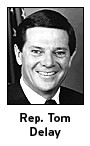
Rep. Tom Delay

Lawmakers decided to postpone a final agreement until after the Nov. 7 elections, but the Florida electoral dispute that clouded the outcome of the presidential race complicated matters.

Increasingly confident that Gov. George W. Bush of Texas, the Republican nominee, would ultimately be declared the winner, GOP lawmakers were arguing last week that overall spending in the Labor-HHS-Education appropriations bill needed to come down, from an $18 billion increase over the fiscal 2000 level to about $12 billion. The increase for the Education Department that was agreed to in October itself exceeds what President Clinton originally proposed early this year and what the Senate and the House passed.

Mr. Clinton has made completing work on the education budget, and protecting a large increase in spending, one of his top priorities, though he also indicated that he might be willing to make a minor reduction. It was unclear late last week which specific cuts would be on the table.

While many Republicans have indicated a willingness to negotiate and resolve the budget dispute, rather than putting it off for the next Congress and administration, House Majority Whip Tom DeLay of Texas, a leader among conservatives, last week took a far more confrontational stand, daring the White House to shut down the government if it would not agree to reduce spending. In fact, Mr. DeLay has suggested that Congress pass a long- term “continuing resolution” that would maintain spending for programs in the four unfinished spending bills at the fiscal 2000 level for the duration of this fiscal year, which ends Sept. 30, 2001.

Emily Miller, a spokeswoman for Mr. DeLay, said the majority whip was trying to prevent President Clinton from forcing through a “massive spending increase.”

Asked about the potential for a government shutdown, White House spokesman Jake Siewert said last week that he did not see it as a possibility.

“We think that there is work to be done, and we are intent upon getting it done,” he said. “And I might point out that there’s a lot of talk about bipartisanship up on [Capitol] Hill in the wake of the election.”

A version of this article appeared in the December 13, 2000 edition of Education Week as Negotiations Continue On Ed. Dept. Budget

Events

School & District Management Webinar EdMarketer Quick Hit: Build Campaigns That Engage K-12 Leaders
We’ll share what’s resonating with Education Week’s K-12 audience based on user behavior across platforms and other proprietary data.
This content is provided by our sponsor. It is not written by and does not necessarily reflect the views of Education Week's editorial staff.
Sponsor
Assessment Webinar
Measuring What Matters: How District Leaders Are Redefining Student Assessment
In this panel discussion, district leaders and systems experts will examine the gap between the outcomes we want and the systems in place.
Content provided by Otus
Early Childhood Webinar Selling Into Early Learning: New Survey Data and Strategies for Marketers
Selling into PreK? Get fresh EdWeek Research Center data and strategies to position your products and reach the right early learning buyers.

EdWeek Top School Jobs

Teacher Jobs
Search over ten thousand teaching jobs nationwide — elementary, middle, high school and more.
View Jobs
Principal Jobs
Find hundreds of jobs for principals, assistant principals, and other school leadership roles.
View Jobs
Administrator Jobs
Over a thousand district-level jobs: superintendents, directors, more.
View Jobs
Support Staff Jobs
Search thousands of jobs, from paraprofessionals to counselors and more.
View Jobs

Read Next

Federal Q&A A Top Democrat Breaks Down His Party's Plans for K-12 in a House Majority
If Democrats retake the House, Rep. Bobby Scott may be in a position to set his chamber’s K-12 agenda.
5 min read
Rep. Bobby Scott, D-Va., speaks during a prayer vigil held by the Chesapeake Coalition of Black Pastors at The Mount (Mount Lebanon Baptist Church) in Chesapeake, Va., Sunday, Nov. 27, 2022, for the six people killed at a Walmart in Chesapeake, Va., when a manager opened fire with a handgun before an employee meeting Tuesday night.
Rep. Bobby Scott, D-Va., speaks during a prayer vigil in Chesapeake, Va., on Nov. 27, 2022. Scott is the ranking Democrat on the U.S. House of Representatives' education committee and will seek the panel's chairmanship if Democrats win a House majority in next month's elections.
Carolyn Kaster/AP
Federal What a Democratic Congress Could Mean for Trump's K-12 Agenda
They may try to reverse—or at least investigate—the Trump admin.'s efforts to dismantle the Ed. Dept.
9 min read
House Minority Leader Hakeem Jeffries, D-N.Y., the top Democrat in the Republican-majority House, is joined by Rep. Pete Aguilar, D-Calif., chair of the House Democratic Caucus, as they criticize President Donald Trump and his policies while talking to reporters about the approaching midterm election, at the Capitol in Washington, Thursday, Sept. 17, 2026.
House Democratic Leader Hakeem Jeffries speaks at the U.S. Capitol on Sept. 17, 2026. He's joined by Rep. Pete Aguilar, D-Calif., who chairs the House Democratic Caucus. If Democrats gain a majority of either chamber of Congress after next month's elections, they'll be able to hold oversight hearings on and launch investigations into the dismantling of the U.S. Department of Education.
J. Scott Applewhite/AP
Federal The Future of Education Research: More Partisan and Largely Left to States?
As Trump administration works to change federal grants, outside researchers try to regroup.
6 min read
Image of file folders with tabs called "funding" "grants" "projects" and a blank note paper paperclipped to the outside.
Collage by Laura Baker/Education Week + Getty
Federal Bipartisan Bill in Congress Would Help Schools Put Cellphone Bans or Restrictions in Place
The bill would establish a federal grant program to support state efforts to restrict cellphones.
5 min read
Sen. Tom Cotton, R-Ark., the chairman of the Senate Intelligence Committee, center, is joined from left by Sen. John Barrasso, R-Wyo., the GOP whip, and Senate Majority Leader John Thune, R-S.D., as he speaks to reporters ahead of a Wednesday meeting with President Donald Trump, at the Capitol in Washington, Tuesday, June 23, 2026. (AP Photo/J. Scott Applewhite) Senate Minority Leader Chuck Schumer, D-N.Y., speaks to reporters at the Capitol in Washington, Tuesday, June 23, 2026.
Sen. Tom Cotton, R-Ark., speaks to reporters ahead of a meeting with President Donald Trump at the Capitol in Washington on June 23, 2026. Cotton is one of the sponsors of a bipartisan bill that would create a grant program for states to implement school cellphone bans or restrictions.
J. Scott Applewhite/AP
