
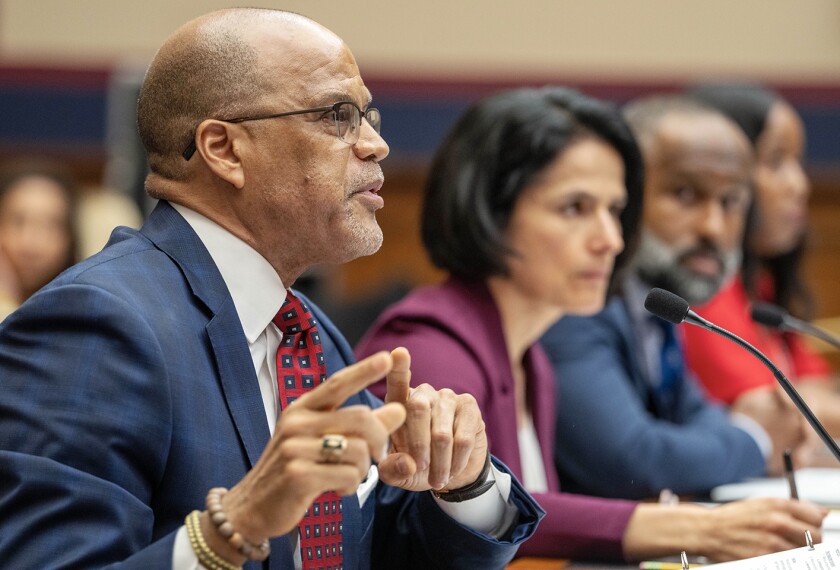
Leaders from three large school districts condemned antisemitism at a congressional hearing on Wednesday and didn’t deny it has been on the rise in their schools. But they defended their handling of hateful incidents and said they’re fighting antisemitism through education, not just discipline.
The U.S. House of Representatives subcommittee hearing was the first at which Republican House members turned their focus to antisemitism in K-12 settings, after training their sights on universities in previous hearings that precipitated the resignations of two university presidents.
The session with K-12 leaders offered a stark contrast to the first hearing with higher education leaders on Dec. 5, where college presidents failed to affirmatively state that calls for genocide of Jewish people violated university policies.
The K-12 leaders were less equivocal, and David Banks, chancellor of the 915,000-student New York City school system, accused Republican lawmakers of seeking “gotcha moments” rather than engaging in constructive problem-solving.
“There have been unacceptable incidents of antisemitism in our schools, where Jewish students and teachers feel unwelcome or unsafe,” Banks said in his opening statement. “That should sound the alarm for us all.”
But he called for a mostly educational response.
“If we really care about solving antisemitism, and I believe this deeply, it’s not about having ‘gotcha’ moments,” he said. “It’s about teaching. You have to raise the consciousness of young people.”
Over two hours, Republican House members grilled Banks and two other district leaders—Karla Silvestre, board president of the Montgomery County schools in Maryland, and Enikia Ford Morthel, superintendent of the Berkeley school district in California.
In his opening statement, Rep. Aaron Bean, R-Fla., who chairs the House Subcommittee on Early Childhood, Elementary, and Secondary Education, accused the district leaders of allowing “vile antisemitism” to occur without repercussions.
“Jewish students in the districts fear riding the bus, wearing their kippah to school, or even just eating and breathing as a Jewish student,” he said.
Wednesday’s hearing, which only involved testimony from leaders of school systems in liberal-leaning areas, illustrated district leaders’ attempts to strike a difficult balance between disciplining those responsible for discrimination, using education to prevent acts of hate, and discussing their actions in a highly public and politically charged setting.
District leaders denounce antisemitism
Each district leader had a different approach to questioning, with Banks engaging in heated back-and-forth exchanges with Reps. Elise Stefanik, R-N.Y., and Burgess Owens, R-Utah, while Silvestre and Morthel were more restrained.
None of them, however, shied away from acknowledging incidents of antisemitism have occurred in their schools since Hamas’ Oct. 7 attack on Israel.
“Since Oct. 7, the district has had formal complaints alleging antisemitism arising from nine incidents within our jurisdiction,” Morthel said. “However, antisemitism is not pervasive in Berkeley Unified School District.”

All three districts are the subject of investigations from the U.S Department of Education’s office for civil rights, which has seen a sharp rise in complaints of antisemitism and Islamophobia since the start of the Israel-Hamas war.
In New York, a chaotic scene unfolded at Hillcrest High School in Queens in November as students rampaged through the halls after they learned a teacher had attended a pro-Israel rally. In Berkeley, a complaint that prompted the OCR investigation alleged that school officials have not taken action to stop bullying and harassment of Jewish and Israeli students. And in Montgomery County, district leaders are contending with multiple reports of vandalism involving antisemitic hate speech and swastikas.
The Council on American-Islamic Relations has also sued the Montgomery County district, accusing it of violating three teachers’ First Amendment rights by placing them on administrative leave for pro-Palestinian views. Those allegations didn’t come up during Wednesday’s hearing.

Discipline vs. education
A number of Republican lawmakers asked the district leaders how they planned to discipline students, teachers, and school leaders involved in antisemitic incidents or walkouts, or for their handling of the situations. Some called for the expulsion and firing of everyone involved.
But the district leaders’ responses weren’t satisfying for Republican members.
“It’s one thing to hear about the bigoted behavior present on today’s college campuses, but it’s utterly appalling to hear that activist teachers are doing the same thing in our classrooms,” Owens said.
In Montgomery County, Silvestre clarified that no one has been fired in response to antisemitic incidents, but that the district was taking “actions” to discipline teachers.
“The board of education in Montgomery is committed to combatting antisemitism, hate speech, and racism wherever and whenever we see it,” Silvestre said.

Morthel declined to comment on specific discipline students and employees in Berkeley have faced, citing California law that protects student and personnel privacy.
“When investigations show that an antisemitic event has occurred, we take action to teach, correct, and redirect our students,” Morthel said. “We do not publicly share our actions because student information is private and legally protected under federal and state law. As a result, some believe we do nothing. This is not true.”
Banks was a little more forthcoming, explaining that “a number of” students at Hillcrest High School were suspended and the school’s principal was “removed.” He later clarified that the principal was not fired, but assigned to another role in the district, not leading a school.
Banks listed a number of actions the New York district has taken to address antisemitism. The district already teaches about the Holocaust in 8th through 11th grades, as New York state law requires, and is partnering with the Museum of Jewish Heritage in New York to create a guide for educators.
The district is also developing new curricula to highlight the culture and contributions of the Jewish community and teach about the prevention of hate crimes, Banks said. The district is training all middle and high school principals on navigating difficult discussions about antisemitism and the Israel-Hamas war.
“We cannot simply discipline our way out of this problem,” he said during his testimony. “The true antidote to ignorance and bias is to teach.”
He also called for a broader focus on hate during a hearing advertised to focus exclusively on antisemitism.
“I stand up not only against antisemitism. I stand up against Islamophobia and all other forms of hate,” he said. “You can’t put them in silos. That’s not the way that we can be responsible about how we can approach this. We have to deal with all forms of hate.”
Democratic lawmakers also shared concerns about antisemitism, but took a different tack from their Republican counterparts.
“I feel strongly that this can be a powerful teaching moment,” said Rep. Kathy Manning, D-N.C. “This is a time when schools should do what we expect them to do. They should teach. They should teach the facts, they should teach understanding, they should teach empathy, and they should teach the critical thinking skills.”
Others argued for more funding for OCR, the Education Department arm that investigates complaints of discrimination at K-12 schools and on college campuses. During a hearing on Tuesday, Education Secretary Miguel Cardona said the office has fewer investigators than it did in 2009 as it’s called on to investigate more complaints.
The Biden administration has asked for an additional $22 million for OCR in its 2025 budget proposal, which is pending before Congress.


