Many teachers often struggle to breathe life into a subject to hold their students’ interest. At an unusual charter school here, teachers can make history, math, science, and English lessons come alive simply by walking outside the classroom.
The school is housed inside one of the richest environments for learning in the country--Henry Ford Museum & Greenfield Village, the massive monument to American culture, history, and technology created in the 1920s by auto pioneer Henry Ford.
A few yards from where Malcolm Carter teaches history sits a glass case containing the tattered rocking chair in which President Lincoln was sitting when he was fatally shot on the night of April 14, 1865.
Science teacher Charles R. Dershimer can drive home a point by leading students outside to visit the reconstruction of Thomas A. Edison’s laboratory from Menlo Park, N.J.--the birthplace of the phonograph and the electric light. Greenfield Village’s 19th-century working farm offers endless opportunities for biology classes.
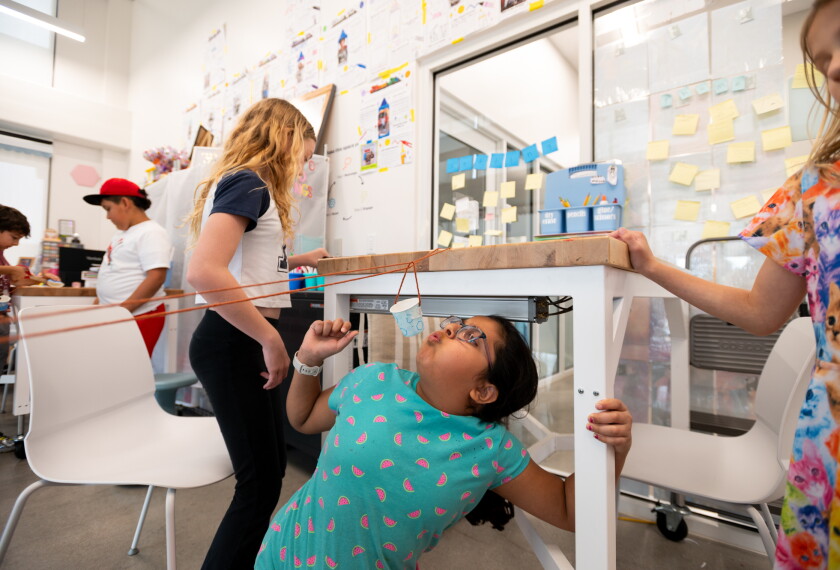
In their glassed-in classrooms in the Henry Ford Museum, students are on constant display to the thousands of people who visit each day, yet they don’t seem to mind. “We don’t pay attention to the people, we just pay attention to our work,” said Isaac Sudut, a dark-haired 14-year-old.
While their learning environment is a far cry from that of traditional high schools, students here still learn the basics. They can then apply those fundamentals to real-life situations--as, for example, when a physics class learned to make a crane that could lift 100 pounds.
But the Henry Ford Academy of Manufacturing Arts and Sciences is not a trade school. Manufacturing is used as the lens through which a liberal arts curriculum is taught, said Wendy Pittman, the school’s president.
Hundreds of Applicants
The school is the result of a unique partnership linking the school, the Ford Motor Co., and the museum. The academy won a charter from the Wayne County Regional Educational Service Agency in 1997, and the school opened last August. It received more than 600 applications, and the 100 9th graders were drawn by lottery from all over the county, which includes Detroit and its southern and western suburbs.
The lottery yielded a racially and ethnically diverse class that is 57 percent male and 43 percent female. “Our students represent the demographics of Wayne County, and they come from 19 school districts,” Ms. Pittman said. Each year, a new freshman class of 100 will be added until the academy reaches its capacity of 400 students.
Seven of the original 100 have dropped out for a variety of reasons, ranging from discomfort with the museum setting to the lack of a traditional athletic program, school officials said. As a result, replacements were chosen from the 400 names on the waiting list.
Jamita Lewis, who enrolled in November, considers herself lucky. The soft-spoken 14-year-old said she previously attended a school in Detroit where there were 2,000 9th graders. “At my other school you weren’t learning anything,” she said. “This school has a better learning environment.” Besides the artifacts in the museum, she said, “we have more technology, and the people here are caring.”
Many of her classmates agree. “We have smaller classrooms, so teachers can pay more attention to each person,” said 15-year-old Chris Chinavare. He compared his new surroundings to his old school, which had only one computer in the classroom. Here, every student has a laptop computer, which the school has leased from Toshiba.
Strong Support
The academy suffers from few of the financial growing pains that plague many charter schools, which are largely autonomous public schools that operate free of most state rules. Ford Motor Co. has pledged $4.8 million over the next five years to help with start-up costs and curriculum development. And with classroom space rented from the museum, school administrators were spared the hassle of finding a building--a common headache for charter organizers.
As a charter school, the academy receives $5,754 per pupil from the state, slightly below the statewide spending average of $5,962.
But many of the faculty and staff argue that it’s not money that makes their school successful. “We’ve created a sense of community,” Ms. Pittman said. The students feel comfortable enough to call their English teacher, Kevin Basmadjian, “Mr. B” or to ask Larry Holliday, the dean of students, to borrow lunch money.
Most students want to be here, Mr. Holliday said proudly, noting that the attendance rate is about 96 percent. “Some kids get here as early at 7 a.m.,” he said, “and that’s two hours before school starts.”
Having a school on the museum’s premises is a fitting return to the educational goals of its founder, said Steven K. Hamp, the president of Henry Ford Museum & Greenfield Village.
Strong Traditions
Henry Ford, who only had a 6th grade education, understood that learning can occur in a lot of different ways, Mr. Hamp said. The automaker and industrialist originally used the historic buildings he had gathered from around the country and reconstructed in Greenfield Village as a K-12 school, which operated from 1929 to 1969.
“People are asking, ‘What does this school have to do with your core business?’” Mr. Hamp said. ''We are coming full circle as we return to our formal education roots.”
The idea of a public school operating in partnership with a corporation and a nonprofit museum marks an attempt to expand upon that tradition. “We want to create a model which has the capability of being replicated in different places,” Mr. Hamp said.
Ms. Pittman, who formerly developed programs and scholarships for study abroad in Eastern Europe, agrees: “It doesn’t have to be a school in a museum, perhaps it could be on Wall Street, in Congress, or at a ranch.”
The auto company, which has its national headquarters in Dearborn, provides more than financial support. When students need professional help, expert assistance is close at hand.
During a two-week unit on the history of production, students learned about how products go from raw materials to a finished state. As part of that unit, they engaged in a project to build 1,000 small mirrors.
When the project was finished, Ford engineers came to the academy and shared with students some secrets of the trade, challenging them to think about costs, safety measures, and worker-training requirements. After listening to presentations from students, the engineers offered suggestions and advice.
“It was good to see that [the students] could present to an audience outside of the school,” said Mr. Dershimer, who is also the academy’s chief of staff.
Such cooperation is the sort of benefit long envisioned by proponents of charter schools.
“I think we’ll be seeing more schools like this,” said Joe Nathan, the director of the Center for School Change at the University of Minnesota. “We’re already seeing a variety of organizations collaborate with schools around the country.”