Federal

Hickok Brings a Taste for Local Control to the No. 3 Washington Job

By Joetta L. Sack — September 19, 2001 3 min read
  • Save to favorites
  • Print

Eugene W. Hickok has a reputation as a contrarian, an education maverick unafraid of taking on the established school groups and wary of an encroaching Washington role.

Now, as the undersecretary of education, Mr. Hickok, great-nephew of Old West icon Wild Bill Hickok, is a part of the Washington establishment.

Occupying the No. 3 slot in the Department of Education hierarchy, Mr. Hickok will work closely with the White House on education-related initiatives and advise Secretary Rod Paige on policy.

Mr. Hickok, who was the secretary of education in Pennsylvania prior to his Washington appointment and maintains a residence in Carlisle, Pa., was an adviser for the 2000 Bush campaign. He didn’t apply for the undersecretary’s job—in fact, he had a few reservations about taking it.

He said he didn’t want to leave Pennsylvania and his service under Gov. Tom Ridge, also a Republican. While his name had circulated during the early weeks of the new Bush administration as the president’s choice for undersecretary, it was mid-March before the White House made an announcement.

Despite his reservations, Mr. Hickok says he’s happy with the job. He’s planning to work on ways to shift more control to states and districts, which was one of his top priorities as a state leader.

“I’m going to have one foot in Pennsylvania and one in D.C., and, hopefully, I’ll get the best of both worlds,” he said.

In the Keystone State, Mr. Hickok worked closely with Gov. Ridge to put in place an array of accountability measures: more rigorous tests for teacher licensure, more specific academic-content standards for student learning, and, with the state legislature’s approval, the state takeover of low-performing districts. He frequently and loudly butted heads with the state’s main teachers’ union over school choice proposals, including vouchers and charter schools.

One of Mr. Hickok’s complaints about what he refers to as the “education establishment” has been what he considers the excessive use of acronyms and jargon. In 1996, he went so far as to fine employees of the Pennsylvania Department of Education $1 each time they spoke in education jargon, rather than plain English.

But what brought Mr. Hickok’s name to those outside the Pennsylvania state lines most prominently was his involvement in an upstart group, the Education Leaders Council, made up of state education leaders of a mostly conservative bent.

He helped establish the group in 1995 as an alternative to the Council of Chief State School Officers and other long-standing education groups, which he and other ELC members viewed as having a characteristically liberal focus on spending increases and federal initiatives. The ELC has promoted local control, greater accountability, and other education measures, such as giving Title I aid to parents to spend on educational services of their own choice.

Mr. Hickok favored some of the ideas put forth by congressional Republicans after they took power in the 1994 elections, particularly those that favored local decision-making. Most education groups were opposed to the GOP plans.

“The problem with some organizations is, when they lobby, they lobby against those things,” he told The Washington Times in 1995 when he bowed out of the CCSSO.

After advising the Bush campaign on education, he helped oversee the transition in the Education Department.

Now, Mr. Hickok says he been converted to the Bushian spirit of working, or at least talking about working, with those on the other side of ideological bright lines. Mr. Hickok says he plans to work more closely with the Washington education groups he once criticized, even if it will result in “some major differences of opinion.”

Events

This content is provided by our sponsor. It is not written by and does not necessarily reflect the views of Education Week's editorial staff.
Sponsor
School & District Management Webinar
Too Many Initiatives, Not Enough Alignment: A Change Management Playbook for Leaders
Learn how leadership teams can increase alignment and evaluate every program, practice, and purchase against a clear strategic plan.
Content provided by Otus
This content is provided by our sponsor. It is not written by and does not necessarily reflect the views of Education Week's editorial staff.
Sponsor
Artificial Intelligence Webinar
Beyond Teacher Tools: Exploring AI for Student Success
Teacher AI tools only show assigned work. See how TrekAi's student-facing approach reveals authentic learning needs and drives real success.
Content provided by TrekAi
This content is provided by our sponsor. It is not written by and does not necessarily reflect the views of Education Week's editorial staff.
Sponsor
College & Workforce Readiness Webinar
Building for the Future: Igniting Middle Schoolers’ Interest in Skilled Trades & Future-Ready Skills
Ignite middle schoolers’ interest in skilled trades with hands-on learning and real-world projects that build future-ready skills.
Content provided by Project Lead The Way

EdWeek Top School Jobs

Teacher Jobs
Search over ten thousand teaching jobs nationwide — elementary, middle, high school and more.
View Jobs
Principal Jobs
Find hundreds of jobs for principals, assistant principals, and other school leadership roles.
View Jobs
Administrator Jobs
Over a thousand district-level jobs: superintendents, directors, more.
View Jobs
Support Staff Jobs
Search thousands of jobs, from paraprofessionals to counselors and more.
View Jobs

Read Next

Federal Ed. Dept. Hangs Banner of Charlie Kirk Alongside MLK Jr., Ben Franklin
It's part of a celebration of the nation's 250th anniversary.
1 min read
New banners of Booker T. Washington, Catharine Beecher and Charlie Kirk hang from the Department of Education, Sunday, March 1, 2026, in Washington.
New banners of Booker T. Washington, Catharine Beecher, and Charlie Kirk hang from the U.S. Department of Education on March 1, 2026, in Washington.
Allison Robbert/AP
Federal Ed. Dept. Wants to Revamp Assistance Program It Calls 'Duplicative,' 'Confusing'
The department's Comprehensive Centers have already been through a year of shakeups.
3 min read
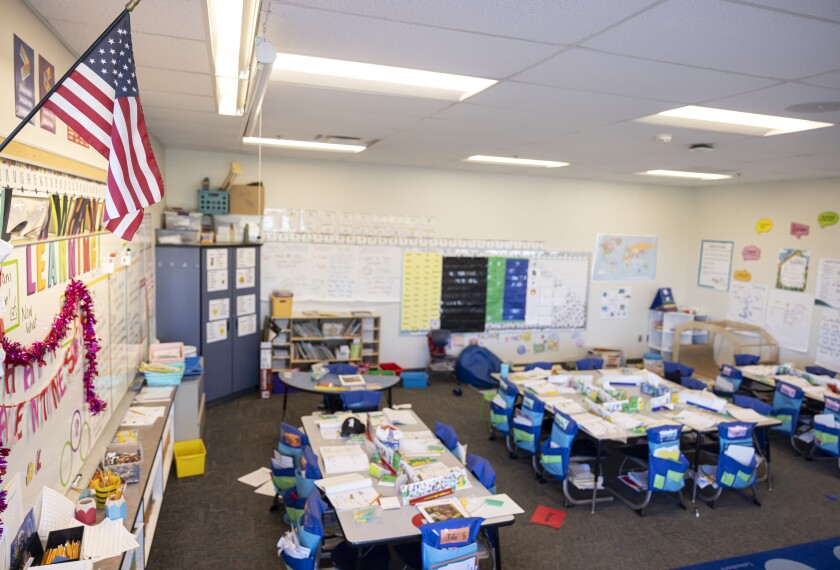
A first grade classroom at a school in Colorado Springs, on Feb. 12, 2026.
A 1st grade classroom at a school in Colorado Springs, Colo., on Feb. 12, 2026. The U.S. Department of Education released a proposal to rework a decades-old program charged with helping states and school districts problem-solve and deploy new initiatives, calling the current structure “duplicative” and “confusing.”
Kevin Mohatt for Education Week
Federal Will the Ed. Dept. Act on Recommendations to Overhaul Its Research Arm?
An adviser's report called for more coherence and sped-up research awards at the Institute of Education Sciences.
6 min read
The U.S. Department of Education building is pictured on Oct. 24, 2025, in Washington, D.C.
The U.S. Department of Education building in Washington is pictured on Oct. 24, 2025. A new report from a department adviser calls for major overhauls to the agency's research arm to facilitate timely research and easier-to-use guides for educators and state leaders.
Maansi Srivastava for Education Week
Federal Trump Talks Up AI in State of the Union, But Not Much Else About Education
The president didn't mention two of his cornerstone education policies from the past year.
4 min read
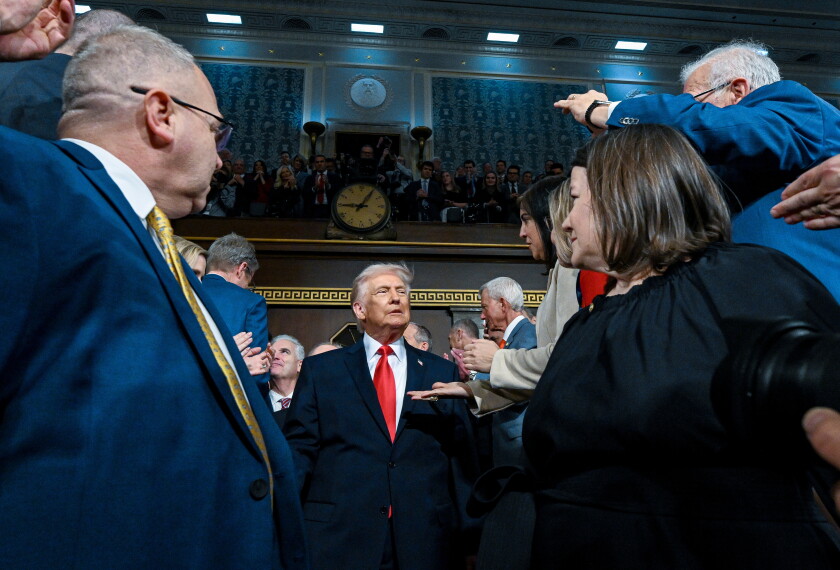
President Donald Trump enters to deliver the State of the Union address to a joint session of Congress in the House chamber at the U.S. Capitol in Washington, Tuesday, Feb. 24, 2026.
President Donald Trump enters to deliver the State of the Union address to a joint session of Congress in the House chamber at the U.S. Capitol in Washington, Tuesday, Feb. 24, 2026. The president devoted little time in the speech to discussing his education policies.
Kenny Holston/The New York Times via AP, Pool