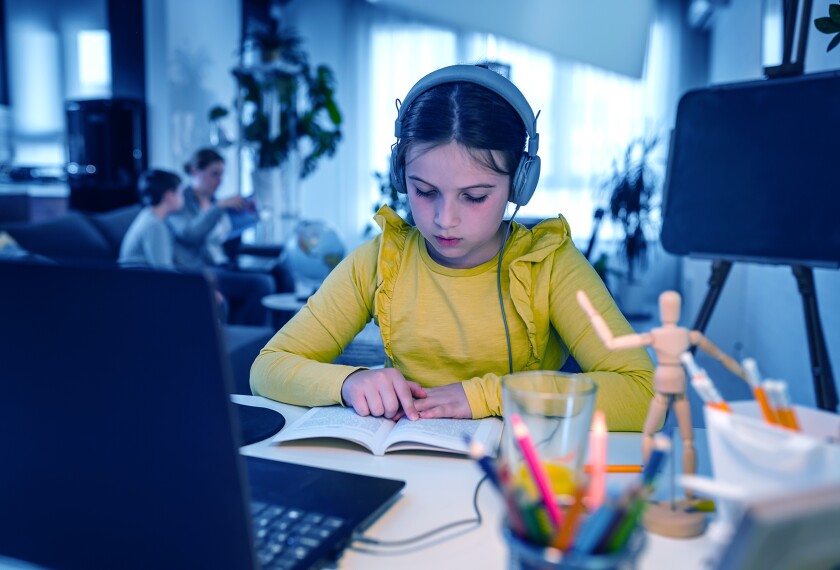
As of January, 43 percent of 4th graders and 48 percent of 8th graders were still learning full time from home, according to newly released federal data.
And the new numbers point to alarming disparities among regions and states in the quality of that remote learning, with a subset of those remote learners—a quarter or more in both grades— receiving fewer than two hours of live or “synchronous” teaching a day.
The long-awaited data, produced by the agency in response to an executive order from President Biden, offer the first nationally representative picture of what proportion of schools offer remote learning, in-person learning, or a hybrid of the two.
In all, 47 percent of grade 4 schools nationwide offered full in-person teaching, and 46 percent of grade 8 schools did. But because many schools are small or remote—and also because families have chosen from among different options—that translated to only 38 percent of grade 4 students and just 28 percent of grade 8 students attending full time in person.
When hybrid learning is added into the picture, more than 75 percent of schools offer at least some in-person instruction. And though the data are limited to two grade levels, federal officials say enrollment patterns are probably similar for other elementary and lower secondary grades.
It’s encouraging news that many schools now offer some in-person learning, said Peggy Carr, the associate commissioner of the assessment division of the National Center for Education Statistics. But she also described the regional contrasts in the amount of live remote teaching as shocking.
“I knew it was going to be low, but not quite that low,” she said.
A quickly changing picture of schools’ instructional mode
President Biden made opening “a majority” of K-8 schools within his first 100 days in office for five-day in-person learning one of his top priorities, but his administration did not set a target for the share of students. The new baseline data suggest that the school target has probably been met by now, but it is much less clear whether, more than two months later, at least half of students are now attending in person five days a week.
Many larger districts have been more cautious about returning to in-person schooling. The federal data also show that students in towns or rural locations were more likely than those living in cities or suburbs to be attending in person.
But that picture has shifted dramatically since the federal survey was taken, too, according to Education Week’s tracker of large, urban districts, a project it’s created with the Council of the Great City Schools.
In early February, only 43 of a sample of 75 large districts in the EdWeek tracker offered some in-person learning, and that number is now 59. Many of these districts have moved from allowing only a limited number of students to attend in-person to letting all students come to school. In addition, many of these districts plan to expand their in-person access even further over the next few weeks.
Uneven access to in-person learning—and uneven amounts of live, remote teaching
The federal data bolster other surveys indicating that Black, Hispanic, and Asian students were more likely to be offered—or to prefer—remote learning. Just 28 percent of 4th grade Black students and 15 percent of 4th grade Asian students were attending in-person full time. Almost half of white students, by contrast, were attending full-time in person; white families have been among the most vocal about returning to schools in cities like New York.
The data were collected earlier this year and represent a sample of 7,000 schools, half in grade 4 and half in grade 8. Additional collections will produce monthly results for the same sample of schools February through May.
But below the surface, the findings raise new questions about how states and districts have managed teaching and learning plans during the pandemic.
For one thing, while many districts said they’d planned to prioritize certain groups of vulnerable students to return to classrooms first, the data do not suggest that such plans led to widespread differences in in-person attendance patterns. Schools notably said in the survey that they prioritized students with disabilities for full-time, in person learning, but fewer than half of those students in 4th grade were doing so.
The findings that look at the subset of students in full-time remote learning show some shocking differences in their access to live-streamed teachers. Twenty-seven percent of those 4th graders and 26 percent of those 8th graders received two or fewer hours of live, synchronous instruction in their remote classes—the rest of their schooling was presumably asynchronous. But students in other states or districts learning remotely got five or more hours of live teaching.
And it appears some of those disparities are due to regional differences. In Oklahoma, 71 percent of 4th grade students in remote learning received two or fewer hours of live teaching, and 73 percent of 8th grade students in Idaho received two or fewer hours of live teaching. Students in cities and in the Northeast typically got more live teaching in their remote classes than did those in towns or in the Midwest.
Parents and advocates alike have urged districts to improve their remote learning offerings; many are concerned about their children’s well-being in remote settings. But the political discussion on school reopening has focused almost exclusively on returning to in-person settings.
The data also do not conform easily to theories about why some districts offered more live-streamed remote teaching than others. Labor contracts have shaped some teaching conditions, modes, and hours, but the data don’t appear to correlate easily to states where unions are strong.
In fact, the states reporting the highest proportion of 4th grade students receiving less than two hours of synchronous instruction are Alabama, which has no public-sector unions, and Arkansas and Oklahoma, where unions are significantly weaker than on the coasts.
It could be the case that, since most students in those states appear to be attending in person, many districts there simply are no longer prioritizing the quality of their remote learning option, or do not have the staff to maintain it.




