
Education Funding

Education Dept. Sees Small Cut in Funding Package That Averted Government Shutdown

By Matthew Stone — March 27, 2024 | Updated: March 28, 2024 3 min read
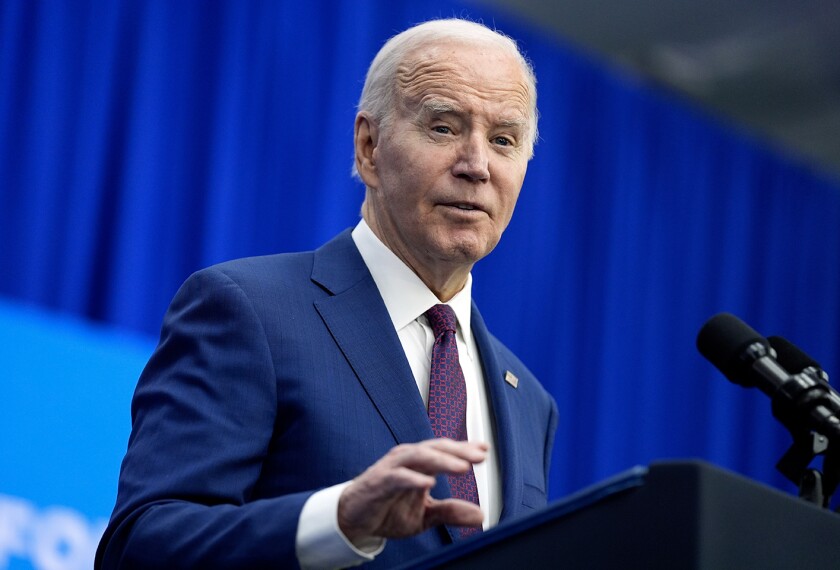
President Joe Biden delivers a speech about healthcare at an event in Raleigh, N.C., on March 26, 2024.
  • Save to favorites
  • Print

The $1.2 trillion funding package that will keep the federal government operating through September includes a cut of about $100 million to the U.S. Department of Education’s budget even as it provides small increases to key K-12 programs and holds the line on others.

President Joe Biden signed the funding package into law over the weekend after it passed the House on March 22, and the Senate early the next day, averting a partial shutdown. The package combines six annual spending bills to pay for different parts of the federal government, which had been operating on stopgap measures in the absence of a final budget for the 2024 fiscal year that began last October.

The Education Department will receive $79.1 billion for the fiscal year that lasts through Sept. 30.

That’s about $100 million less than the department’s final budget for the 2023 fiscal year, a drop of about 0.2 percent. And it’s far short of the $90 billion Biden had requested for the department in his initial 2024 budget proposal, which he unveiled a year ago, in March 2023.

But even with the overall cut, lawmakers provided increases of $20 million each to Title I grants that support services for low-income students and Individual with Disabilities Education Act, or IDEA, funds that help schools cover special education costs. Title I and IDEA are the two largest federal funds for K-12 schools.

The $20 million increases would bring Title I funding to just above the $18.4 billion allocated to the program in 2023 and bring IDEA funding to just above its 2023 level of $14.2 billion.

An Education Department spokesperson said the year-over-year differences are largely the result of mid-year budgets cuts and earmarks—funding lawmakers designated for specific projects.

The federal government typically accounts for less than 10 percent of the money spent each year on public education nationwide.

The Republican-controlled House had initially passed deep cuts to Title I and the elimination of funds that support English learners and teacher preparation, recruitment, and professional development. The spending bills that became law preserve that funding, according to a summary from the Senate’s appropriations committee.

Outside of the Education Department budget, the spending bill increases funding for Head Start by $275 million over last year, bringing total financing for the early-childhood program this year to $12.3 billion.

The additional money is meant to help the program address staffing shortages as it experiences its highest turnover in two decades, according to the appropriations committee summary. The Biden administration proposed a new rule in the fall that seeks to raise Head Start teacher pay in the coming years to bring it closer to K-12 teacher salaries, a change that will require additional funding for Head Start programs, which have been serving fewer children in recent years.

In his initial 2024 budget proposal, Biden had sought a $1.1 billion increase over 2023 for the program that serves children living at or near the federal poverty level.

See Also

Close cropped photo of a young child putting silver coins in a pink piggy bank.
iStock/Getty

The newly approved spending package also includes funding in the Defense Department budget to double enrollment in that agency’s prekindergarten programs for children of military members.

The National Association of Secondary School Principals welcomed the new budget.

It “avoids painful cuts while increasing the resources for high-needs students like mine,” Chris Young, the principal of North Country Union High School in Newport, Vt., and the principal association’s advocacy champion, said in a statement.

Biden unveiled his budget proposal for the 2025 fiscal year, which begins Oct. 1, before lawmakers had passed the final 2024 spending package.

In the 2025 budget proposal—which is unlikely to pass a divided Congress as is—he requested $82 billion for the Education Department, representing a smaller increase than he’d proposed in past years to stay within spending caps the president negotiated last year with then-House Speaker Kevin McCarthy to avert a default on the national debt. Those spending caps also apply to the 2024 funding bills.

Biden’s 2025 budget proposal includes increases for Title I and IDEA, as well as an $8 billion academic-acceleration grant program meant to help districts maintain learning-recovery initiatives they’ve launched in recent years with the help of $190 billion in federal COVID-relief funds, the last round of which are set to expire Sept. 30.
See Also

President Joe Biden delivers remarks on lowering prices for American families during an event at the YMCA Allard Center on March 11, 2024, in Goffstown, N.H.
President Joe Biden delivers remarks on lowering prices for American families during an event at the YMCA Allard Center on March 11, 2024, in Goffstown, N.H. Biden's administration released its 2025 budget proposal, which includes a modest spending increase for the Education Department.
Evan Vucci/AP
Education Funding Biden's Budget Proposes Smaller Bump to Education Spending
Libby Stanford, March 11, 2024
7 min read

Events

This content is provided by our sponsor. It is not written by and does not necessarily reflect the views of Education Week's editorial staff.
Sponsor
Artificial Intelligence Webinar
Managing AI in Schools: Practical Strategies for Districts
How should districts govern AI in schools? Learn practical strategies for policies, safety, transparency, and responsible adoption.
Content provided by Lightspeed Systems
This content is provided by our sponsor. It is not written by and does not necessarily reflect the views of Education Week's editorial staff.
Sponsor
Student Absenteeism Webinar
Removing Transportation and Attendance Barriers for Homeless Youth
Join us to see how districts around the country are supporting vulnerable students, including those covered under the McKinney–Vento Act.
Content provided by HopSkipDrive
This content is provided by our sponsor. It is not written by and does not necessarily reflect the views of Education Week's editorial staff.
Sponsor
Reading & Literacy Webinar
Two Jobs, One Classroom: Strengthening Decoding While Teaching Grade-Level Text
Discover practical, research-informed practices that drive real reading growth without sacrificing grade-level learning.
Content provided by EPS Learning

EdWeek Top School Jobs

Teacher Jobs
Search over ten thousand teaching jobs nationwide — elementary, middle, high school and more.
View Jobs
Principal Jobs
Find hundreds of jobs for principals, assistant principals, and other school leadership roles.
View Jobs
Administrator Jobs
Over a thousand district-level jobs: superintendents, directors, more.
View Jobs
Support Staff Jobs
Search thousands of jobs, from paraprofessionals to counselors and more.
View Jobs

Read Next

Education Funding School Mental Health Projects Get 3-Month Reprieve as Court Rules Against Trump
The projects to expand school-based services have faced nearly a year of funding uncertainty and legal limbo.
5 min read
A student adds a note to others expressing support and sharing coping strategies, as members of the Miami Arts Studio mental health club raise awareness on World Mental Health Day, Tuesday, Oct. 10, 2023, at Miami Arts Studio, a public 6th-12th grade magnet school, in Miami.
A student adds a note expressing support and sharing coping strategies during a World Mental Health Day activity on Oct. 10, 2023, at Miami Arts Studio, a magnet school in Miami. Most recipients of two federal school mental health services grants the Trump administration has attempted to cancel over the past year will see their funding continue at least through June 1.
Rebecca Blackwell/AP
Education Funding Some Halted Federal Funds for Community Schools Will Flow, But More Remain Frozen
Schools in Illinois will regain access to some federal grant funds, but programs nationwide continue to struggle.
5 min read
Image of money symbol, books, gavel, and scale of justice.
DigitalVision Vectors
Education Funding The Trump Admin. Says It Supports Career-Tech. Ed. It Canceled CTE Grants Anyway
Nineteen projects—many in rural areas—lost funding that was helping students prepare for college and careers.
12 min read
As part of the program, the Business students at Donald M. Payne Sr. Tech Campus in Newark, NJ on Feb. 26, 2026m have access to computers with subscriptions to the latest software to help them prepare for the workforce.
Business students at the Donald M. Payne Sr. School of Technology in Newark, N.J., work in a computer lab on Feb. 25, 2026. A U.S. Department of Education grant was helping students in business and other fields at the school access enrichment programming, college courses, and financial support after graduation. But the department terminated the grant, along with 18 other similar awards across the country, last summer.
Oliver Farshi for Education Week
Education Funding Educators Warn Flat English Learner Funding Falls Short of Growing Demand
Educators remain uncertain about the future of federal funds for English learners.
3 min read
Pictures show what mouth shape different sounds make on the walls of Diana Oviedo-Holguin’s class at Heritage Elementary School in San Antonio, Texas, on Sept. 3, 2025.
Pictures show what mouth shape different sounds make on the walls of Diana Oviedo-Holguin’s class at Heritage Elementary School in San Antonio, Texas, on Sept. 3, 2025. While educators feel relieved that federal dollars for supplemental English-learner resources will continue in the next fiscal year, they remain uncertain for the years to come.
Noah Devereaux for Education Week
