
Education Funding

Education Dept. Sees Small Cut in Funding Package That Averted Government Shutdown

By Matthew Stone — March 27, 2024 | Updated: March 28, 2024 3 min read
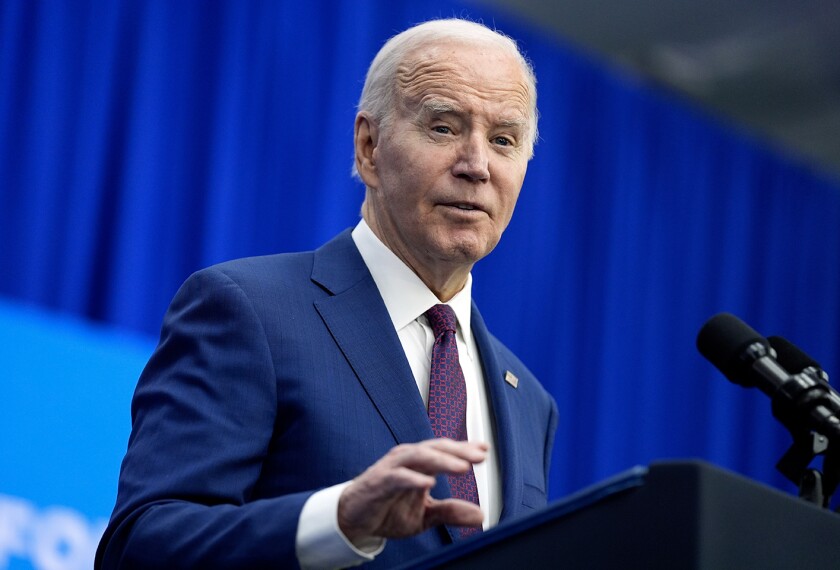
President Joe Biden delivers a speech about healthcare at an event in Raleigh, N.C., on March 26, 2024.
  • Save to favorites
  • Print

The $1.2 trillion funding package that will keep the federal government operating through September includes a cut of about $100 million to the U.S. Department of Education’s budget even as it provides small increases to key K-12 programs and holds the line on others.

President Joe Biden signed the funding package into law over the weekend after it passed the House on March 22, and the Senate early the next day, averting a partial shutdown. The package combines six annual spending bills to pay for different parts of the federal government, which had been operating on stopgap measures in the absence of a final budget for the 2024 fiscal year that began last October.

The Education Department will receive $79.1 billion for the fiscal year that lasts through Sept. 30.

That’s about $100 million less than the department’s final budget for the 2023 fiscal year, a drop of about 0.2 percent. And it’s far short of the $90 billion Biden had requested for the department in his initial 2024 budget proposal, which he unveiled a year ago, in March 2023.

But even with the overall cut, lawmakers provided increases of $20 million each to Title I grants that support services for low-income students and Individual with Disabilities Education Act, or IDEA, funds that help schools cover special education costs. Title I and IDEA are the two largest federal funds for K-12 schools.

The $20 million increases would bring Title I funding to just above the $18.4 billion allocated to the program in 2023 and bring IDEA funding to just above its 2023 level of $14.2 billion.

An Education Department spokesperson said the year-over-year differences are largely the result of mid-year budgets cuts and earmarks—funding lawmakers designated for specific projects.

The federal government typically accounts for less than 10 percent of the money spent each year on public education nationwide.

The Republican-controlled House had initially passed deep cuts to Title I and the elimination of funds that support English learners and teacher preparation, recruitment, and professional development. The spending bills that became law preserve that funding, according to a summary from the Senate’s appropriations committee.

Outside of the Education Department budget, the spending bill increases funding for Head Start by $275 million over last year, bringing total financing for the early-childhood program this year to $12.3 billion.

The additional money is meant to help the program address staffing shortages as it experiences its highest turnover in two decades, according to the appropriations committee summary. The Biden administration proposed a new rule in the fall that seeks to raise Head Start teacher pay in the coming years to bring it closer to K-12 teacher salaries, a change that will require additional funding for Head Start programs, which have been serving fewer children in recent years.

In his initial 2024 budget proposal, Biden had sought a $1.1 billion increase over 2023 for the program that serves children living at or near the federal poverty level.

See Also

Close cropped photo of a young child putting silver coins in a pink piggy bank.
iStock/Getty

The newly approved spending package also includes funding in the Defense Department budget to double enrollment in that agency’s prekindergarten programs for children of military members.

The National Association of Secondary School Principals welcomed the new budget.

It “avoids painful cuts while increasing the resources for high-needs students like mine,” Chris Young, the principal of North Country Union High School in Newport, Vt., and the principal association’s advocacy champion, said in a statement.

Biden unveiled his budget proposal for the 2025 fiscal year, which begins Oct. 1, before lawmakers had passed the final 2024 spending package.

In the 2025 budget proposal—which is unlikely to pass a divided Congress as is—he requested $82 billion for the Education Department, representing a smaller increase than he’d proposed in past years to stay within spending caps the president negotiated last year with then-House Speaker Kevin McCarthy to avert a default on the national debt. Those spending caps also apply to the 2024 funding bills.

Biden’s 2025 budget proposal includes increases for Title I and IDEA, as well as an $8 billion academic-acceleration grant program meant to help districts maintain learning-recovery initiatives they’ve launched in recent years with the help of $190 billion in federal COVID-relief funds, the last round of which are set to expire Sept. 30.
See Also

President Joe Biden delivers remarks on lowering prices for American families during an event at the YMCA Allard Center on March 11, 2024, in Goffstown, N.H.
President Joe Biden delivers remarks on lowering prices for American families during an event at the YMCA Allard Center on March 11, 2024, in Goffstown, N.H. Biden's administration released its 2025 budget proposal, which includes a modest spending increase for the Education Department.
Evan Vucci/AP
Education Funding Biden's Budget Proposes Smaller Bump to Education Spending
Libby Stanford, March 11, 2024
7 min read

Events

Jobs Regional K-12 Virtual Career Fair: DMV
Find teaching jobs and K-12 education jubs at the EdWeek Top School Jobs virtual career fair.
This content is provided by our sponsor. It is not written by and does not necessarily reflect the views of Education Week's editorial staff.
Sponsor
School Climate & Safety Webinar
Cardiac Emergency Response Plans: What Schools Need Now
Sudden cardiac arrest can happen at school. Learn why CERPs matter, what’srequired, and how districts can prepare to save lives.
Content provided by American Heart Association
Teaching Profession Webinar Effective Strategies to Lift and Sustain Teacher Morale: Lessons from Texas
Learn about the state of teacher morale in Texas and strategies that could lift educators' satisfaction there and around the country.

EdWeek Top School Jobs

Teacher Jobs
Search over ten thousand teaching jobs nationwide — elementary, middle, high school and more.
View Jobs
Principal Jobs
Find hundreds of jobs for principals, assistant principals, and other school leadership roles.
View Jobs
Administrator Jobs
Over a thousand district-level jobs: superintendents, directors, more.
View Jobs
Support Staff Jobs
Search thousands of jobs, from paraprofessionals to counselors and more.
View Jobs

Read Next

Education Funding A School Wants a Tornado Shelter. A Federal Grant Keeps Getting in the Way
The district still can't spend a FEMA grant it was originally awarded in 2022.
9 min read
FemaGrant Maiorella 02
A new gym under construction in Wisconsin's Cuba City school district, pictured April 16, 2026, would have also served as a tornado shelter, thanks to an $8.8 million FEMA grant. But nearly four years after it was awarded the grant, the district still doesn't have the money.
Arthur Maiorella for Education Week
Education Funding Trump Sidestepped Congress on More Than $1 Billion in Ed. Spending Last Year
Newly published documents show how the Ed. Dept. departed from Congress' plans.
13 min read
The likeness of George Washington is seen on a U.S. one dollar bill, March 13, 2023, in Marple Township, Pa. The nonpartisan Congressional Budget Office says it expects the federal government will be awash in debt over the next 30 years.
Newly published budget documents show the U.S. Department of Education, in the first year of President Donald Trump's second term, took roughly $1 billion Congress appropriated for specific education programs and spent it differently than how lawmakers intended—or didn't spend it all.
Matt Slocum/AP
Education Funding Federal Funds for Schools Will Still Flow Through Ed. Dept. System—For Now
The Trump administration has been touting its transfer of K-12 programs to the Labor Department.
5 min read
Remaining letters on the Department of Education on Wednesday, March 18, 2026, in Washington.
Remaining letters on the U.S. Department of Education building in Washington on Wednesday, March 18, 2026. Despite the agency's efforts to shift management of many of its programs to the U.S. Department of Labor, key K-12 funds will continue to flow through the Education Department's grants system this summer.
Allison Robbert/AP
Education Funding Trump's Budget Proposes Billions in K-12 Cuts. Will They Happen?
Trump is proposing level funding for Title I, a modest boost for special education, and major cuts elsewhere.
6 min read
A third-grade teacher at the Mountain View Elementary School's Global Immersion Academy in Morganton, N.C. works with her students in the Spanish portion of the program. With the inaugural class of the Global Immersion Academy (GIA) at at the school entering fourth grade this year, Burke County Public Schools is seeing more signs of success for its dual language program.
A teacher in a North Carolina dual-language program works with her students. In his latest budget proposal, President Donald Trump once again proposes to eliminate the $890 million fund that pays for supplemental services for English learners. Schools can use Title III funds for costs tied to dual-language programs that educate English learners.
Jason Koon/The News-Herald via AP
