Law & Courts

District’s At-Large Elections Violated Minority Voting Rights, Federal Appeals Court Finds

By Mark Walsh — January 07, 2021 3 min read
Image of people at voting booths.
  • Save to favorites
  • Print

A federal appeals court on Wednesday upheld a trial court’s ruling that at-large school board elections in a New York state school district violate the Voting Rights Act of 1965 because they dilute the voting power of Black and Latino residents.

The decision comes in a case involving the East Ramapo Central School District, which has some 8,800 students and covers large Orthodox and Hasidic Jewish populations that send about 29,000 students to private religious schools.

At the heart of the case are findings that two local rabbis and other leaders in the Orthodox community have long recruited and slated candidates for election to the nine-member East Ramapo school board and that the board often served the interests of the private school community. Although some minority candidates have been slated by the Orthodox leaders and elected, they were not the preferred candidates of minority voters in the district, court papers say.

“The record is replete with evidence that the private-school [community]-run board was chronically unresponsive to public-school concerns,” says the Jan. 6 decision in Clerveaux v. East Ramapo Central School District by a unanimous three-judge panel of the U.S. Court of Appeals for the 2nd Circuit, in New York City.

The resident population of the East Ramapo district is described in court papers as 65.7 percent white, 19.1 percent Black, 10.7 percent Latino, and 3.3 percent Asian.

Minority candidates won seven out of 32 contested board elections from 2005 to 2018, but from 2008 to 2018, the only minority candidates who won did so with the support of the Orthodox organization, court papers say. Thus, according to the voting-rights lawsuit filed by the New York Civil Liberties Union on behalf of the NAACP and other plaintiffs, minority residents were not able to elect their preferred candidates.

In 2014, a state-appointed monitor investigated the board’s activities and found that the “board appears to favor the interests of private schools over public schools.”

For example, the 2nd Circuit panel said, the board closed two public schools over minority opposition and “made a sweetheart deal with a yeshiva to sell it one of the closed schools at a discounted price.”

The board also made accommodations at its meetings for Yiddish-speaking parents but not for Spanish-speaking parents, resulting in New York state issuing a corrective action plan, court papers say.

‘Significant Control’ of Slating Process

The 2nd Circuit court upheld the district court’s reliance on data from the plaintiffs’ voting rights expert over that of the defendants’ expert. The district court concluded that the Black and Latino communities in the school district were politically cohesive and that the white majority votes as a bloc in board elections such that no minority-preferred candidate won a contested election since 2008.

The racially polarized voting in the district elections could not be explained by differences in policy preferences, the district court had ruled. The 2nd Circuit held that voting for private-school friendly policies was a proxy for race in violation of Section 2 of the Voting Rights Act.

“Those policies favorable to the private-school community come at the cost of the public-school community,” the appeals court said. “It defies reality to say that those who vote for private-school-friendly policies would be ignorant that the brunt of these policies is borne by minority children.”

The 2nd Circuit panel said the Orthodox organization’s failure to conduct open calls for candidates, the necessity for inside connections to be slated, the vetting process, and the use of only “safe” or politically or legally expedient minority candidates, all support the finding that minority candidates and residents were denied meaningful access to the slating process.

“These facts underscore the significant control of the white private-school leaders over the slating process, which worked to exclude minority interests and viewpoints from the slate and ultimately the board,” the court said.

The 2nd Circuit upheld the district court’s injunction barring any board elections under the at-large system pending the resolution of the case. In their lawsuit, the plaintiffs’ asked for a single-member district system for election board members, but it is not clear whether that remedy has been ordered or might come after further proceedings.

Events

This content is provided by our sponsor. It is not written by and does not necessarily reflect the views of Education Week's editorial staff.
Sponsor
Artificial Intelligence Webinar
AI in Schools: What 1,000 Districts Reveal About Readiness and Risk
Move beyond “ban vs. embrace” with real-world AI data and practical guidance for a balanced, responsible district policy.
Content provided by Securly
This content is provided by our sponsor. It is not written by and does not necessarily reflect the views of Education Week's editorial staff.
Sponsor
Recruitment & Retention Webinar
K-12 Lens 2026: What New Staffing Data Reveals About District Operations
Explore national survey findings and hear how districts are navigating staffing changes that affect daily operations, workload, and planning.
Content provided by Frontline Education
Education Funding Webinar Congress Approved Next Year’s Federal School Funding. What’s Next?
Congress passed the budget, but uncertainty remains. Experts explain what districts should expect from federal education policy next.

EdWeek Top School Jobs

Teacher Jobs
Search over ten thousand teaching jobs nationwide — elementary, middle, high school and more.
View Jobs
Principal Jobs
Find hundreds of jobs for principals, assistant principals, and other school leadership roles.
View Jobs
Administrator Jobs
Over a thousand district-level jobs: superintendents, directors, more.
View Jobs
Support Staff Jobs
Search thousands of jobs, from paraprofessionals to counselors and more.
View Jobs

Read Next

Law & Courts Supreme Court’s Gender Identity Ruling Leaves Schools Seeking Clarity
Advocates say they would welcome more from the Supreme Court on gender-notification policies.
7 min read
The Supreme Court is photographed, Friday, Feb. 27, 2026, in Washington.
The Supreme Court is photographed, Friday, Feb. 27, 2026, in Washington. The high court recently ruled that California policies that sometimes limit or discourage schools from disclosing information to parents about children’s gender transitions and expressions at school likely violate parents’ constitutional rights
Rahmat Gul/AP
Law & Courts Supreme Court Backs Parents in School Gender Disclosure Fight
The Supreme Court restored an injunction blocking California policies on student gender transitions
8 min read
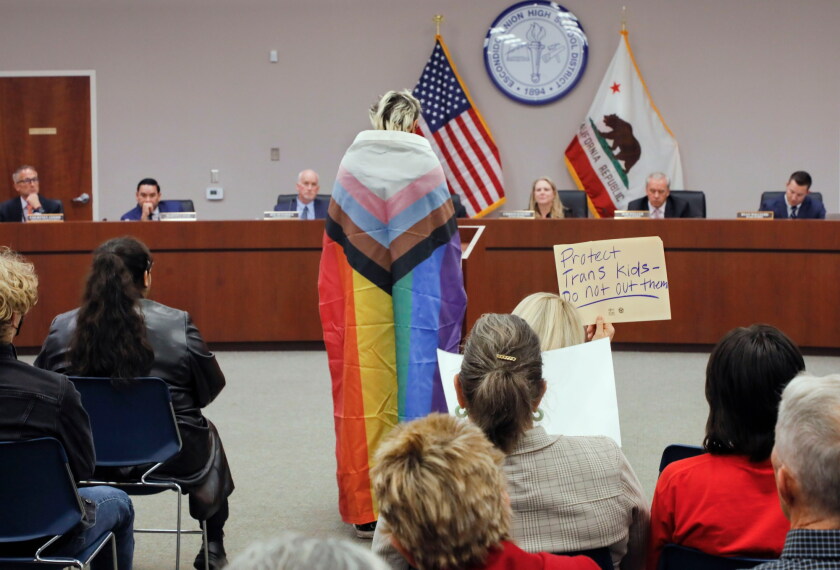
Teacher’s aide Amelia Mester, wrapped in a Pride flag, urges Escondido Union High School District not to have employees notify parents if they believe a student may be transgender in November 2025. A policy on the issue in the city’s elementary school district is the subject of a federal class-action lawsuit in which a judge just sided against the district.
Teacher’s aide Amelia Mester, wrapped in a Pride flag, urges Escondido Union High School District not to have employees notify parents if they believe a student may be transgender at a meeting in November 2025. Two parents and two teachers from the district sued in 2023, challenging California state guidance concerning student gender transitions and parental notification. The U.S. Supreme Court has now reinstated a lower-court decision overturning those state policies.
Charlie Neuman for The San Diego Union-Tribune/TNS
Law & Courts Appeals Court Allows Louisiana Ten Commandments Displays to Proceed
The court said it was premature to rule on the constitutionality of La. Ten Commandments displays.
3 min read
Students work under Ten Commandments and Bill of Rights posters on display in a classroom at Lehman High School in Kyle, Texas, Thursday, Oct. 16, 2025.
Students work under Ten Commandments and Bill of Rights posters on display in a classroom at Lehman High School in Kyle, Texas, Oct. 16, 2025. A federal appeals court has lifted a lower-court injunction blocking a Louisiana law that requires Ten Commandments displays, clearing the way for the law to take effect.
Eric Gay/AP
Law & Courts Social Media Companies Face Legal Reckoning Over Mental Health Harms to Children
Some of the biggest players from Meta to TikTok are getting a chance to make their case in courtrooms around the country.
6 min read
Social Media Kids Trial 26050035983057
Meta CEO Mark Zuckerberg leaves court after testifying in a landmark trial over whether social media platforms deliberately addict and harm children, on Feb. 18, 2026, in Los Angeles.
AP Photo/Damian Dovarganes
