Federal

Budget Plan in Senate Would Restore Bush’s College, Voc. Ed. Cuts

By Erik W. Robelen — March 30, 2005 3 min read
  • Save to favorites
  • Print

Suggesting the difficulty President Bush may face in getting Congress to trim education spending in the coming fiscal year, the Senate this month narrowly backed a Democratic measure adding $5.4 billion in such aid to a budget blueprint.

The amendment offered by Sen. Edward M. Kennedy of Massachusetts, which seeks to restore some of the White House’s proposed reductions to college and vocational education programs, among other items, passed the Republican-controlled chamber 51-49 on March 17. Six Republicans sided with Senate Democrats in favor of the measure.

“I am pleased by my amendment’s passage and the signal it sends that this Senate can come together and restore Bush’s education budget cuts,” Sen. Kennedy said in a statement that day.

But the ultimate fate of that and other provisions in the Senate version of the fiscal 2006 budget resolution—which seeks to guide tax and spending decisions on Capitol Hill—is far from certain. The resolution passed by the GOP-controlled House takes a decidedly different approach to budget matters on key issues.

Some observers doubt that Congress will be able to agree on a budget resolution, the first step—though one lawmakers don’t always complete—for constructing the federal budget. In any case, it’s only later, in separate appropriations legislation, that Congress gets down to the nitty-gritty of spelling out funding levels for individual agencies and programs.

The crucial figure set forth in the budget resolution is the overall limit on such spending.

‘Not the Perfect Bill’

President Bush in February unveiled his budget request for fiscal 2006, which begins Oct. 1, proposing for the first time in a decade to cut overall Department of Education spending. He would reduce the agency’s discretionary budget by $530 million, or nearly 1 percent, to $56 billion, and eliminate 48 programs. (“Cuts Proposed in Bush Budget Hit Education,” Feb. 16, 2005.)

Those plans have encountered opposition from Democrats and even some GOP lawmakers.

But some top Republicans seem to be on board for the objective of scaling back domestic programs as part of the $2.5 trillion budget plan put forward by Mr. Bush.

“We have created a government that is too big and spends too much,” Rep. Jim Nussle, the Iowa Republican who chairs the House Budget Committee, said March 16 as floor debate began in his chamber on the budget.

The resolution that passed the lower house March 17 on a nearly party-line vote of 218-214 stayed within the general framework outlined by the president, especially his call for holding overall federal discretionary spending to $843 billion. There is no mention in the accompanying committee report of how much the House envisions spending on education, though the level in the broader budget category for education, health, and labor programs was the same as Mr. Bush’s request.

But a wrinkle emerged in the Senate’s deliberations, where the budget measure—which initially seemed generally to track the president’s plans—saw some notable changes, such as increasing education spending by $5.4 billion and removing nearly $15 billion in proposed Medicaid cuts.

“This is not the perfect bill, not the bill I would choose had I controlled the magic wand,” said Sen. Judd Gregg, R-N.H., the chairman of the Senate Budget Committee, after some 50 hours of floor debate. He voted against Sen. Kennedy’s amendment.

The overall Senate plan passed 51-49 on March 17, with all Democrats opposed, despite their support for Sen. Kennedy’s amendment. The House and the Senate now are on their Easter recess until the second week of April.

The Senate bill “really gives us our only hope,” said Edward R. Kealy, the executive director of the Committee for Education Funding, a Washington lobbying coalition that wants a big budget boost for education. He noted that, because of Sen. Kennedy’s amendment, the Senate’s discretionary spending ceiling is more than $5 billion higher than the House’s ceiling.

“Now we have a fighting chance here,” he said, “because if that number were to prevail, the appropriators would have more room.”

Events

This content is provided by our sponsor. It is not written by and does not necessarily reflect the views of Education Week's editorial staff.
Sponsor
School Climate & Safety Webinar
Belonging as a Leadership Strategy for Today’s Schools
Belonging isn’t a slogan—it’s a leadership strategy. Learn what research shows actually works to improve attendance, culture, and learning.
Content provided by Harmony Academy
This content is provided by our sponsor. It is not written by and does not necessarily reflect the views of Education Week's editorial staff.
Sponsor
School & District Management Webinar
Too Many Initiatives, Not Enough Alignment: A Change Management Playbook for Leaders
Learn how leadership teams can increase alignment and evaluate every program, practice, and purchase against a clear strategic plan.
Content provided by Otus
This content is provided by our sponsor. It is not written by and does not necessarily reflect the views of Education Week's editorial staff.
Sponsor
Artificial Intelligence Webinar
Beyond Teacher Tools: Exploring AI for Student Success
Teacher AI tools only show assigned work. See how TrekAi's student-facing approach reveals authentic learning needs and drives real success.
Content provided by TrekAi

EdWeek Top School Jobs

Teacher Jobs
Search over ten thousand teaching jobs nationwide — elementary, middle, high school and more.
View Jobs
Principal Jobs
Find hundreds of jobs for principals, assistant principals, and other school leadership roles.
View Jobs
Administrator Jobs
Over a thousand district-level jobs: superintendents, directors, more.
View Jobs
Support Staff Jobs
Search thousands of jobs, from paraprofessionals to counselors and more.
View Jobs

Read Next

Federal Ed. Dept. Hangs Banner of Charlie Kirk Alongside MLK Jr., Ben Franklin
It's part of a celebration of the nation's 250th anniversary.
1 min read
New banners of Booker T. Washington, Catharine Beecher and Charlie Kirk hang from the Department of Education, Sunday, March 1, 2026, in Washington.
New banners of Booker T. Washington, Catharine Beecher, and Charlie Kirk hang from the U.S. Department of Education on March 1, 2026, in Washington.
Allison Robbert/AP
Federal Ed. Dept. Wants to Revamp Assistance Program It Calls 'Duplicative,' 'Confusing'
The department's Comprehensive Centers have already been through a year of shakeups.
3 min read
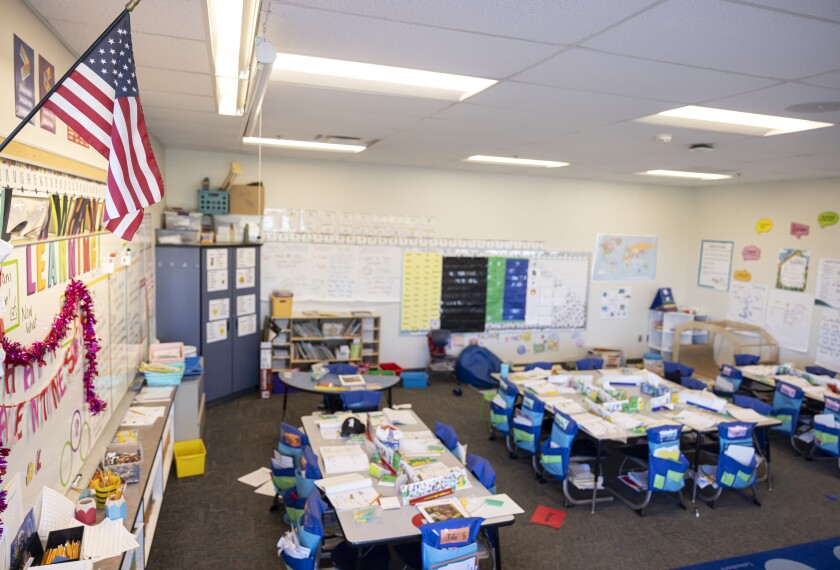
A first grade classroom at a school in Colorado Springs, on Feb. 12, 2026.
A 1st grade classroom at a school in Colorado Springs, Colo., on Feb. 12, 2026. The U.S. Department of Education released a proposal to rework a decades-old program charged with helping states and school districts problem-solve and deploy new initiatives, calling the current structure “duplicative” and “confusing.”
Kevin Mohatt for Education Week
Federal Will the Ed. Dept. Act on Recommendations to Overhaul Its Research Arm?
An adviser's report called for more coherence and sped-up research awards at the Institute of Education Sciences.
6 min read
The U.S. Department of Education building is pictured on Oct. 24, 2025, in Washington, D.C.
The U.S. Department of Education building in Washington is pictured on Oct. 24, 2025. A new report from a department adviser calls for major overhauls to the agency's research arm to facilitate timely research and easier-to-use guides for educators and state leaders.
Maansi Srivastava for Education Week
Federal Trump Talks Up AI in State of the Union, But Not Much Else About Education
The president didn't mention two of his cornerstone education policies from the past year.
4 min read
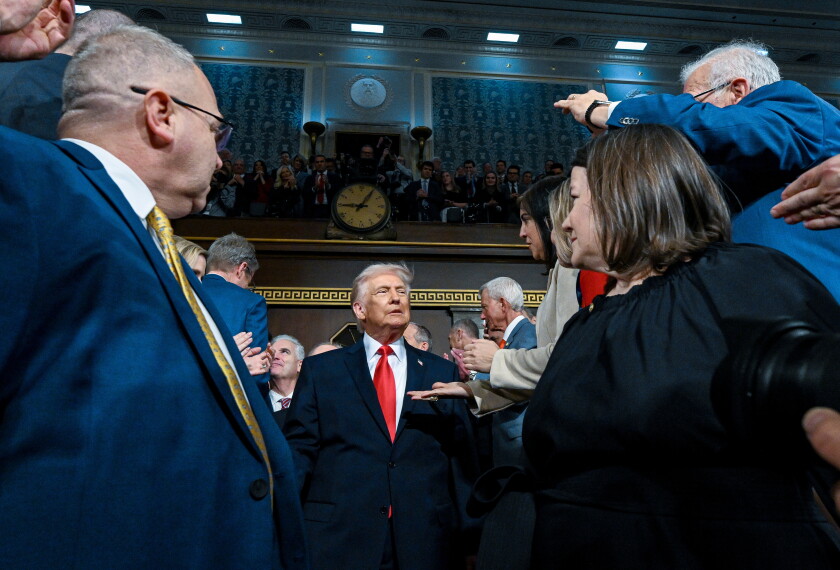
President Donald Trump enters to deliver the State of the Union address to a joint session of Congress in the House chamber at the U.S. Capitol in Washington, Tuesday, Feb. 24, 2026.
President Donald Trump enters to deliver the State of the Union address to a joint session of Congress in the House chamber at the U.S. Capitol in Washington, Tuesday, Feb. 24, 2026. The president devoted little time in the speech to discussing his education policies.
Kenny Holston/The New York Times via AP, Pool