Federal

Angelina Jolie Highlights Iraqi Students’ Plight

By Mary Ann Zehr — April 09, 2008 3 min read
BRIC ARCHIVE
  • Save to favorites
  • Print

The United States and the international community need to make the education of Iraqi children a higher priority, the actress and refugee advocate Angelina Jolie said April 8 at a panel discussion sponsored by the Council on Foreign Relations about children affected by conflict in their countries.

“To reach them and help them deal with their future, it should be one of our highest priorities,” she said.

The actress, a goodwill ambassador for the United Nations High Commissioner for Refugees, has visited strife-ridden Iraq twice in the past year. When she met with Iraqi families, parents told her a pressing issue is how to get their children into school, she said. “Iraq has a history of a high-quality education system. So they are aware of their loss.”

Ms. Jolie described some schools there as being overcrowded and said others were being used as housing for Iraqis displaced by the war, now in its sixth year. She characterized international efforts to provide education for Iraqi children and other children living in areas of violent conflict as a “drop in the bucket.”

She was joined in that view by Gene Sperling, the director of the Center for Universal Education at the Council on Foreign Relations, with whom she co-chairs the Education Partnership for Children of Conflict. Mr. Sperling said children in war-torn countries are often overlooked because other nations don’t want to give to governments perceived to be fragile. In addition, said the former national economic adviser to President Clinton, “education is often last in line in a humanitarian-crisis situation.”

Officials from UNICEF recently said that last school year 50 percent to 60 percent of Iraq’s children were enrolled in the country’s primary schools, although they said attendance rates were likely much lower. Statistics for this school year aren’t available.

Iraq’s high-quality education deteriorated over several decades and has been affected by violence and sectarian conflict resulting from the current war, said another panelist, Safaa El-Kogali, a senior economist for the World Bank and a team leader for the World Bank’s Iraq education programs.

During the war, insurgents have targeted educators, Ms. El-Kogali said. “Teachers and students have had to move continuously, and sometimes in opposite directions,” she said. As a result, some schools have too many teachers and others don’t have enough.

Since 2003, about 2,750 schools in Iraq have been destroyed, Ms. El-Kogali said. The Iraq Ministry of Education estimates the country needs 4,000 new schools, she said.

“The security situation remains very serious,” Ms. El-Kogali added.

Girls Out of School
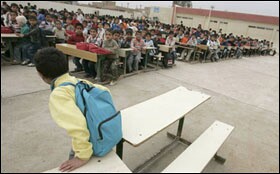
Iraqi Schoolchildren: 5 Years of War

Read more stories from our special collection, Iraqi Schoolchildren: 5 Years of War.

Several others on the panel sponsored by the Washington think tank expressed concern that far fewer Iraqi girls are attending school than boys—about one girl attends for every four boys, Mr. Sperling noted. That represents a shift from the situation prior to the war.

George Rupp, the president and chief executive officer of the International Rescue Committee, with headquarters in New York City, which provides relief to refugees, also noted that the children of many Iraqis who have fled their homeland and are living in Syria and Jordan are not attending school. He said that Iraqi refugees aren’t permitted to work in those countries, yet some have resorted to having their children work illegally.

In addition to calling on the United States to provide more money to serve the humanitarian needs, including education, of Iraqis, two of the panelists—Ms. Jolie and Mr. Rupp—urged the United States to pick up the pace in admitting Iraqi refugees to the United States.

Ms. Jolie said the United States took in 375 Iraqi refugees in January, 444 in February, and 751 in March. While heartened that the rate of acceptance is increasing each month, she said the United States is still 9,000 short of reaching its stated goal of admitting 12,000 Iraqi refugees in fiscal 2008.

A version of this article appeared in the April 16, 2008 edition of Education Week

Events

This content is provided by our sponsor. It is not written by and does not necessarily reflect the views of Education Week's editorial staff.
Sponsor
Webinar
Smarter Tools, Stronger Outcomes: Empowering CTE Educators With Future-Ready Solutions
Open doors to meaningful, hands-on careers with research-backed insights, ideas, and examples of successful CTE programs.
Content provided by Pearson
Webinar Supporting Older Struggling Readers: Tips From Research and Practice
Reading problems are widespread among adolescent learners. Find out how to help students with gaps in foundational reading skills.
This content is provided by our sponsor. It is not written by and does not necessarily reflect the views of Education Week's editorial staff.
Sponsor
Reading & Literacy Webinar
Improve Reading Comprehension: Three Tools for Working Memory Challenges
Discover three working memory workarounds to help your students improve reading comprehension and empower them on their reading journey.
Content provided by Solution Tree

EdWeek Top School Jobs

Teacher Jobs
Search over ten thousand teaching jobs nationwide — elementary, middle, high school and more.
View Jobs
Principal Jobs
Find hundreds of jobs for principals, assistant principals, and other school leadership roles.
View Jobs
Administrator Jobs
Over a thousand district-level jobs: superintendents, directors, more.
View Jobs
Support Staff Jobs
Search thousands of jobs, from paraprofessionals to counselors and more.
View Jobs

Read Next

Federal Trump’s Ed. Dept. Slashed Civil Rights Enforcement. How States Are Responding
Could a shift in civil rights enforcement be the next example of "returning education to the states?"
6 min read
Pennsylvania Sen. Lindsey Williams, D-Allegheny, is pictured during a confirmation hearing for acting
Pennsylvania state Sen. Lindsey Williams, a Democrat, is pictured during an education committee hearing on Aug. 12, 2025. Williams is preparing legislation that would create a state-level office of civil rights to investigate potential civil rights violations in schools. Williams is introducing the measure in response to the U.S. Department of Education's slashing of its own office for civil rights.
Courtesy of Pennsylvania Senate Democratic Caucus
Federal Fired NCES Chief: Ed. Dept. Cuts Mean 'Fewer Eyes on the Condition of Schools'
Experts discuss how federal actions have impacted equity and research in the field of education.
3 min read
Peggy Carr, Commissioner of the National Center for Education, speaks during an interview about the National Assessment of Education Process (NAEP), on Oct. 21, 2022, in Washington.
Peggy Carr, the former commissioner of the National Center for Education Statistics, speaks during an interview about the National Assessment of Education Process, on Oct. 21, 2022, in Washington. Carr shared her thoughts about the Trump administration's massive staff cuts to the Education Department in a recent webinar.
Alex Brandon/AP
Federal What Should Research at the Ed. Dept. Look Like? The Field Weighs In
The agency requested input on the Institute of Education Sciences' future. More than 400 comments came in.
7 min read
 Vector illustration of two diverse professionals wearing orange workman vests and hard hats as they carry and connect a very heavy, oversized text bubble bringing the two pieces shaped like puzzles pieces together as one. One figure is a dark skinned male and the other is a lighter skinned female with long hair.
DigitalVision Vectors
Federal Education Department Layoffs Would Affect Dozens of Programs. See Which Ones
Entire teams that work on key funding streams may not return to work even when the shutdown ends.
3 min read
Education Secretary Linda McMahon appears before the House Appropriation Panel about the 2026 budget in Washington, D.C., on May 21, 2025.
Education Secretary Linda McMahon appears before U.S. House of Representatives members to discuss the 2026 budget in Washington on May 21, 2025. The U.S. Department of Education laid off 465 employees during the federal government shutdown. The layoff, if it goes through, will virtually wipe out offices in the agency that oversee key grant programs.
Jason Andrew for Education Week
