School Climate & Safety

What Schools Need To Know About Anonymous Threats—And How to Prevent Them

By Caitlynn Peetz Stephens — November 20, 2024 3 min read
Tightly cropped photo of hands on a laptop with a red glowing danger icon with the exclamation mark inside of a triangle overlaying the photo
  • Save to favorites
  • Print

The number of schools receiving anonymous threats is on the rise, but there are some steps districts can take to reduce the likelihood of being targeted by hoax bomb and shooting threats.

Threatening messages sent via phone or email, posted on social media, or left in writing on school property by an unidentified person can cause major disruptions to school operations.

Though nearly always a hoax, all of them must be taken seriously and shared with law enforcement, and can result in school evacuations, lockdowns, a large police response, or the closing of school altogether, said Don Hough, the deputy associate director of the School Safety Task Force at the federal Cybersecurity and Infrastructure Security Agency.

See Also

Barrow Sheriff Jud Smith provides an update on the shooting at Apalachee High School in Winder, Ga., on Sept. 4, 2024.
John Spink/The Atlanta Journal-Constitution via TNS
School Climate & Safety Why Responding to Student Threats Is So Complicated
Evie Blad & Olina Banerji, September 5, 2024
8 min read

Most of the threats—which have “significantly increased” in frequency in the past two years, Hough said—are made by students simply trying to disrupt the school day and get a day off.

It should be seen as a sign that the student “needs greater intervention and support from the community,” he said during a webinar on Nov. 18 hosted by AASA, The School Superintendents Association. The threats could also include “swatting,” a term that refers to filing a false report with the aim of stoking chaos and provoking a large law enforcement response.

Much of the response to threats is out of schools’ hands—that’s up to police. But schools can prepare for them and try to prevent them, Hough said.

The payoff from prevention: fewer disruptions, more positive school culture

It’s no small task and it encompasses several key areas, Hough said, but the payoff could mean less disrupted class time, a more positive school culture, and a greater sense of safety.

To prepare, school leaders need to ensure their communities know when and how to report threats, Hough said. Specifically for threats made on social media, students should be reminded to “report, don’t repost,” he said.

“We all know … these threats can spread like wildfire on social media,” Hough said. “Too often, it’s through the school community before we have a handle on what’s said.”

It’s also important to train staff who are most likely to receive the threats—people who monitor emails to the school, control access to outside doors, and answer phone calls—about how to ask probing questions when on the line with someone making a threat.

If someone phones in a bomb threat, for example, the staff member needs to get as much specific information as possible by asking additional questions, like where the device is, when was it placed, and who is calling. Then the staff member needs to be prepared to repeat the information to law enforcement and school leadership, Hough said.

Schools should host “internet safety nights” or provide handouts to families with information about youth social media use, including what apps are available to children and what they’re used for. Schools should also make it clear what kind of behavior is unacceptable on social media, and that making threats online is “no different than making that threat in person,” Hough said.

“Make it clear that they’re taken seriously, that the process is transparent, and those online threats turn into real-world consequences,” he said.

Threats can be a “cry for help”

Often, when students make threats toward their school, it’s a “cry for help,” Hough said, so districts may be well served by prioritizing investments in mental health supports for students both to prevent potential problems in the future and to ensure schools have the ability to connect students to supportive services if they are identified as making a threat.

Perhaps the most important step schools can take now, before they are targeted with an anonymous threat, is to establish positive and collaborative relationships with local law enforcement, Hough said. It is helpful to establish which agency is responsible for which elements of the response, he said. For example, the police may be responsible for investigating the legitimacy of the threat and identifying who made it, while the school is responsible for communicating with families and for discipline, he said.

“There’s no single right answer in responding to these threats,” Hough said. “But too often schools wait until they’ve received a threat to build relationships. A plan has to be in place before that.”

Events

This content is provided by our sponsor. It is not written by and does not necessarily reflect the views of Education Week's editorial staff.
Sponsor
College & Workforce Readiness Webinar
Building for the Future: Igniting Middle Schoolers’ Interest in Skilled Trades & Future-Ready Skills
Ignite middle schoolers’ interest in skilled trades with hands-on learning and real-world projects that build future-ready skills.
Content provided by Project Lead The Way
This content is provided by our sponsor. It is not written by and does not necessarily reflect the views of Education Week's editorial staff.
Sponsor
Artificial Intelligence Webinar
AI in Schools: What 1,000 Districts Reveal About Readiness and Risk
Move beyond “ban vs. embrace” with real-world AI data and practical guidance for a balanced, responsible district policy.
Content provided by Securly
This content is provided by our sponsor. It is not written by and does not necessarily reflect the views of Education Week's editorial staff.
Sponsor
Recruitment & Retention Webinar
K-12 Lens 2026: What New Staffing Data Reveals About District Operations
Explore national survey findings and hear how districts are navigating staffing changes that affect daily operations, workload, and planning.
Content provided by Frontline Education

EdWeek Top School Jobs

Teacher Jobs
Search over ten thousand teaching jobs nationwide — elementary, middle, high school and more.
View Jobs
Principal Jobs
Find hundreds of jobs for principals, assistant principals, and other school leadership roles.
View Jobs
Administrator Jobs
Over a thousand district-level jobs: superintendents, directors, more.
View Jobs
Support Staff Jobs
Search thousands of jobs, from paraprofessionals to counselors and more.
View Jobs

Read Next

School Climate & Safety Q&A This Principal Puts Relationships Ahead of Content. Here’s How
A school leader discusses how he and his staff create a safe and supportive learning environment.
5 min read
Damon Lewis.
"We're going to get to the standards ... but we have to make sure that our kids feel safe enough to come into our building," said Damon Lewis, the principal for Ponus Ridge STEAM Academy in Norwalk, Conn., and the National Middle Level Principal of the Year in 2025.
Allyssa Hynes/NASSP/NASSP via reporter
School Climate & Safety Father Who Gave Gun to School Shooting Suspect Is Guilty of 2nd-Degree Murder
Colin Gray is one of several parents prosecuted after their children were accused in fatal shootings.
4 min read
Colin Gray, the father of Apalachee High School shooting suspect Colt Gray, reacts after a jury convicted him of second-degree murder and involuntary manslaughter at Barrow County Courthouse in Winder, Ga., Tuesday, March 3, 2026.
Colin Gray, the father of Apalachee High School shooting suspect Colt Gray, reacts after a jury convicted him of second-degree murder and involuntary manslaughter at Barrow County Courthouse in Winder, Ga., on March 3, 2026. Gray's conviction marks the latest instance of a parent being held criminally responsible for a school shooting.
Abbey Cutrer/Atlanta Journal-Constitution via AP, Pool
School Climate & Safety This Key Factor Helps Students Feel Safe at School
Students who believe educators take their safety concerns seriously are more likely to feel safe.
3 min read
A hallway at a school in Morrisville, Pa., on Nov. 13, 2025. Data from a recent survey shows the link between safety and relationships come as schools carve out portions of their increasingly limited budgets on school security measures, safety training, and mental health programs to keep students safe.
A recent survey shows the link between safety and relationships as schools struggle to carve out portions of their increasingly limited budgets for school security measures, safety training, and mental health programs. A hallway at a school in Morrisville, Pa., is shown on Nov. 13, 2025.
Rachel Wisniewski for Education Week
School Climate & Safety Shootings at School and Home in British Columbia, Canada, Leave 10 Dead Including Suspect
Canadian Prime Minister Mark Carney said he grieved with families "whose lives have been changed irreversibly today."
3 min read
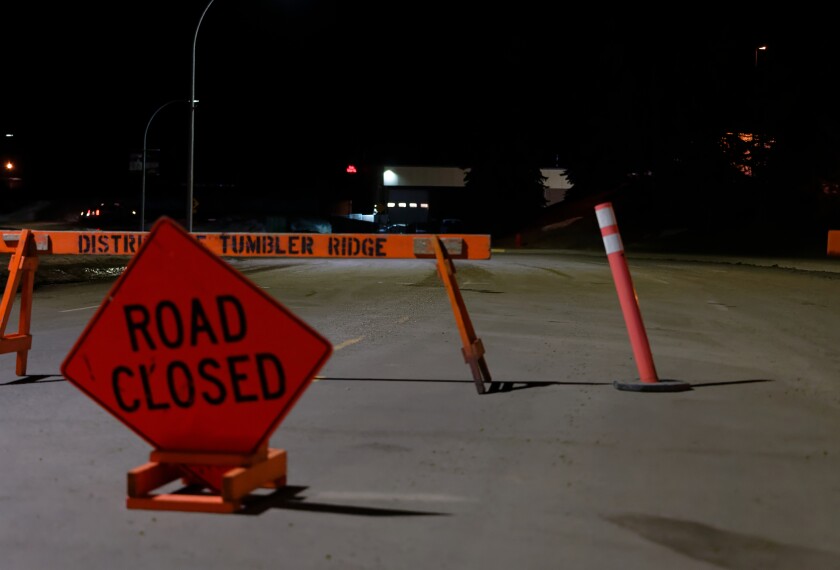
The road is blocked off before the Tumbler Ridge Secondary School, in Tumbler Ridge, B.C., Canada, on Wednesday, Feb. 11, 2026.
Jesse Boily/Canadian Press via AP