

Updated: The U.S. Centers for Disease Control and Prevention on Friday issued updated advice that retains COVID-19 shots on the vaccination schedule for children ages 6 months to 17, in contrast to Health and Human Services Secretary Robert F. Kennedy’s statements earlier in the week. However, the advice says the vaccinations are to be “individually based and informed by a decision process between the health care provider and the patient or parent/guardian.”
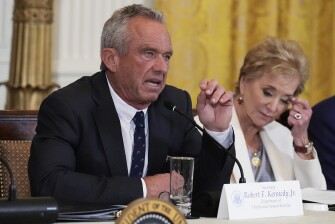
U.S. Health and Human Services Secretary Robert F. Kennedy Jr.'s announcement this week that COVID-19 vaccines are no longer recommended for healthy children has some school and public health experts concerned that families that want the shots for their children won’t be able to get them.
Although a small minority of children are up to date on their COVID shots, the new federal recommendations could remove one tool that can help keep children well enough to attend school, at a time when schools are still fighting high levels of absenteeism.
“Our job as school nurses is to keep kids in their seats. We want children in class, learning, and anything that’s preventable should be prevented,” said Lynn Nelson, president-elect of the National Association of School Nurses. “I’m not suggesting that all children have COVID vaccines or that they be be required, just that it’s a decision that should be made at the health care provider level, in collaboration with the parent.”

In making his announcement via a social media post May 27, Kennedy—a longtime vaccine critic who has peddled false information about shots—said the COVID vaccine was removed from the U.S. Centers for Disease Control and Prevention’s recommended immunization schedule for both healthy children and pregnant women. The move follows action by the U.S. Food and Drug Administration on May 20 that effectively limits COVID vaccines to older people and people at risk of developing severe complications if they contract the disease.
The CDC previously recommended that everyone 6 months and older receive a COVID shot annually.
“Last year, the Biden Administration urged healthy children to get yet another COVID shot despite the lack of clinical data to support repeat booster strategy in children,” Kennedy said in the video.
But Nelson of the school nurses association said the decision “defies science” that shows the vaccines are safe and beneficial for children.
The shift in recommendations may allow health insurers—including Medicaid, which millions of children from low-income households rely on—to stop covering the costs of receiving the vaccine, which could effectively strip many families of their ability to choose whether they want their children to be vaccinated, Nelson said.

Insurance companies are required to cover CDC-recommended vaccinations without charging copayments.
“It quickly becomes an access issue,” she said. “Absolutely any vaccine decision should be made between a parent and their physician—period. But if families can’t afford the vaccine, they can decide it’s in the best interest of the child to receive it but cannot get it. That part is the most concerning to me.”
RFK Jr.'s announcement is his latest vaccine-skeptical move
Kennedy is a longtime, vocal critic of vaccines who led a nonprofit that has sued vaccine makers as well as state and local governments over vaccination requirements for students and health care workers. The nonprofit, Children’s Health Defense, also produces videos, newsletters, and social media campaigns with false claims that experts say erode trust in vaccines.
Kennedy in April pledged “a massive testing and research effort” to determine the cause of autism, an effort that will include taking “a look at vaccines” as a risk factor. Extensive research has found no link between vaccines and autism.
Some experts have said his most recent move to limit access to COVID vaccines is a prime example of Kennedy’s efforts to undermine the public’s confidence in vaccines.

Sean O’Leary, chair of the American Academy of Pediatrics’ Committee on Infectious Diseases, said in a statement to Education Week that the decision “could strip families of choice.”
“This decision bypasses a long-established, evidence-based process used to ensure vaccine safety and ignores the expertise of independent medical experts, including members of CDC committees who are examining the evidence regarding the vaccine to make recommendations for the fall,” he said. “... Those who want to vaccinate may no longer be able to, as the implications for insurance coverage remain unclear. It’s also unclear whether health care workers would be eligible to be vaccinated.”
A Health and Human Services Department spokesperson told the Washington Post that “with the COVID-19 pandemic behind us, it is time to move forward.”
Low numbers of children are up to date on COVID shots
Childhood uptake of the COVID vaccine has been relatively low in recent years. About 13% of children ages 6 months to 17 years were up to date on their COVID vaccines as of April 26, according to CDC data. That’s compared to 14.2% at the same time in 2024.
Closer to the apex of the pandemic, however, a much higher percentage of children received COVID vaccinations. One study by the National Institutes of Health, using CDC data, found that 28% of children ages 5 to 11, and 65% of kids ages 12 to 17, were up to date on their COVID vaccines in late 2021 and early 2022.
At that time, some districts and states required kids to be vaccinated to return to in-person classes and activities following prolonged pandemic-related closures. Those requirements were short-lived and, as of February, no state required COVID vaccinations for K-12 students. Individual school districts do not set student vaccination requirements—they are determined by state law. Twenty-one states ban the requirement of the COVID vaccine for school-aged children, according to a tracker by the National Academy for State Health Policy.
Even so, President Donald Trump in February issued an executive order to withhold federal funding from schools, colleges, and state education departments that require students to receive the COVID vaccination. The New York Times reported at the time that only 15 colleges still required COVID vaccines for students.
Widespread tracking of new COVID-19 cases is now rare, but the CDC reports that wastewater viral activity—a measure of the prevalence of the disease among people without relying on testing—is low nationally.
Regardless, Nelson at the National Association of School Nurses said it’s concerning to limit access to any vaccines that can help prevent or lessen the severity of communicable diseases that can make children sick and keep them out of class.
“COVID is not over,” she said. “It’s just about how dangerous each new wave will be.”


