Opinion Blog

Ask a Psychologist

Helping Students Thrive Now

Angela Duckworth and other behavioral-science experts offer advice to teachers based on scientific research. Read more from this blog.

Student Well-Being & Movement Opinion

Why Teachers Need to Be Honest With Students

It’s foundational for fostering human connection
By Eranda Jayawickreme — March 22, 2023 3 min read
What do teachers need to know about honesty?
  • Save to favorites
  • Print

What do teachers need to know about honesty?

If you want to develop strong relationships, honesty is fundamental. I answered questions about this topic for Character Lab as a Tip of the Week:

Let’s start with the basics. Why is honesty so important?

For thousands of years, honesty has been held up as a really important character trait by different philosophical traditions, religious traditions, across multiple cultures. A second, more practical, reason for caring about honesty is that if we want to get things done in the world, we need to form trusting relationships. People need to be able to take what we say at face value. And that has implications for forming good partnerships and marriages and being an active and successful participant in social life. So there are real consequences to being honest or dishonest.

A third reason is that we desire honesty. My colleagues and I asked people in a study a few years ago, what are the characteristics of someone you respect, someone you like? The number one pick is honesty. A lot of other traits are important, like being compassionate and being fair. But honesty comes out on top.

If everyone thinks honesty is important, why is it so hard?

It’s interesting, right? What’s most distinctive about honesty is that, in some cases, people lie because there’s tension with another action that also seems moral. For example, when you’re giving feedback to your child or a student, you want to be honest because otherwise, they aren’t going to learn. But you also want to be mindful of their self-esteem, so you have the motivation to be kind and compassionate. You want to find a balance between benevolence and honesty.

There’s also the famous philosophical case of the “Nazi at the door.” Imagine this scenario: You’re hiding people, and Nazi soldiers knock on your door and ask, “Are you hiding people?” What do you do? The moral thing to do is to lie, but then you’re lying. So how do you resolve that paradox? You have these situations where being honest may not be the right thing to do. Thankfully, many of us don’t have to deal with these sorts of moral dilemmas often.

What do you think researchers know about honesty that most people get wrong?

We all see these high-profile instances of people cheating or lying that make the news. A classic example is Bernie Madoff, who ran a Ponzi scheme and defrauded people. Or Tiger Woods, with his history of marital infidelity. When people read news stories like these, they assume that because these famous figures are lying, you can’t trust people. And that belief can be corrosive. If you go around the world thinking that most people will not be truthful with you, you’re going to be distrustful. It’s going to prevent you from fostering human connection, real human bonds. But in our research, we’re finding that most people are honest in their everyday life.

A skeptic might say that people will tell researchers they’re honest just to make themselves look good.

In our recent research, we’ve been using experience-sampling methods—we can send people messages and ask them how honest they are being right now. And there are certain contexts where people are more willing to say they’ve been dishonest. I think that’s really cool because it shows that people are actually willing to acknowledge that, sometimes, they engage in behavior that could be considered immoral.

For example, if you ask people, “In the last hour or so, were you in a situation where you had to deliver unpleasant news or where you were motivated to avoid something you didn’t want to do?” When you ask people whether they were in a specific situation like that, some people are happy to say, “Yes, I was in that situation, and no, I didn’t tell the truth.” But research is finding that, for the most part, we’re honest with our partners. We’re honest with our friends.

Related Tags:

The opinions expressed in Ask a Psychologist: Helping Students Thrive Now are strictly those of the author(s) and do not reflect the opinions or endorsement of Editorial Projects in Education, or any of its publications.

Events

This content is provided by our sponsor. It is not written by and does not necessarily reflect the views of Education Week's editorial staff.
Sponsor
Artificial Intelligence Webinar
Managing AI in Schools: Practical Strategies for Districts
How should districts govern AI in schools? Learn practical strategies for policies, safety, transparency, as well as responsible adoption.
Content provided by Lightspeed Systems
This content is provided by our sponsor. It is not written by and does not necessarily reflect the views of Education Week's editorial staff.
Sponsor
Reading & Literacy Webinar
Unlocking Success for Struggling Adolescent Readers
The Science of Reading transformed K-3 literacy. Now it's time to extend that focus to students in grades 6 through 12.
Content provided by STARI
Jobs Virtual Career Fair for Teachers and K-12 Staff
Find teaching jobs and K-12 education jubs at the EdWeek Top School Jobs virtual career fair.

EdWeek Top School Jobs

Teacher Jobs
Search over ten thousand teaching jobs nationwide — elementary, middle, high school and more.
View Jobs
Principal Jobs
Find hundreds of jobs for principals, assistant principals, and other school leadership roles.
View Jobs
Administrator Jobs
Over a thousand district-level jobs: superintendents, directors, more.
View Jobs
Support Staff Jobs
Search thousands of jobs, from paraprofessionals to counselors and more.
View Jobs

Read Next

Student Well-Being & Movement School Counselors See Rising Trauma Linked to Immigration Enforcement
The school staff whose job it is to support students say they see major signs of emotional distress.
6 min read
Students take a recess break outside of St. Paul district school in St. Paul, MN, February 23, 2026.
Students take recess outside an elementary school in St. Paul, Minn., on Feb. 23, 2026.
Tim Evans for Education Week
Student Well-Being & Movement Looking for SEL's Benefits? Good Implementation Is Key, Experts Say
How well an SEL program is implemented is critical for achieving the outcomes that research promises.
6 min read
Students visit the Alaqua Animal Rescue in Freeport, Fla., for an SEL-based curriculum on Aug. 23, 2025.
Students visit the Alaqua Animal Rescue in Freeport, Fla., for an SEL lesson on Aug. 23, 2025. Social-emotional learning can be a powerful tool for boosting student engagement and improving behavior and academic performance, but experts say it has to be implemented well.
Micah Green for Education Week
Student Well-Being & Movement Millions of Students Attend Schools Near Toxic Sites, a New Study Shows
The study explores schools' proximity to hazardous sites and students' exposure to pollutants.
4 min read
The Fifth Ward Elementary School and residential neighborhoods sit near the Denka Performance Elastomer Plant, back, in Reserve, La., Friday, Sept. 23, 2022. Less than a half mile away from the elementary school, the plant makes synthetic rubber, emitting chloroprene, listed as a carcinogen in California, and a likely one by the Environmental Protection Agency.
The Fifth Ward Elementary School and nearby residential neighborhoods in Reserve, La., pictured here on Sept. 23, 2022, sit near a synthetic rubber plant that has emitted chloroprene, which California lists as a carcinogen. New research finds thousands of schools are located within a quarter mile of such environmental hazard sites.
Gerald Herbert/AP
Student Well-Being & Movement 3 Driving Questions to Create a Sense of Belonging in Schools
Students who feel they belong in their school are more likely to show up and learn.
5 min read
MVCS 1981
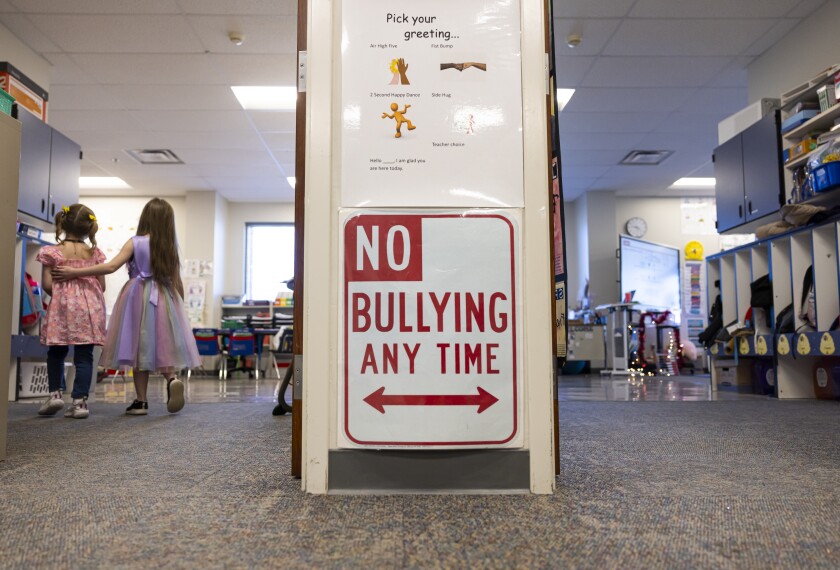
A sign discouraging bullying is seen as two students walk into a classroom at a school in Colorado Springs, Colo., on Feb. 12, 2026. Experts say creating a sense of belonging in school can help curb problems like bullying.
Kevin Mohatt for Education Week