

How do I help students talk about their feelings?
Kids are not going to talk about their feelings unless you talk about your feelings. I answered questions about this topic for Character Lab as a Tip of the Week:
Most people want to be more emotionally intelligent, but how do we do that?
I use the acronym RULER to talk about five essential skills. The first R is recognizing emotions in myself and others. That’s paying attention to my physiology, to where my brain is taking me. It’s paying attention to your facial expressions, vocal tone, body language—trying to make meaning out of that.
The U is understanding emotion—the causes and the consequences of feelings. What makes me feel angry? What makes you feel angry? Anger is about injustice, but what I see as an injustice and what you see as an injustice might be different.
L is labeling emotions—having that precise word. E is expressing emotions—knowing how and when to express emotions with different people across contexts and cultures. And then the final R of RULER is the regulation of emotion. These are the strategies we use to help us prevent or reduce unwanted emotions and initiate the ones that we want to have.
Where do you think people have the most trouble?
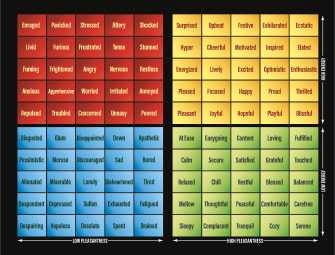
Labeling. Most people have not been brought up with an advanced emotional vocabulary, and even when they learn words, they don’t really know what they mean. Everybody’s stressed. Or anxious. But do they know the difference? My research shows that most people clump together the anxiety, the stress, the fear, the pressure, the overwhelm, the worry. It’s all one big clump of red on our mood meter. That makes it hard to find the best strategy to regulate those feelings.
What’s the mood meter?
The mood meter is a tool that helps you plot how you feel as a product of two dimensions: pleasantness and energy. If you’re high pleasant, high energy, you’re in the yellow—the generally happy emotions. If you’re high pleasant but low in energy, you’re in the green—chilled out. If you’re unpleasant with a lot of energy, you’re in the red—the angry emotions. And if you’re unpleasant with a little bit of energy, you’re in the blue—sad.
The mood meter helps us take all the complexities that are in our minds and bodies and put it into an emotion space. It’s easy for people to say, I’m in the yellow or green or blue or red. And then from there, we can get more granular by asking people questions. “Well, what’s happening for you right now?” “Oh, I’m doing an interview, that’s exciting.” “I’m about to go to bed. I’m tired.” “I’m about to do a presentation—I’m overwhelmed.”
How can I better understand my emotions?
Download the app How We Feel, which provides definitions for 144 emotions and 36 research-based strategies. The app can help you build a more advanced emotional vocabulary and understand how your feelings are linked to things like the people you’re with and what you’re doing. And you can track that over time. If you set reminders throughout the day—you’re at home, you’re at school, you’re at the gym—and you’re plotting your emotions over the course of a month, you can analyze your data to see what color quadrant you’ve been in and in what context with whom.
It can be very eye-opening because some people think, “Oh, I’m always in the red.” And that might be because they only think about their feelings when they’re in the red. Whereas, when they use the tool and plot themselves throughout the day, they start realizing, “Actually, I do experience wider and more pleasant emotions.”
What do people get wrong about emotions?
People sometimes think of anger and stress and anxiety as bad. But there are no bad emotions. All emotions are information. Let’s say you have a kid or a significant other and you’re plotting yourself in the red with those people, you’re angry. That’s an indication that you’ve got to work on your relationships. It’s not a bad thing.
You’ll want to ask yourself, what’s going on in your life? Is it that you have no space? Is it the people you’re with who are bringing you into the red? Is it your work? And then start setting goals—say, I want to be 5 percent less red next week. You’re not going to get rid of your red. Because life is about being in the red and blue. We’re complex people who should feel the full range of emotions.
How can we teach kids about emotional intelligence?
Be a role model. Parents and teachers want me to teach them the tricks of nurturing an emotionally intelligent child. And what they don’t realize is that the real trick is their own development of the skills and modeling them.
Kids are not going to talk about their feelings unless you talk about your feelings. Not when your head is spinning out of irritation. But maybe in the morning you can say, “Hey, how are you doing today? Last night, I didn’t sleep so well, and I’m kind of irritable this morning. I just want to let you know that if I look a little off today, it’s not because of you. It’s just that I’m trying to get myself together.” Talking about feelings every day—it’s just part of who we are. We talk about feelings here.


