Opinion Blog

Ask a Psychologist

Helping Students Thrive Now

Angela Duckworth and other behavioral-science experts offer advice to teachers based on scientific research. Read more from this blog.

Student Well-Being & Movement Opinion

The Hidden Impact of Informal Student Mentoring

4 ways schools can encourage teacher-student relationships
By Matthew A. Kraft — February 07, 2024 3 min read
How can schools make mentoring more feasible for teachers?
  • Save to favorites
  • Print

How can schools make mentoring more feasible for teachers?

When I was in high school, my U.S. history teacher kept a box of Quaker Oats on a windowsill in his classroom. After class one day, I asked him, “What’s the deal with the oats?”

That was the first of many long conversations I would have with Mr. Hinshaw, who was raised in a Quaker community and became my mentor. He was funny, disarming, and patient. Our talks helped me stay centered during times of personal and family challenges. He pushed me to be a deeper thinker and a better friend.

My serendipitous experience of finding a mentor at school is a common one. In a new study, Noelle Hurd, Alex Bolves, and I found that 1 out of every 6 students names a teacher, counselor, or coach as their most impactful mentor in life outside of their immediate family.

We show that students who experience informal mentoring relationships go on to achieve considerably greater academic success. Having a school-based natural mentor raised students’ GPAs and made them much more likely to attend college. These differences were not simply a pattern of higher-achieving students being more likely to have a mentor but rather the direct effects of mentors (our research included comparisons of similar students such as twins).

But we also found a concerning pattern. Though students from low socioeconomic backgrounds benefited most from the guidance and advice of school-based mentors, they also were the least likely to report having one. In fact, some schools have twice as many students reporting these natural mentoring relationships than other schools do.

So, what can schools do to make mentoring more feasible for teachers and equitable for students?

Our research points to four areas:

Recognize and reward the effort teachers invest in informal mentoring. This can range from informal, private notes of appreciation to more formal, publicly announced awards for teachers who go above and beyond.

Create more opportunities for small-group interactions between educators and students. Schools can aim for smaller class sizes for selected subjects or design advisory periods where students stay with the same teacher across several years. Outside the classroom, schools can empower students to form clubs around their areas of interest and provide stipends to faculty members who serve as club mentors and sponsors.

Foster a school environment where all students feel a sense of belonging. Teachers, administrators, and staff can participate in a collective and concerted effort to reflect on the experiences of all their students in school. One first step might be to engage in a relationship-mapping exercise to better understand which students do and don’t have a connection with a school-based adult.

Recruit and retain a more socioeconomically and racially diverse teacher workforce. Some districts are working to develop a more diverse supply of teachers from their own communities via Grow Your Own educator pipeline programs. Schools can also analyze feedback from staff working-condition surveys to ensure teachers of all backgrounds feel supported and valued. When students see teachers that look like themselves, they may be more open to developing a deeper connection based on shared identities and common backgrounds.

Our data simply reflect what has been long known in the education community. If you work at a school, you are more than an educator—you are also an informal counselor, social worker, and life coach to many students. People often think of mentorship as something that happens as part of formal programs like Big Brothers Big Sisters. But informal, naturally occurring mentoring is just as important, especially when it is with educators who can support students to thrive in school and beyond.

Related Tags:

The opinions expressed in Ask a Psychologist: Helping Students Thrive Now are strictly those of the author(s) and do not reflect the opinions or endorsement of Editorial Projects in Education, or any of its publications.

Events

This content is provided by our sponsor. It is not written by and does not necessarily reflect the views of Education Week's editorial staff.
Sponsor
Artificial Intelligence Webinar
Managing AI in Schools: Practical Strategies for Districts
How should districts govern AI in schools? Learn practical strategies for policies, safety, transparency, as well as responsible adoption.
Content provided by Lightspeed Systems
This content is provided by our sponsor. It is not written by and does not necessarily reflect the views of Education Week's editorial staff.
Sponsor
Reading & Literacy Webinar
Unlocking Success for Struggling Adolescent Readers
The Science of Reading transformed K-3 literacy. Now it's time to extend that focus to students in grades 6 through 12.
Content provided by STARI
Jobs Virtual Career Fair for Teachers and K-12 Staff
Find teaching jobs and K-12 education jubs at the EdWeek Top School Jobs virtual career fair.

EdWeek Top School Jobs

Teacher Jobs
Search over ten thousand teaching jobs nationwide — elementary, middle, high school and more.
View Jobs
Principal Jobs
Find hundreds of jobs for principals, assistant principals, and other school leadership roles.
View Jobs
Administrator Jobs
Over a thousand district-level jobs: superintendents, directors, more.
View Jobs
Support Staff Jobs
Search thousands of jobs, from paraprofessionals to counselors and more.
View Jobs

Read Next

Student Well-Being & Movement School Counselors See Rising Trauma Linked to Immigration Enforcement
The school staff whose job it is to support students say they see major signs of emotional distress.
6 min read
Students take a recess break outside of St. Paul district school in St. Paul, MN, February 23, 2026.
Students take recess outside an elementary school in St. Paul, Minn., on Feb. 23, 2026.
Tim Evans for Education Week
Student Well-Being & Movement Looking for SEL's Benefits? Good Implementation Is Key, Experts Say
How well an SEL program is implemented is critical for achieving the outcomes that research promises.
6 min read
Students visit the Alaqua Animal Rescue in Freeport, Fla., for an SEL-based curriculum on Aug. 23, 2025.
Students visit the Alaqua Animal Rescue in Freeport, Fla., for an SEL lesson on Aug. 23, 2025. Social-emotional learning can be a powerful tool for boosting student engagement and improving behavior and academic performance, but experts say it has to be implemented well.
Micah Green for Education Week
Student Well-Being & Movement Millions of Students Attend Schools Near Toxic Sites, a New Study Shows
The study explores schools' proximity to hazardous sites and students' exposure to pollutants.
4 min read
The Fifth Ward Elementary School and residential neighborhoods sit near the Denka Performance Elastomer Plant, back, in Reserve, La., Friday, Sept. 23, 2022. Less than a half mile away from the elementary school, the plant makes synthetic rubber, emitting chloroprene, listed as a carcinogen in California, and a likely one by the Environmental Protection Agency.
The Fifth Ward Elementary School and nearby residential neighborhoods in Reserve, La., pictured here on Sept. 23, 2022, sit near a synthetic rubber plant that has emitted chloroprene, which California lists as a carcinogen. New research finds thousands of schools are located within a quarter mile of such environmental hazard sites.
Gerald Herbert/AP
Student Well-Being & Movement 3 Driving Questions to Create a Sense of Belonging in Schools
Students who feel they belong in their school are more likely to show up and learn.
5 min read
MVCS 1981
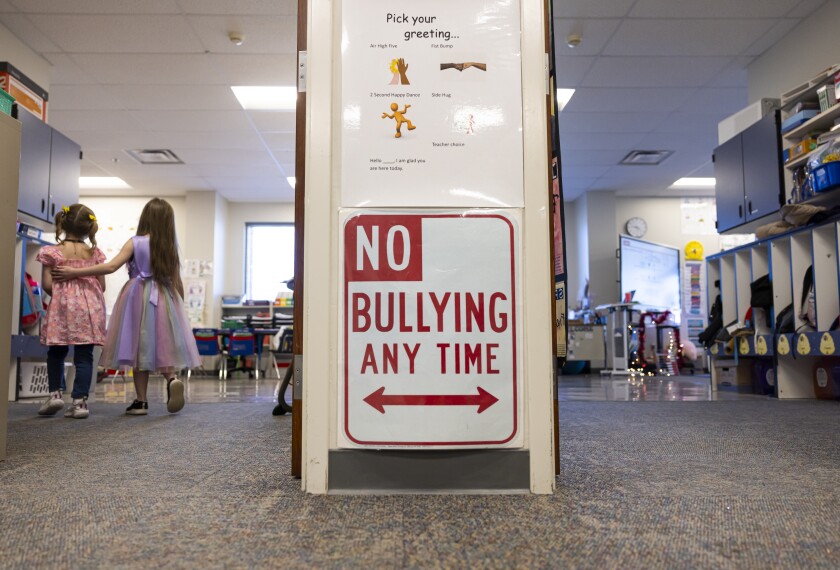
A sign discouraging bullying is seen as two students walk into a classroom at a school in Colorado Springs, Colo., on Feb. 12, 2026. Experts say creating a sense of belonging in school can help curb problems like bullying.
Kevin Mohatt for Education Week