Opinion
School & District Management Opinion

We Must Confront the Pandemic Within the Pandemic: Racism

A Virginia superintendent addresses systemic racism in his community and beyond
By Gregory C. Hutchings Jr. — July 14, 2021 3 min read
A large crowd stretching into the distance marches with banners and flags.
  • Save to favorites
  • Print

The COVID-19 pandemic has placed near-unparalleled obstacles before American educators. It also offers opportunities to rethink what we are doing. But the unspoken truth that needs to be expressed is that this latest pandemic developed within another 400-year-old pandemic of rampant racism and the inequities facing Black, Indigenous, and people of color—BIPOC—in the United States.

Like all superintendents, I find myself having to justify my decisions while focusing on efforts to keep our students’ and staff members’ best interests first. An added issue in my case is that I am African American and constantly working to overcome the overt and covert racism that BIPOC leaders deal with. Unfortunately, I even experience racism in my own community.

This dual pandemic has revealed racists across our country. Even during this global crisis, racism found a way to raise its ugly head. As the trial of Derek Chauvin for the murder of George Floyd reminded us, BIPOC Americans continue to face racism and unscrupulous practices when confronted by law enforcement officials. We need to tackle racism head on. For educators, this means having the courage to dismantle systemic racism in our schools.

About This Series

Over the coming weeks we will be rolling out 17 lessons from experienced district leaders who spent the last year leading from home. Learn more and see the full collection of lessons.

Despite the pandemic, the Alexandria, Va., city public schools that I lead continue to make racial equity a top priority. Last year, we adopted a five-year strategic plan that forges a path to becoming an anti-racist school system. We started by changing the name of one of our high schools—T.C. Williams High School—whose football team was the subject of the movie “Remember the Titans.” Why do that? Because the school was named after a racist former superintendent who vowed in the face of Brown v. Board of Education to keep our schools segregated. But we must go beyond name changes to tackle systemic racism throughout our nation’s public schools—in curriculum, funding, and opportunities for advanced classes.

Many BIPOC families across the country have been disproportionately hesitant to send their children back to school in person for fear that COVID-19 will take their lives. The data show that BIPOC people experienced longer waiting times in emergency rooms than white people and, in some instances, received substandard medical treatment even before the pandemic.

We must continue to encourage our BIPOC communities to get vaccinated and protect their families from the coronavirus. But it is also imperative that we understand why many in these communities may mistrust the medical establishment. Consider the cruel Tuskegee syphilis experiment conducted by the federal government from 1932 to as late as 1972. One of the most infamous biomedical studies in history, the “experiment” left African American men intentionally uninformed about their infection as scientists researched the effects of untreated syphilis—even after penicillin emerged as an effective treatment. Knowing this history may shed some light on why the BIPOC communities are hesitant to take scientists at their word about the value of vaccinations.

So, let’s speak this unspoken truth about racism: The COVID-19 pandemic arrived more than a year ago; our nation’s racial inequities have been around for more than 400 years. Both pandemics continue to shape our lives. We must strive for the day that people’s skin color does not determine their life experiences. We must strive for the day when our BIPOC communities feel heard, seen, and respected. We must strive for the day that all commit to being anti-racist and celebrate our diversity as a source of American pride and strength. When that day arrives, the need to march and protest that Black Lives Matter will evaporate.

We can’t wait another 400 years. There’s no better time than today to take the first step.

Complete Collection

Superintendents discuss ideas at a roundtable.
Vanessa Solis/Education Week and Getty Images

Coverage of leadership, summer learning, social and emotional learning, arts learning, and afterschool is supported in part by a grant from The Wallace Foundation, at www.wallacefoundation.org. Education Week retains sole editorial control over the content of this coverage.

Events

This content is provided by our sponsor. It is not written by and does not necessarily reflect the views of Education Week's editorial staff.
Sponsor
Artificial Intelligence Webinar
Managing AI in Schools: Practical Strategies for Districts
How should districts govern AI in schools? Learn practical strategies for policies, safety, transparency, as well as responsible adoption.
Content provided by Lightspeed Systems
This content is provided by our sponsor. It is not written by and does not necessarily reflect the views of Education Week's editorial staff.
Sponsor
Reading & Literacy Webinar
Unlocking Success for Struggling Adolescent Readers
The Science of Reading transformed K-3 literacy. Now it's time to extend that focus to students in grades 6 through 12.
Content provided by STARI
Jobs Virtual Career Fair for Teachers and K-12 Staff
Find teaching jobs and K-12 education jubs at the EdWeek Top School Jobs virtual career fair.

EdWeek Top School Jobs

Teacher Jobs
Search over ten thousand teaching jobs nationwide — elementary, middle, high school and more.
View Jobs
Principal Jobs
Find hundreds of jobs for principals, assistant principals, and other school leadership roles.
View Jobs
Administrator Jobs
Over a thousand district-level jobs: superintendents, directors, more.
View Jobs
Support Staff Jobs
Search thousands of jobs, from paraprofessionals to counselors and more.
View Jobs

Read Next

School & District Management What School Leaders Should Do When Parents Are Detained (DOWNLOADABLE)
School leaders are increasingly in need of guidance due to heightened immigration enforcement.
1 min read
Valley View Elementary School principal Jason Kuhlman delivers food donations to families from the school Tuesday, Feb. 3, 2026, in Columbia Heights, Minn.
Valley View Elementary School Principal Jason Kuhlman delivers food donations to school families on Feb. 3, 2026, in Columbia Heights, Minn. School leaders in the Twin Cities have been trying to assuage the fears of over immigration enforcement.
Liam James Doyle/AP
School & District Management Opinion Why Bad Bunny’s Half-Time Performance Was a Case Study for School Leadership
The megastar’s show was an invitation in a challenging moment. Did you catch it?
3 min read
Bad Bunny performs during halftime of the NFL Super Bowl 60 football game between the New England Patriots and the Seattle Seahawks, Sunday, Feb. 8, 2026, in Santa Clara, Calif.
Charlie Riedel/AP
School & District Management Texas Leader Named Superintendent of the Year
The 2026 superintendent of the year has led his district through rapid growth amid a local housing boom.
2 min read
Superintendent Roosevelt Nivens speaks after being announced as AASA National Superintendent of the Year in Nashville, Tenn. on Feb. 12, 2026.
Superintendent Roosevelt Nivens of the Lamar Consolidated schools in Texas speaks after being named National Superintendent of the Year in Nashville, Tenn. on Feb. 12, 2026, at the National Conference on Education sponsored by AASA, The School Superintendents Association.
Kaylee Domzalski/Education Week
School & District Management On Capitol Hill, Relieved Principals Press for Even More Federal Support
With the fiscal 2026 budget maintaining level K-12 funding, principals look to the future.
7 min read
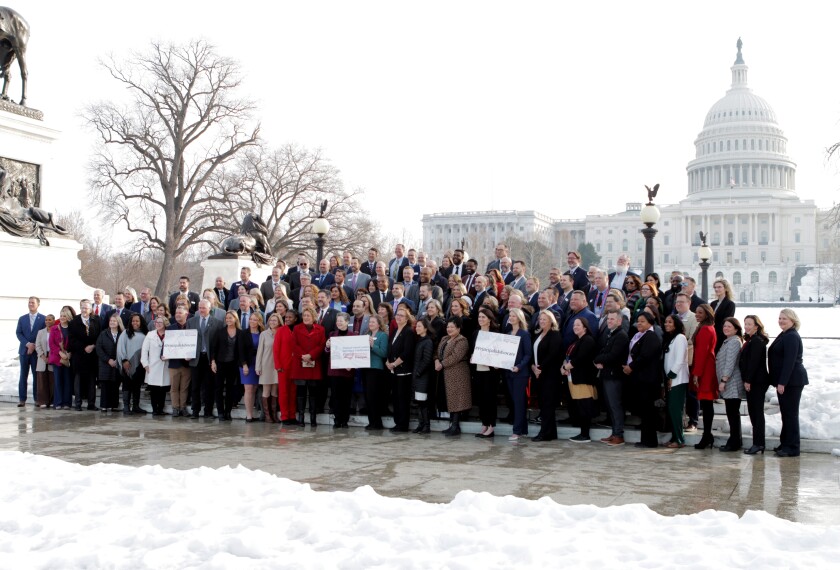
In this image provided by NAESP, elementary school principals gathered on Capitol Hill recently to meet with their state's congressional delegations in Washington
Elementary school principals gathered on Capitol Hill on Feb. 11, 2026,<ins data-user-label="Madeline Will" data-time="02/12/2026 11:53:27 AM" data-user-id="00000175-2522-d295-a175-a7366b840000" data-target-id=""> </ins>to meet with their state's congressional delegations in Washington. They advocated for lawmakers to protect federal K-12 investments.
John Simms/NAESP