Opinion Blog

Ask a Psychologist

Helping Students Thrive Now

Angela Duckworth and other behavioral-science experts offer advice to teachers based on scientific research. Read more from this blog.

Student Well-Being & Movement Opinion

Students With Food Allergies Are Lonelier: Here’s How to Help

By Ayelet Fishbach — January 26, 2022 2 min read
How do I help kids with food allergies not feel left out?
  • Save to favorites
  • Print

What can I do to help students with food allergies at class parties?

Kids with food restrictions feel left out when they can’t fully participate at a party. Here’s something I wrote recently about the topic for Character Lab as a Tip of the Week:

When my son was in preschool, he was diagnosed with gluten sensitivity. It’s a mild condition, his pediatrician assured us, one he’d most likely outgrow (and he eventually did). But for the time being, he needed to abstain from gluten.

Adjusting my son’s diet was relatively easy, since gluten-free bread and pasta are now ubiquitous. What I didn’t expect was the social toll. He was so frustrated when he couldn’t eat at school birthday parties that I was tempted to pull him out each time before the cake—and his inevitable tears—arrived.

Meals are inherently a social activity. Most of us would rather eat with others than alone and with good reason: Sharing similar foods forms a social connection. In our research, my colleagues and I found, a child who misses out on birthday cake or pizza at a school party is less deprived of a treat than of the social bond that sharing food engenders.

In one study, we asked elementary school teachers to rate each student on statements like “the child feels left out of things” and “the child is well-liked by other children.” We found that students with food restrictions were less integrated—in other words, they were lonelier. Kids who were new to the class or had a learning difficulty had an even harder time socially, but having a food allergy had a bigger impact on loneliness than being a non-native English speaker did.

And the effect extends beyond food allergies. In another study, we assigned students under the age of 21 to play games with others who could legally consume alcohol. When the underage students thought their peers drank wine instead of sparkling cider, they felt left out.

Don’t think of food allergies solely as a nutritional issue. The damage to social well-being is just as consequential.

Do recognize that breaking bread is often less about the food itself than the connection over a shared interest. To compensate, young people with food allergies can form bonds in other ways—say, by participating in team sports, playing an instrument as part of an ensemble, or using screen time to play team-based computer games. Food restrictions may be on the rise, but loneliness doesn’t have to be.
The opinions expressed in Ask a Psychologist: Helping Students Thrive Now are strictly those of the author(s) and do not reflect the opinions or endorsement of Editorial Projects in Education, or any of its publications.

Events

This content is provided by our sponsor. It is not written by and does not necessarily reflect the views of Education Week's editorial staff.
Sponsor
Artificial Intelligence Webinar
Managing AI in Schools: Practical Strategies for Districts
How should districts govern AI in schools? Learn practical strategies for policies, safety, transparency, and responsible adoption.
Content provided by Lightspeed Systems
This content is provided by our sponsor. It is not written by and does not necessarily reflect the views of Education Week's editorial staff.
Sponsor
Student Absenteeism Webinar
Removing Transportation and Attendance Barriers for Homeless Youth
Join us to see how districts around the country are supporting vulnerable students, including those covered under the McKinney–Vento Act.
Content provided by HopSkipDrive
This content is provided by our sponsor. It is not written by and does not necessarily reflect the views of Education Week's editorial staff.
Sponsor
Reading & Literacy Webinar
Two Jobs, One Classroom: Strengthening Decoding While Teaching Grade-Level Text
Discover practical, research-informed practices that drive real reading growth without sacrificing grade-level learning.
Content provided by EPS Learning

EdWeek Top School Jobs

Teacher Jobs
Search over ten thousand teaching jobs nationwide — elementary, middle, high school and more.
View Jobs
Principal Jobs
Find hundreds of jobs for principals, assistant principals, and other school leadership roles.
View Jobs
Administrator Jobs
Over a thousand district-level jobs: superintendents, directors, more.
View Jobs
Support Staff Jobs
Search thousands of jobs, from paraprofessionals to counselors and more.
View Jobs

Read Next

Student Well-Being & Movement 3 Driving Questions to Create a Sense of Belonging in Schools
Students who feel they belong in their school are more likely to show up and learn.
5 min read
MVCS 1981
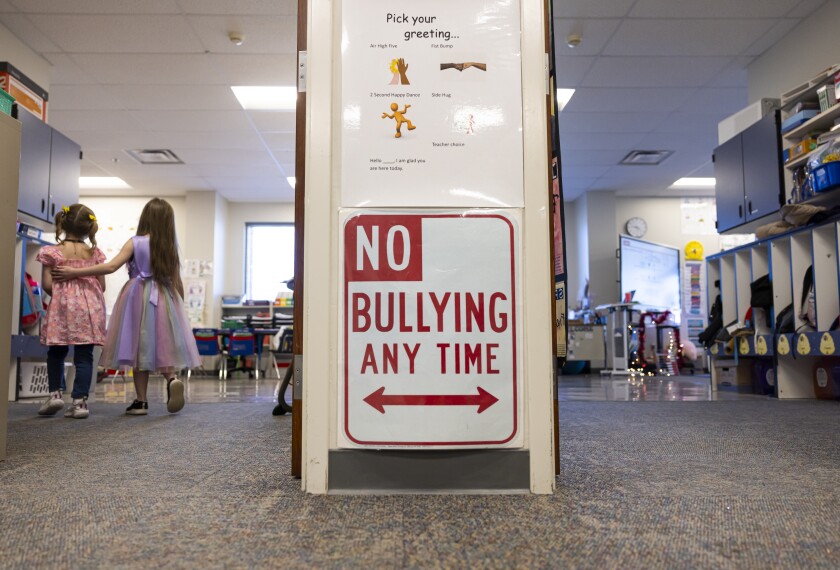
A sign discouraging bullying is seen as two students walk into a classroom at a school in Colorado Springs, Colo., on Feb. 12, 2026. Experts say creating a sense of belonging in school can help curb problems like bullying.
Kevin Mohatt for Education Week
Student Well-Being & Movement Opinion Why a Good School Needs Both Coaches and Referees
If teachers are forced into being referees, they can't fill that role properly or coach well, either.
6 min read
The United States Capitol building as a bookcase filled with red, white, and blue policy books in a Washington DC landscape.
Luca D'Urbino for Education Week
Student Well-Being & Movement Q&A Cellphones: The 'Most Formidable Adversary' Schools Have Ever Faced
The Spokane schools in Washington paired cellphone restrictions with expanded extracurricular activities.
5 min read
Students at Glover Middle School in Spokane, Wash. make bookmarks and snowflakes during Falcon Time on Dec. 3, 2025.
Students at Glover Middle School in Spokane, Wash. make bookmarks and snowflakes during Falcon Time on Dec. 3, 2025. The district has sought to encourage students to spend less time on devices.
Kaylee Domzalski/Education Week
Student Well-Being & Movement Want Kids to Have Better SEL Skills? Try Using Sports
In a panel discussion, district leaders and an expert discuss why sports is a great place to learn life skills.
3 min read
Students play basketball at Parkway Sports & Health Science Academy on Feb. 21, 2025 in La Mesa, Calif.
Students playing basketball at Parkway Sports & Health Science Academy on Feb. 21, 2025, in La Mesa, Calif. Some schools are using sports as a way to help students develop social-emotional skills.
Ariana Drehsler for Education Week
