Let’s face it. We all value our time. And whether it’s personal or professional time, as educators we want to make the most of it. So do our students.
But despite our best intentions (and most elaborate to-do lists) sometimes we find ourselves overwhelmed by busyness--whether natural or artificial--and that can mean more left to do than done.
In each year teaching high school science, I saw countless students and educators fall victim to this same pattern and learn the same hard lesson: the smallest action is better than the biggest intention. Every September, there was an air of hope as I distributed school-purchased planners to my students. Just think of the potential; the possibilities; the unfettered opportunity to be organized and get things done!
We’ve all been there at one time or another, but as the school year went on, I found that the enthusiasm with which we entered the year for being organized and productive gradually faded.
Early on, we used the planners with fidelity, but the practice quickly dropped off. Before we knew it, the wheels had come off the wagon--planners disappeared, missing assignments ensued, and hopes for productivity sharply decreased.

I wish I could say this was only a teenager issue, but it was not.
Actually, my personal motivation to get things written down in the planner fell off the chart at a seemingly-critical point every February -- leaving all of us in a mid-year slump. This horrible cycle dependably repeats itself annually in classrooms everywhere for adults and kids.
If we are not careful to take action against the natural law of diminishing drive throughout the school year, our productivity will not be the only thing that falls off.
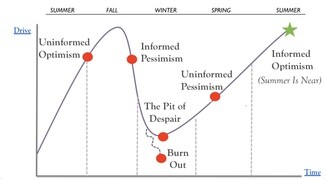
This graphic adapted from Julio Peironcely at NextScientist.com sums up the issue of productivity and motivation throughout the school year. Coming off the high points of summer, students and educators alike are anticipating only great things and success in the upcoming year. Reality sets in during the fall as we realize that the summer vibes won’t last and we remember the struggle is real. We don’t exactly know why it feels like it does, but we know it feels discouraging as winter arrives. The lows become lower and days become drearier until we nearly burn out before the spring thaw. That’s when we finally recall that inconsistencies in effort are normal and to be expected. Phew! It’s not us. Still pessimistic, at least we know that there is hope as summer comes back into view. The warmer spring days seem to encourage everyone to have a little more pep in their step and get things done as the year ends.
But there’s good news: this awful roller coaster does not have to go like this!
When I started studying skill-based approaches to productivity, I realized that the real issue had to do with executive function skills and our brain’s ability to coordinate the thoughts, feelings, and actions needed to accomplish complex tasks. It isn’t just about motivation.
And that’s true for adults, but even more noticeable for children. Allow me to explain.
Whether it is assignment completion, classroom behavior, or giving students timely and useful feedback on their learning, issues of productivity in school come down to a set of skills for thinking, focusing, and taking action. Children are not born with these skills, they’re developed. But when we see the results of a lack of these skills in schoolkids, it often gets the student labeled as lazy or unmotivated.
While a lack of willpower is often cited as the reason that things like this happen, I found that it was actually a lack of skillpower, because much of will is skill.
Being productive yields getting motivated, and that requires creating small wins, which are achieved when we take action first. It is not that we need to wait until we have the motivation to act; instead, we need to act in order to get motivated.
According to Ross Greene, PhD, it turns out that for kids and adults alike, we do well at things when we can. That means we need to be intentional about developing the skills needed to be more productive in our students and ourselves.
Simply determining what needs to be done will not enhance productivity. That is why agendas and planners (alone) are not the solution. We must go beyond the to-do list for ourselves as educators and with our students in order to develop skills and build systems and habits for success.
So how can we move from a culture of “to-do” to “done” and better use our time for maximum return? Furthermore, how can we help our students to do the same?
The key insight that follows might just surprise you, because it is likely something that you (and your students) probably never learned in school. It is an altogether unique formula and straightforward recipe for productivity. It seems to be common sense, yet it is at the same time so wonderfully complicated that it is not common practice.
To Do + When = Done
Moving from “to-do” to “done” requires knowing not just what you want to do, but when you will do it. So stop making to-do lists and stop having your students merely use an agenda. Instead, put things on your calendar to get more done. Since what gets scheduled gets done, this small adjustment to your productivity workflow will make you more likely to accomplish what you set out to do.
Here’s why. When we make to-do lists, that is, when we decide what we are going to do, we get comfortable that we have a plan. We don’t know when we will get it done, just that we will (or, at least, that we hope to.) But the smallest action is more valuable than the greatest intention, so leaving it at the to-do list leaves us in a suspended state without a cue to get things done. By putting your to-do list on your calendar, you plan when you will do what. That means when the time to do something approaches, it triggers you to do the thing you planned to do. Without the trigger, it is easy to forget or ignore. This same strategy is the antidote to the ineffective approach for grabbing lunch with a friend, fondly known as, “we should get together sometime.”
By incorporating this equation as a principle for managing time into your professional practice, and by sharing it with your students as well, you’ll find yourself working smarter, not harder in no time at all!
If you are ready to take the next steps to move from to-do to done, then check out the following resources to use with colleagues or students so you can do things differently, and not just do the same things better.
Resources:
How to Write a Book Without Losing Your Mind
//www.theatlantic.com/science/archive/2018/08/how-to-write-a-book-without-losing-your-mind/566462/
The Science of Perfect Timing
//www.youtube.com/watch?v=Yn1gjO9yw6I
Don’t Set Goals, Make New Habits Instead
//timkastelle.org/blog/2013/12/dont-set-goals-make-new-habits-instead/
Losers have goals and winners have systems
Why you should focus on habits and systems, not goals
//drive.google.com/file/d/0B5r9nzOJUdgtNlFxdU1RYjVwTGc/view?usp=sharing
Gary G. Abud, Jr. is an educational consultant, speaker, and writer near Detroit. His work currently focuses on helping kids with ADHD to succeed in school by offering coaching and workshops to educators, students, and families. Previously, Gary has served students in K-12 schools as a STEM teacher, curriculum specialist, and principal. In 2014, he was selected as the Michigan Teacher of the Year.
Photo courtesy of KynaB and Creative Commons.


