Opinion Blog

Ask a Psychologist

Helping Students Thrive Now

Angela Duckworth and other behavioral-science experts offer advice to teachers based on scientific research. Read more from this blog.

Student Well-Being & Movement Opinion

How to Increase Curiosity—and Happiness to Boot

By Angela Duckworth — May 26, 2021 2 min read
Does curiosity make me happier?
  • Save to favorites
  • Print

Why is curiosity useful?
Curiosity helps you process information deeply and remember what you learn. It’s also correlated with happiness. Here’s something I wrote about the topic recently for Character Lab as a Tip of the Week:
“Cows don’t get cavities.”
“Really?”
“Nope. They don’t. Surprising, right? They eat all day long. And obviously, they’re not brushing their teeth.”
Mark was getting excited now.
And so was I. It wasn’t that I had strong preexisting convictions about cows and cavities. But nonetheless, I leaned forward, eyes wide, eager to know more.
“Neither do horses,” Mark continued. “Unless you feed them sugar cubes, of course.”
Mark Wolff is the dean of Penn Dental Medicine. He has known for a long time that refined sugar is a massively important cause of cavities—much more important than I’d realized.
At dinner with my family that evening, I couldn’t wait to share my new fun fact. And after dinner (decaffeinated coffee, no sugar), I found myself on an hourslong “wild Google chase,” learning about how sugar feeds the bacteria that naturally live in our mouths, which leads the bacteria to multiply. They digest the sugar, producing acid as a waste product—and the acid erodes the enamel on our teeth.
What good is curiosity—the emotion that dilates our pupils and propels us to ask questions and pay special attention to the information we hunt down?
Recent research suggests that consistent curiosity goes hand in hand with happiness. For 21 days, participants kept a daily diary in which they responded to several different measures of well-being and, in addition, two curiosity questions:
Today, I viewed challenging situations as an opportunity to grow and learn.
Everywhere I went today, I was out looking for new things or experiences.
On a scale from 0 (not at all) to 10 (very), the average rating for these curiosity questions was about 3—quite a bit lower than I would have expected—but there was a lot of variability, both across days and between people.
It turns out that consistently high ratings on these curiosity questions were correlated with higher ratings of life satisfaction, flourishing relationships, feelings of competence, and physical exercise.
Of course, with a diary study like this one, it’s impossible to tell whether curiosity causes happiness or, in fact, happiness causes curiosity—or if some third variable encourages both curiosity and happiness. I suspect that, as with so much of life, all three possibilities have at least some truth.
For me, a day when I ask a lot of questions is a very good day. And the two questions in the diary study are a wonderful reminder of how I want to live my life.
Try kicking off tonight’s dinner conversation with this question: “Did you learn anything new today?” Be ready to go first with something you learned. And make sure everyone takes a turn. As Albert Einstein once observed: “The important thing is not to stop questioning.”

The opinions expressed in Ask a Psychologist: Helping Students Thrive Now are strictly those of the author(s) and do not reflect the opinions or endorsement of Editorial Projects in Education, or any of its publications.
Events

This content is provided by our sponsor. It is not written by and does not necessarily reflect the views of Education Week's editorial staff.
Sponsor
Artificial Intelligence Webinar
Managing AI in Schools: Practical Strategies for Districts
How should districts govern AI in schools? Learn practical strategies for policies, safety, transparency, and responsible adoption.
Content provided by Lightspeed Systems
This content is provided by our sponsor. It is not written by and does not necessarily reflect the views of Education Week's editorial staff.
Sponsor
Student Absenteeism Webinar
Removing Transportation and Attendance Barriers for Homeless Youth
Join us to see how districts around the country are supporting vulnerable students, including those covered under the McKinney–Vento Act.
Content provided by HopSkipDrive
This content is provided by our sponsor. It is not written by and does not necessarily reflect the views of Education Week's editorial staff.
Sponsor
Reading & Literacy Webinar
Two Jobs, One Classroom: Strengthening Decoding While Teaching Grade-Level Text
Discover practical, research-informed practices that drive real reading growth without sacrificing grade-level learning.
Content provided by EPS Learning

EdWeek Top School Jobs

Teacher Jobs
Search over ten thousand teaching jobs nationwide — elementary, middle, high school and more.
View Jobs
Principal Jobs
Find hundreds of jobs for principals, assistant principals, and other school leadership roles.
View Jobs
Administrator Jobs
Over a thousand district-level jobs: superintendents, directors, more.
View Jobs
Support Staff Jobs
Search thousands of jobs, from paraprofessionals to counselors and more.
View Jobs

Read Next

Student Well-Being & Movement 3 Driving Questions to Create a Sense of Belonging in Schools
Students who feel they belong in their school are more likely to show up and learn.
5 min read
MVCS 1981
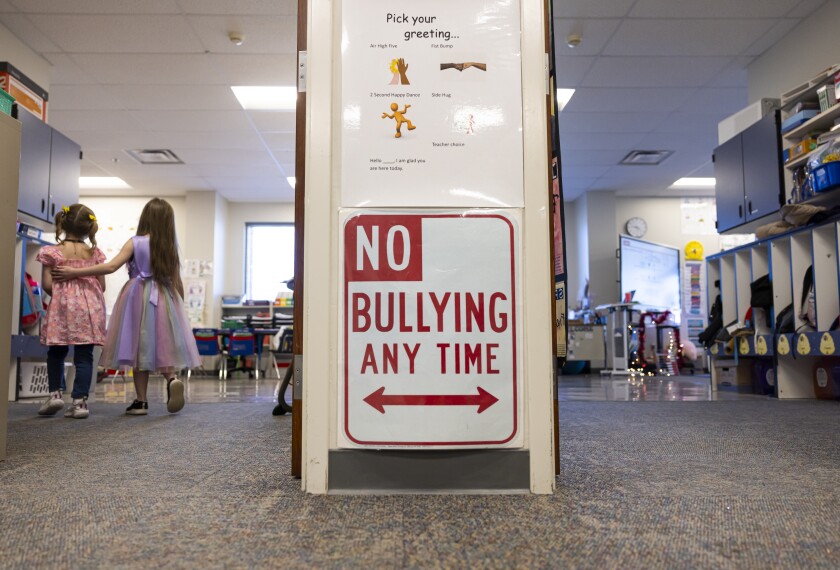
A sign discouraging bullying is seen as two students walk into a classroom at a school in Colorado Springs, Colo., on Feb. 12, 2026. Experts say creating a sense of belonging in school can help curb problems like bullying.
Kevin Mohatt for Education Week
Student Well-Being & Movement Opinion Why a Good School Needs Both Coaches and Referees
If teachers are forced into being referees, they can't fill that role properly or coach well, either.
6 min read
The United States Capitol building as a bookcase filled with red, white, and blue policy books in a Washington DC landscape.
Luca D'Urbino for Education Week
Student Well-Being & Movement Q&A Cellphones: The 'Most Formidable Adversary' Schools Have Ever Faced
The Spokane schools in Washington paired cellphone restrictions with expanded extracurricular activities.
5 min read
Students at Glover Middle School in Spokane, Wash. make bookmarks and snowflakes during Falcon Time on Dec. 3, 2025.
Students at Glover Middle School in Spokane, Wash. make bookmarks and snowflakes during Falcon Time on Dec. 3, 2025. The district has sought to encourage students to spend less time on devices.
Kaylee Domzalski/Education Week
Student Well-Being & Movement Want Kids to Have Better SEL Skills? Try Using Sports
In a panel discussion, district leaders and an expert discuss why sports is a great place to learn life skills.
3 min read
Students play basketball at Parkway Sports & Health Science Academy on Feb. 21, 2025 in La Mesa, Calif.
Students playing basketball at Parkway Sports & Health Science Academy on Feb. 21, 2025, in La Mesa, Calif. Some schools are using sports as a way to help students develop social-emotional skills.
Ariana Drehsler for Education Week
