Opinion Blog

Ask a Psychologist

Helping Students Thrive Now

Angela Duckworth and other behavioral-science experts offer advice to teachers based on scientific research. Read more from this blog.

Student Well-Being & Movement Opinion

A Writing Exercise That Helps Students Build Resilience

By Brady K. Jones — June 09, 2021 2 min read
How do I help students build resilience?
  • Save to favorites
  • Print

This is the second in a two-part series on learning from success and failure. Read the first piece here.
What can I do to help my students gain confidence in their abilities?
The struggle is real. And research shows that reflecting on the times you succeed also gets you to recognize the struggle that goes with it. Here’s something I wrote about the topic recently for Character Lab as a Tip of the Week:
I majored in Spanish in college, and after graduation, I wasn’t sure what to do with my degree. One gray winter day toward the end of my senior year, I found myself in Chicago applying for an interpreter position at a law firm.
The fast-talking attorney who interviewed me gave me an impromptu test: I had to translate a colleague’s words from Spanish to English on the spot, as if she were testifying in court. Flustered, I struggled to keep up. After only a minute or so, the attorney waved her colleague out of the room, then turned to me and said, “I have to be honest. That translation was not sufficient.”
Ouch. It still hurts to tell that story! And when I remember that day, I don’t feel motivated to do the hard work of learning a second language. I feel like running in the other direction.
What is motivating, then? What does make me want to continue to do this hard thing? My best memories of learning a second language involve struggle, yes, but also success. The first time I ordered in Spanish at a restaurant, hands shaking—and was rewarded with the waiter’s warm smile of understanding. The satisfaction I felt when, after years of study, I finally “got” the subjunctive tense.
New research suggests that for a lot of kids, thinking about success helps them achieve more. In a recent experiment, we asked one group of 9th grade students to write about a failure and how they learned or grew from it. Another group of students wrote about a success and how they made it happen. The students who wrote about success had better academic outcomes over the school year.
Why might this be the case? Aren’t we supposed to learn from failure? To answer this question, we looked carefully at what students in both groups actually wrote. It turns out, the success group included themes of struggle and resilience just as often as the failure group did, even though we didn’t ask them to. When they wrote about an achievement, they seemed to automatically think about all they had to overcome first. In fact, their writing activity may have given them a double benefit: a feeling of competence paired with a reminder of their resilience.
Don’t dwell exclusively on failures when helping a child build resilience.
Do ask the young people in your life to tell you about a time they really nailed it. It will give them an opportunity to relive a win as well as reflect on the obstacles they faced along the way. And struggle + success is a powerful combination.

The opinions expressed in Ask a Psychologist: Helping Students Thrive Now are strictly those of the author(s) and do not reflect the opinions or endorsement of Editorial Projects in Education, or any of its publications.
Events

This content is provided by our sponsor. It is not written by and does not necessarily reflect the views of Education Week's editorial staff.
Sponsor
Artificial Intelligence Webinar
Managing AI in Schools: Practical Strategies for Districts
How should districts govern AI in schools? Learn practical strategies for policies, safety, transparency, as well as responsible adoption.
Content provided by Lightspeed Systems
This content is provided by our sponsor. It is not written by and does not necessarily reflect the views of Education Week's editorial staff.
Sponsor
Reading & Literacy Webinar
Unlocking Success for Struggling Adolescent Readers
The Science of Reading transformed K-3 literacy. Now it's time to extend that focus to students in grades 6 through 12.
Content provided by STARI
Jobs Virtual Career Fair for Teachers and K-12 Staff
Find teaching jobs and K-12 education jubs at the EdWeek Top School Jobs virtual career fair.

EdWeek Top School Jobs

Teacher Jobs
Search over ten thousand teaching jobs nationwide — elementary, middle, high school and more.
View Jobs
Principal Jobs
Find hundreds of jobs for principals, assistant principals, and other school leadership roles.
View Jobs
Administrator Jobs
Over a thousand district-level jobs: superintendents, directors, more.
View Jobs
Support Staff Jobs
Search thousands of jobs, from paraprofessionals to counselors and more.
View Jobs

Read Next

Student Well-Being & Movement 3 Driving Questions to Create a Sense of Belonging in Schools
Students who feel they belong in their school are more likely to show up and learn.
5 min read
MVCS 1981
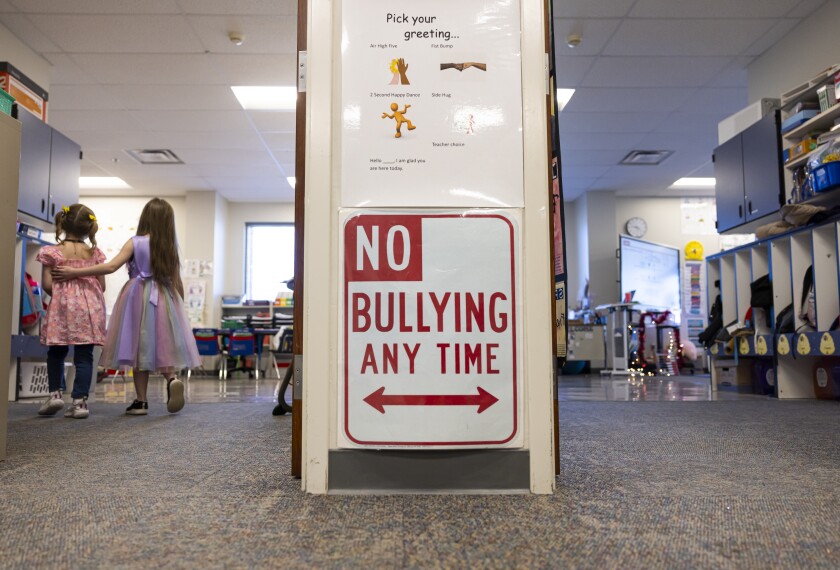
A sign discouraging bullying is seen as two students walk into a classroom at a school in Colorado Springs, Colo., on Feb. 12, 2026. Experts say creating a sense of belonging in school can help curb problems like bullying.
Kevin Mohatt for Education Week
Student Well-Being & Movement Opinion Why a Good School Needs Both Coaches and Referees
If teachers are forced into being referees, they can't fill that role properly or coach well, either.
6 min read
The United States Capitol building as a bookcase filled with red, white, and blue policy books in a Washington DC landscape.
Luca D'Urbino for Education Week
Student Well-Being & Movement Q&A Cellphones: The 'Most Formidable Adversary' Schools Have Ever Faced
The Spokane schools in Washington paired cellphone restrictions with expanded extracurricular activities.
5 min read
Students at Glover Middle School in Spokane, Wash. make bookmarks and snowflakes during Falcon Time on Dec. 3, 2025.
Students at Glover Middle School in Spokane, Wash. make bookmarks and snowflakes during Falcon Time on Dec. 3, 2025. The district has sought to encourage students to spend less time on devices.
Kaylee Domzalski/Education Week
Student Well-Being & Movement Want Kids to Have Better SEL Skills? Try Using Sports
In a panel discussion, district leaders and an expert discuss why sports is a great place to learn life skills.
3 min read
Students play basketball at Parkway Sports & Health Science Academy on Feb. 21, 2025 in La Mesa, Calif.
Students playing basketball at Parkway Sports & Health Science Academy on Feb. 21, 2025, in La Mesa, Calif. Some schools are using sports as a way to help students develop social-emotional skills.
Ariana Drehsler for Education Week
