
When Rosa A. Smith took the helm of a small Massachusetts foundation a few years ago, she commissioned a study to help the philanthropy better target its work to close the scholastic gaps between boys and girls.
” Public Education and Black Male Students: A State Report Card” is available online from The Schott Foundation for Public Education. ()
The message that emerged from the data was not the one she expected. But it was so compelling that it altered the path of the Cambridge-based Schott Foundation for Public Education. It has replaced its gender-gap work with a new focus on how schools can better meet the needs of African-American boys and young men.
The foundation’s work in two other areas, fiscal equity and early-childhood education, continues. But the data showing that most educational gender gaps are closing—while black boys and adolescents still struggle on many scholastic indicators, from graduation rates to test scores—were too striking to suggest that the Schott Foundation should continue to conduct business as usual, Ms. Smith said.
Read the accompanying story,
“This is a group that not a lot of people were talking about,” Ms. Smith, a former superintendent of the Columbus, Ohio, school district, said in an interview. “But it’s a moral issue we have to examine. The accumulated consequences of school failure are greatest for this group of students. It is so life-determining. And if we do this work well, everybody in a community wins.”
Drawing Notice
Built from the earnings of a high-technology media publishing firm, the Schott Foundation is small—it awards $2 million in grants annually on a $4 million budget. But Ms. Smith, the foundation’s president, hopes it can help open new pathways for young black men.
In late October, the philanthropy issued a study showing that on average, nationally, only 40 percent of black males graduate with their high school classes, compared with 70 percent of white male students. The report also detailed how black males are disproportionately represented among school discipline cases and in special education referrals. (“Renewed IDEA Targets Minority Overrepresentation,” this issue.) The problems were particularly bad in some big cities with large African-American enrollments.
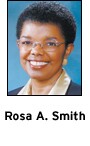
In the past two years, Ms. Smith has strategically placed her writings on the topic in publications that reach policymakers. She also has organized several gatherings of scholars, activists, and civic leaders to brainstorm about effective strategies to address the situation.
“Rosa has really thought outside the box on this issue,” said one attendee at such a meeting, Linda C. Wing, the deputy director of the University of Chicago’s Center for Urban School Improvement. “She has stimulated people’s thinking and brought to the surface knowledge and ideas they might not have had.”
Pedro A. Noguera, a New York University professor who has written about societal forces that affect urban education, views the Schott Foundation’s work as a welcome part of a newly emerging dialogue on the problem. Solving it, he said, will require more research, and reflection on areas that make many people uncomfortable, such as racial and gender differences in parenting practices and teaching styles.
It also might mean rethinking how schools are organized, said Gregory Hodge, a school board member in Oakland, Calif. He believes that smaller, more personalized schools—many of which are popping up in that San Francisco Bay-area city—could benefit African-American boys by encouraging strong relationships and mentoring.
Part of building success for black boys, Mr. Hodge said, will involve changing negative images popularized by the entertainment industry and the news media, which often depict them as criminal or anti-intellectual.
“It’s about rehumanizing African-American males,” he said. “If people don’t value these young men, they don’t have the advocates that they need, working with and for them.”
Teacher Misperceptions
Teacher preparation must also be re-examined if schools are to become vehicles for success for young black men, said La Vonne I. Neal, an associate professor of education at Southwestern University in Georgetown, Texas. The issue becomes even more pressing as demographic shifts bring ever more student diversity into American schools, she said.
“How do we prepare all our teachers to be culturally responsive?” she said. “If you don’t understand students’ diverse social and cultural behaviors, then you won’t know that what you’re seeing as problematic is not a deficit, it’s just different.”
Students often suffer from teachers’ misperceptions, and black males suffer disproportionately, she said. In a study of public middle schools in Texas, Ms. Neal and her colleagues found that adolescent males who adopted a walk she calls “the stroll,” common among black males, were more often perceived by their teachers to be more aggressive and less intelligent than other students, and were more often referred for special education evaluation.
Rossi Ray-Taylor, the executive director of the Minority Student Achievement Network, an Evanston, Ill.-based association of suburban districts that are examining ways to eliminate racial and ethnic achievement gaps, said she hopes the Schott Foundation’s work will help keep the national conversation about school improvement framed correctly.
Too often, she said, such discussions take on a tenor that blames students for performing poorly, rather than looking squarely at the failings of the systems in which they function.
“How are kids experiencing school?” Ms. Ray-Taylor said. “What are the pressures on African-American males that could be pulling them off track? Are we expecting different things from them? Are they expecting that from themselves? Where are we broken, as a school system? That’s where we’ve got to keep the question.”


