Student Well-Being & Movement

Digging In

April 20, 2007 1 min read
  • Save to favorites
  • Print

Dozens of nonprofits, growers’ associations, botanical gardens, and other groups offer assistance to teachers interested in starting school gardens. Here are just a few:

The Chicago Botanic Garden gives hands-on help to schools in the Chicago area. Educators elsewhere can use the School Garden Wizard, an online resource with tips for everything from convincing principals to using gardens as teaching tools.
www.schoolgardenwizard.org
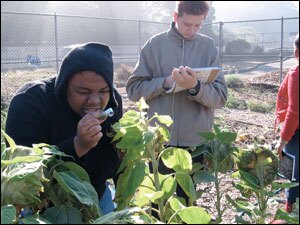
High school kids from June Jordan School for Equity watch ladybugs eat aphids.

The National Gardening Association has a Web page with information for young gardeners and teachers, including projects and success stories. Teachers can subscribe to an e-newsletter, apply for grants, and sign up for conferences.
www.kidsgardening.org

The Edible Schoolyard, a garden and kitchen classroom in Berkeley, California, offers a more philosophical perspective. (“The garden and kitchen provide a context for understanding seasonality and life cycles.”) The 10-year-old program started with the help of acclaimed chef Alice Waters.
www.edibleschoolyard.org

See Also

Return to the main story,

Growing Vegetable Lovers

The Western Growers Association provides step-by-step advice for getting started, such as forming a garden committee, testing soil, and ensuring the garden will get five to eight hours of sun each day.
www.wga.com

Related Tags:

A version of this article appeared in the May 01, 2007 edition of Teacher Magazine as Digging In

Events

This content is provided by our sponsor. It is not written by and does not necessarily reflect the views of Education Week's editorial staff.
Sponsor
Artificial Intelligence Webinar
Managing AI in Schools: Practical Strategies for Districts
How should districts govern AI in schools? Learn practical strategies for policies, safety, transparency, as well as responsible adoption.
Content provided by Lightspeed Systems
This content is provided by our sponsor. It is not written by and does not necessarily reflect the views of Education Week's editorial staff.
Sponsor
Reading & Literacy Webinar
Unlocking Success for Struggling Adolescent Readers
The Science of Reading transformed K-3 literacy. Now it's time to extend that focus to students in grades 6 through 12.
Content provided by STARI
Jobs Virtual Career Fair for Teachers and K-12 Staff
Find teaching jobs and K-12 education jubs at the EdWeek Top School Jobs virtual career fair.

EdWeek Top School Jobs

Teacher Jobs
Search over ten thousand teaching jobs nationwide — elementary, middle, high school and more.
View Jobs
Principal Jobs
Find hundreds of jobs for principals, assistant principals, and other school leadership roles.
View Jobs
Administrator Jobs
Over a thousand district-level jobs: superintendents, directors, more.
View Jobs
Support Staff Jobs
Search thousands of jobs, from paraprofessionals to counselors and more.
View Jobs

Read Next

Student Well-Being & Movement Teachers Keep the Lessons of 'Mister Rogers' Neighborhood' Alive in the Classroom
Teachers say Fred Rogers' work has informed how they weave together academic and SEL lessons.
4 min read
This June 8, 1993 file photo shows Fred Rogers during a rehearsal for a segment of his television program Mr. Rogers' Neighborhood in Pittsburgh.
Fred Rogers rehearses a segment of his television program "Mister Rogers' Neighborhood" in Pittsburgh in this June 8, 1993 file photo.
Gene J. Puskar/AP
Student Well-Being & Movement Do Book Bans Protect Students, or Silence Needed Conversations?
When schools ban books that contain sensitive topics, is it the right move?
5 min read
Surreal open book ready to be read in a wild meadow
iStock/Getty
Student Well-Being & Movement Teens Are Sleeping Less. Why Schools Should Be Worried
Lack of sleep is directly tied to lower academic performance.
4 min read
A Mansfield Senior High School student rests during his health class on sleep, in Mansfield, Ohio, Dec. 6, 2024.
A high school student rests during a health class about sleep habits in Mansfield, Ohio, on Dec. 6, 2024. Researchers found that the number of teens getting insufficient sleep, defined as seven hours or less a night, rose from 69% in 2007 to 78% in 2023.
Phil Long/AP
Student Well-Being & Movement Download Catching Bad Days Before They Become Behavior Problems
What are the subtle signs that tell you students are maybe struggling? Here's a useful guide.
1 min read
032026 behavior tutor Banerji GT
Gina Tomko/Education Week + Canva
