
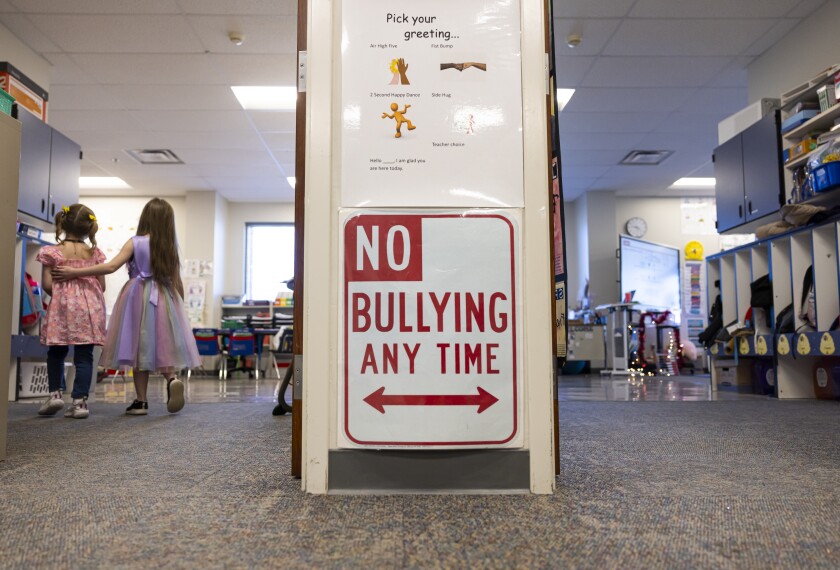
Students who feel they belong in their school are more likely to show up and learn. That’s especially important today as many schools are struggling with high levels of student absenteeism.
But creating a school culture where every student feels valued as an individual, has a relationship with a trusted adult, and strong connections with peers can feel elusive.
So, how can educators promote belonging and remove barriers to achieving it? And what does belonging look like in a school context?
These were topics of discussion during a session at the Collaborative for Academic, Social, and Emotional Learning, or CASEL, annual virtual conference Feb. 18-19.
Following are what a panel of experts highlighted as three driving questions schools need to ask:
1. What does ‘belonging’ look like?
Although difficult to describe, Rose Prejean-Harris, the assistant superintendent of 6-12 curriculum and instruction for the DeKalb County schools in Georgia, said there’s a specific feeling when she steps into a school where students have that all-important sense of belonging.
“You want to walk into a space where you don’t need an invitation, where you’re just naturally part of the ecosystem,” she said.
But what does that mean in practical terms?
First, schools where students feel like they belong have low levels of student and teacher absenteeism, said Prejean-Harris.
Belonging is critical for our brains and for us to feel like we can stretch ourselves and engage in learning.
There are other ways to measure how connected students feel to their school, said Hedy Chang, the founder and executive director of Attendance Works, a nonprofit organization. Are students—or even teachers and parents—able to name a school staff member who cares about them? Do students have supportive peer groups? Are students engaged in relevant or meaningful work or projects? And do students feel seen, heard, and welcomed?
All of that, said Chang, is fairly straightforward to measure with student and parent surveys, which will yield valuable data for school leaders who want to sketch a picture of what belonging looks like in their schools.
“If you have those things in place, I believe you’ve created belonging and you’ll feel belonging,” she said.
2. How can educators promote belonging?
The bulk of this work comes down to daily interactions, said Chang: For example, do teachers greet individual students by name when they walk into the classroom?
Schools can also take bigger steps to promote belonging. Chang cited an example of a middle school principal who arranged students into cohorts with four shared teachers. Their classrooms were next to each other, and they were given joint planning time.
That created a much more suitable environment for relationship-building between students and their peers, students and teachers, and teachers and their colleagues, Chang said.
“We sometimes expect that creating belonging, connection, relationship-building, somehow is going to miraculously happen in teachers’ free time,” she said. “That’s not going to work. We’ve got to build it into the way schools are structured and how we organize our interactions, so this happens daily with our kids and our families.”

Many educators also leverage social-emotional-learning strategies to teach the skills that foster belonging in schools, according to a January EdWeek Research Center survey. Sixty-three percent of teachers, principals, and district leaders said in the survey that they (or their teachers) use SEL approaches to address challenges with students’ friendships and peer connections. Fifty-eight percent use SEL to tackle issues with student engagement, and 55% said the same of bullying. About 1 in 3 educators use SEL to help address student absenteeism.
But the issue of belonging isn’t limited to kids. Creating a school where students feel like they belong starts at the top with building and even district leaders, said Prejean-Harris. Principals need to be able to feel like they are included and are supported, too, she said.
“Creating that sense of belonging, a community, once you can do that with the leaders, that trickles down,” Prejean-Harris said.
Teacher belonging is also an essential piece, said Joy Cantey, a senior director for program design for the New Teacher Center, a teacher support nonprofit. New teachers, in particular, can end up feeling isolated, she said, and they need opportunities to make connections and build community with colleagues early in their careers.
Whether through mentoring or instructional coaching, schools must attend to teachers’ well-being, Cantey said, “so that they know they belong in the space and it’s a place that they want to show up every day.”
3. What are common barriers to belonging?
Finally, educators can help foster a sense of belonging by focusing on students’ strengths and what they can do, said Cantey.
“How do we in our school community lean into assets?” she said, when discussing students. “Any time we’re talking about data, it could be academic, it could be attendance, how do we shift mindsets to be more asset-based?”
School leaders also must be aware of practices or policies that might undermine students’ sense of belonging, said Chang. Schools need to do more than build environments that support student belonging, they must assess barriers they may have created unintentionally.
It’s an issue she sees all the time with student attendance. For example, she cited the tone of the automatic notice that is sent to families when their children miss school without an excuse. Notices that threaten families with court action, say, don’t help build a sense of belonging—if anything, those kinds of messages push families away.
“What we know is that chronic absence is actually associated with higher levels of adverse childhood experiences,” Chang said. “When kids and families have faced trauma, the worst thing you can do is say, ‘What’s wrong with you?’ What you need to say is, ‘Hey, what happened? How can I help?’”
Blaming students or their parents for poor attendance or poor school culture overall can also get in the way of building a sense of belonging for students, said Sheldon Berman, the interim president and CEO of CASEL, who moderated the panel.
Rather, he said, educators should ask: “What is it in our school that is actually [creating] a barrier to that student’s attendance or engagement or sense of belonging?” he said. “Many people look at SEL as fixing the kid rather than fixing the environment.”


