When does technology become too prevalent in education? It is a widely held belief among school administrators that technological innovation enhances education by providing students with personalized attention and technological literacy. Consequently, schools have eagerly increased the presence of the Internet and devices that utilize it. As a current high school junior, I see signs of this push everywhere.
The Internet has become ubiquitous in classrooms across the nation; almost 100 percent of public schools had access in 2005, up from a mere 35 percent in 1994. Ninety-eight percent of “computers for instructional purposes” in elementary and secondary public schools were connected to the Web in 2008, according to the National Center for Education Statistics.
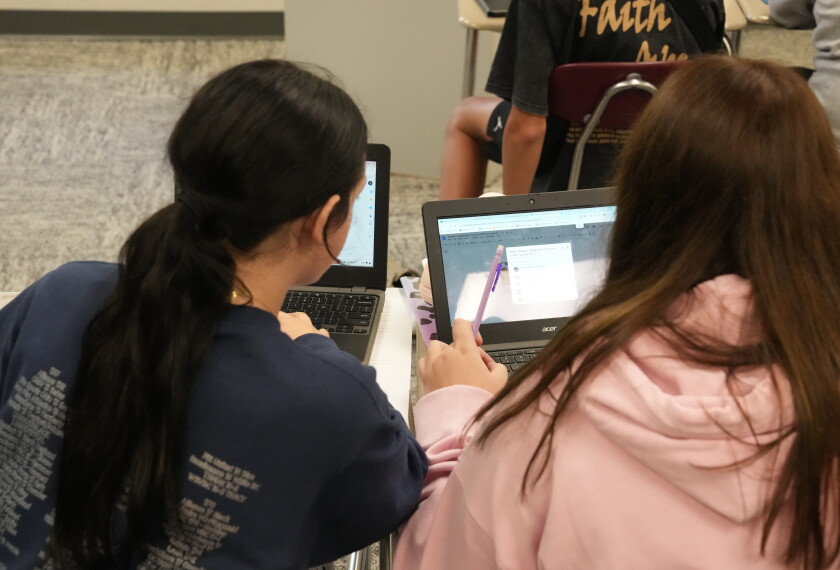
In the past, a common technological tool in schools has been the shared desktop computer. More recently, however, “1-to-1" initiatives—one device to one student—have become prominent. In these programs, each student is given a device to use for educational purposes. For example, Central Middle School in Hartford, Wis., began a 1-to-1 program in 2011 that lent a laptop computer to each of its incoming 6th graders. The program now includes the entire middle school.
Excessive technology at too young an age poses a serious threat to the continuation of a personal education."
One-to-1 programs are also taking place in earlier grade levels. The 2011 announcement from the school district of Auburn, Maine, that it would provide Apple iPads to each of its kindergarten students was met with widespread media attention.
The Los Angeles Unified School District, the country’s second-largest district, began a controversial $1 billion initiative last year that aimed to provide each student in the district with an iPad. Similarly, the Greenwich, Conn., public schools’ 1-to-1 initiative calls for personal devices to be issued to all students by the 2015-16 school year; two K-5 schools have already received 800 devices.
However, the rush to expand educational technology, to become advanced or “forward-thinking,” has produced results that not only can be unhelpful, but also can be detrimental to the goal of assisting in students’ educations.
It seems that the spread of technology in education is founded on the idea that the benefits extend to every level of the educational system.
Yet this “race to adopt” mentality, whereby more technology at earlier ages and grade levels is viewed as better, ignores the fundamentally different educational objectives for kindergartners vs. older students.
These initiatives, especially those at early grade levels, portend a future in which personal devices of infinite distractions and potential danger permeate the very foundations of education. Students enrolled in the Los Angeles iPad initiative managed to bypass security features to browse the Internet without restrictions, according to the Los Angeles Times.
Kindergarten is a time when children develop personal relationships with teachers and interact socially with other students. A screen does not afford any of these benefits; in fact, it inhibits them.
Perhaps educational institutions go through with these expensive plans because they feel it makes their schools more appealing to potential families. Nevertheless, excessive technology at too young an age poses a serious threat to the continuation of a personal education.
Of course, some technology does have a place in the classroom, but it should not be so prevalent that children just learning to read have access to tools one associates with high school or college-level students.
For example, in 2nd grade, I was placed in front of a computer for a large part of the year to study math. Even though it was an attempt to allow for more advanced learning, I found that mindlessly adding numbers together and typing the answer were too monotonous for me to remain enthusiastic about a subject I had previously loved. Supportive interaction with my teacher was missing.
Although applications on devices like the iPad are certainly more interactive than they were on the desktop in 2nd grade, the principle remains the same: A good score or “thumbs-up” on a screen cannot provide the same level of motivation as a traditional teacher, especially for younger students.
Even leaders in technology from Silicon Valley seem to realize that an education of social skills and human relationships in elementary school is far more valuable than immediate technological literacy.
The Silicon Valley branch of the Waldorf Schools (an international association of K-12 schools) enforces a complete technological prohibition on students through 7th grade, yet it has attracted the children of technology executives, such as those employed by Google, eBay, and Apple, as pointed out by The New York Times.
Given that those creating the future of technology believe pens and pencils are the most beneficial tools for elementary-age children, school systems should reconsider instituting far-and-wide technology changes that represent a possible threat to imperative educational goals.