
Secretary of Education Margaret Spellings last week outlined a bold plan to move forward on proposals in a federal commission’s report calling for a major shakeup of the nation’s higher education system.
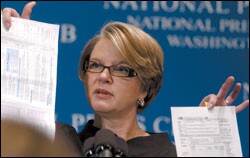
Ms. Spellings announced that the Department of Education would seek to create a massive, searchable database to give parents and students more detailed information about individual colleges and universities. She proposed giving grants to states and postsecondary schools to develop assessments to measure student learning, while cautioning against “one-size-fits-all” standardized tests. And she outlined measures to streamline the federal financial-aid process.
Those proposals would help give parents and policymakers a sense of what students are gaining from their college educations, Ms. Spellings said.
“We know higher education is the key to our children’s future. We want more than anything to provide it,” the secretary said. “Yet, it’s becoming difficult to do so and still make ends meet. And like many parents, I’m wondering—will my daughter graduate equipped with the skills for a career, or is she going to move back home with me?”
Many of Ms. Spellings’ proposals were based on recommendations in a report presented to her last month by the Commission on the Future of Higher Education, which the secretary charged last year with making long-range recommendations for the direction of U.S. colleges and universities.
While there appears to be a broad consensus behind some of her ideas, such as simplifying the federal financial-aid form, immediate reaction from some members of Congress and some key figures in the higher education community signaled that the secretary may face resistance on some of her more ambitious plans, such as the searchable database, which would require congressional approval.
“I will monitor carefully new federal efforts to collect data,” Sen. Lamar Alexander, R-Tenn., a former university president and U.S. education secretary who is the chairman of the Senate Health, Labor, Education, and Pensions Committee’s subcommittee overseeing higher education, said in a statement.
“Information for consumers is a good thing,” Sen. Alexander said. “But American higher education does not need a barrage of new regulations imposing new costs so someone in Washington can try to figure out how to improve the Harvard classics department and Nashville Auto Diesel College—both of whose students are eligible for federal grants and loans.”
Addressing Anxieties
In her speech at the National Press Club on Sept. 26, Ms. Spellings defended the proposed database, saying it would allow students and parents to compare different types of postsecondary schools by providing statistics such as graduation rates and tuition costs. She said the database, which would eventually be accessible on the Education Department’s Web site, would not jeopardize student privacy.
But David L. Warren, the president of the National Association of Independent Colleges and Universities, in Washington, said he was not sure that the information in such a database would be properly protected.
“Guarantees made by Secretary Spellings that individual student information would be fully protected is at odds with the reality of federal databases, which have experienced numerous widely publicized breaches in recent months,” he said in a statement.
In August, the portion of the Education Department’s Web site dealing with federal aid inadvertently displayed secure information, such as birthdays and Social Security numbers of aid recipients.
David Ward, the president of the American Council on Education, a Washington-based association of 1,800 colleges and universities, applauded the secretary’s plan to hold a major conference in the spring to get feedback from the higher education community on her ideas. Ms. Spellings also announced plans to convene the accreditation community in November to discuss how the college-accrediting process can put more emphasis on student learning.
“Many of my deepest anxieties were somewhat diminished,” Mr. Ward said. “She talked about a process, a dialogue.”
He said colleges and universities should do more to make “effectiveness” data, such as graduation rates, available. But he added that high-quality tests to measure student learning will be hard to design, given the diversity of colleges and programs of study.
“Learning-outcome data is really problematic,” he said.
Secretary Spellings seemed more likely to get support for her plan to simplify the federal financial-aid process by working with the states to use existing income and tax data to help students complete the Free Application for Federal Student Aid, or FAFSA, in half the time.
She also said that she supported the higher education commission’s recommendation to bolster need-based financial aid and that she would work with Congress on its proposal to streamline the 17 federal financial-aid programs.
“Higher education’s escalating sticker price has many parents facing the tough choice—whether to save for college or their own retirement,” Ms. Spellings said.
But the secretary stopped short of urging Congress to act on the panel’s recommendation to boost Pell Grants to cover 70 percent of the cost of in-state tuition at public, four-year institutions. That disappointed some advocates for students.
“I had hoped she would go further on Pell Grants and need-based aid,” said Robert Shireman, the executive director of the Project on Student Debt, a Berkeley, Calif.-based research and advocacy organization.
High School Accountability
On K-12 education, Ms. Spellings renewed calls for Congress to extend the principles of the No Child Left Behind Act to high schools, an idea also promoted by President Bush but which has yet to gain momentum with lawmakers.
“They put this on the table two years in a row,” said Kevin Carey, the research and policy manager at Education Sector, a Washington-based education policy think tank. He said the Bush administration will need to come up with a different way to pay for the high school accountability plan, other than by proposing to cut popular programs such as vocational education, if officials are serious about getting it through Congress.
Ms. Spellings also recommended revamping the 12th grade National Assessment of Educational Progress, the federally sponsored test administered to a sample of schools across the country, to provide state data on college and workforce preparedness, which President Bush has already suggested. She also called for more federal research on adult literacy to identify effective strategies and programs.


