Professional Development

Behind the Scenes

December 13, 2000 2 min read
  • Save to favorites
  • Print
Click on the image to enlarge.

This new Education Week series will follow Assistant Editor David J. Hoff, and Photo Editor Allison Shelley, as they both follow teachers participating in the National Science Foundation’s Teachers Experiencing Antarctica and the Arctic. We hope to bring you updates from Mr. Hoff about his own experiences in the Antarctic, as well as his dispatches from the field about the NSF program and its participants, along with photos.

Getting to Antarctica is no trip to the mall. Because medical emergencies in Antarctica are not easily resolved, the NSF requires visitors to undergo a rigorous medical and dental examination prior to leaving. The official U.S. Antarctic Program guidebook devotes an entire chapter on what and how to pack.

The first leg of the journey takes them to Los Angeles, then to Auckland, New Zealand, and then to Christchurch (see map, above).

Fearless Photo Editor Allison Shelley. We hope she’ll be dressing more warmly than this.
—Brian Liu

“That flight alone is 18 hours long, and because you cross the international dateline, you lose a day in transit,” said Ms. Shelley.

Once in Christchurch, the pair will repair to the CDC (clothing distribution centers) to be outfitted for their ECW (extreme cold weather) gear.

An eight-hour journey to McMurdo Station, which serves as base-camp, completes phase one of the trek.

After landing at McMurdo station (on a runway laid out on sea ice), several days attendance at “snow school” is required.

“I believe that besides learning how to survive the eventuality of the harshest, or at least coldest, happenstances on earth, we will also be learning to make igloos,” said Ms. Shelley.
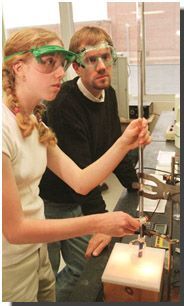
Assistant Editor David Hoff with a Hanover High School student.
Our intrepid reporter/expeditioner, David J. Hoff, right, learns from a Hanover High School, N.H., student.
—Allison Shelley

Cold-weather photography requires special planning. Ms. Shelley consulted photographers who have operated in such extremes. “All of my gear will be autofocus and operate on semi-auto settings so that I don’t have to take my hands out of the gloves to make adjustments. I will also be using lithium batteries—they work better and last longer—in very cold conditions,” Ms. Shelley said.

Ms. Shelley, who hails from Long Beach, Calif., has been Education Week‘s photo editor/chief photographer for eight months. Prior to that she was a daily newspaper staff photographer. Of the world’s seven continents, Antarctica will be the sixth that she has travelled. She is not overly fond of cold weather, she says.

Likewise, the process of reporting and writing in Antarctica will be different for Mr. Hoff than what he does week-to-week at Education Week, Mr. Hoff said.

“For most stories, you have a concept of what you’re going to see and experience before you go,” he said. “Even though I’ve been reading about life in Antarctica, I still can’t picture it. It remains a mystery to me, and I don’t have a clue as to how I’m going to describe it.”

Mr. Hoff has been writing about education for nine years, the past four years as a staff writer and assistant editor at Education Week. He currently covers curriculum issues in math and science. His wife and 3-year-old and 8-month-old sons will be patiently awaiting his return. “This trip promises to be the highlight of my career so far—and maybe even the adventure of a lifetime,” said Mr. Hoff.

Events

This content is provided by our sponsor. It is not written by and does not necessarily reflect the views of Education Week's editorial staff.
Sponsor
College & Workforce Readiness Webinar
Smarter Tools, Stronger Outcomes: Empowering CTE Educators With Future-Ready Solutions
Open doors to meaningful, hands-on careers with research-backed insights, ideas, and examples of successful CTE programs.
Content provided by Pearson
Reading & Literacy Webinar Supporting Older Struggling Readers: Tips From Research and Practice
Reading problems are widespread among adolescent learners. Find out how to help students with gaps in foundational reading skills.
This content is provided by our sponsor. It is not written by and does not necessarily reflect the views of Education Week's editorial staff.
Sponsor
Reading & Literacy Webinar
Improve Reading Comprehension: Three Tools for Working Memory Challenges
Discover three working memory workarounds to help your students improve reading comprehension and empower them on their reading journey.
Content provided by Solution Tree

EdWeek Top School Jobs

Teacher Jobs
Search over ten thousand teaching jobs nationwide — elementary, middle, high school and more.
View Jobs
Principal Jobs
Find hundreds of jobs for principals, assistant principals, and other school leadership roles.
View Jobs
Administrator Jobs
Over a thousand district-level jobs: superintendents, directors, more.
View Jobs
Support Staff Jobs
Search thousands of jobs, from paraprofessionals to counselors and more.
View Jobs

Read Next

Professional Development Teachers Need Help Reaching Teens Who Missed Basic Reading Skills. Can PD Help?
There are far fewer PD providers to train secondary teachers on reading fundamentals.
9 min read
High school teachers learn how to teach reading to struggling older readers during an AIM training at Marietta High School in Marietta, Ga., on Nov. 10, 2025.
Most secondary educators don't get much teacher preparation to help students struggling to read. Realizing that its teachers needed help, the Marietta district in Georgia has invested in PD that gives high school teachers techniques for integrating word-reading, vocabulary, and other skills, like this workshop at Marietta High School on Nov. 10, 2025.
Jason Drakeford for Education Week
Professional Development Video How One District Is Getting Secondary Teachers Up to Speed on Reading Support
A district invests in improving secondary teachers' knowledge to help students needing reading support.
1 min read
High school teachers learn how to teach reading to struggling older readers during an AIM training at Marietta High School in Marietta, Ga., on Nov. 10, 2025.
Jason Drakeford for Education Week
Professional Development Opinion Calling Yourself a 'Lead Learner' Doesn't Make It So
As an educator, knowing your job well can dull your desire to grow. There's a way to change that.
5 min read
Screenshot 2025 11 20 at 5.50.16 PM
Canva
Professional Development Opinion How Education Leaders Can Build a Better Space for Collaborative Learning
School improvement often falls flat, and initiatives are easily abandoned. That can be changed.
5 min read
Screenshot 2025 11 07 at 3.38.08 PM
Canva
