A year makes a big difference in the life and learning of a child, and a new study suggests the early-childhood curriculum Tools of the Mind may be significantly more effective for children in kindergarten than preschool.
A new randomized, controlled evaluation published in the November issue of the journal PLOS-One suggests the early-childhood curriculum gave a significant boost for kindergartners in a slew of areas, including higher reasoning, attention control, and reading, vocabulary, and mathematics performance. The effects were strongest for students in high-poverty schools, who also showed lower physical signs of stress as a result of the program.
“What I think we found surprising is, children who were higher on the developmental scale in kindergarten were able to do so much more that we ever thought possible—like a level of writing we never imagined in kindergarten—but also, for children on the other end of the developmental scale, we saw so much growth,” said Giordana M. Cote, who taught one of three kindergarten classes that piloted the program during the study at Station Avenue Elementary School in South Yarmouth, Mass.
Tools of the Mind is based on the premise—put forth in the 1920s and 1930s by Russian psychologist Lev Vygotsky—that children develop autonomy, social skills, and self-control much better through playing make-believe with each other than by being directed to it by an adult. The curriculum and activities based on that approach were developed at Metropolitan State University of Denver in the 1990s; the program now is run by the nonprofit Third Sector New England.
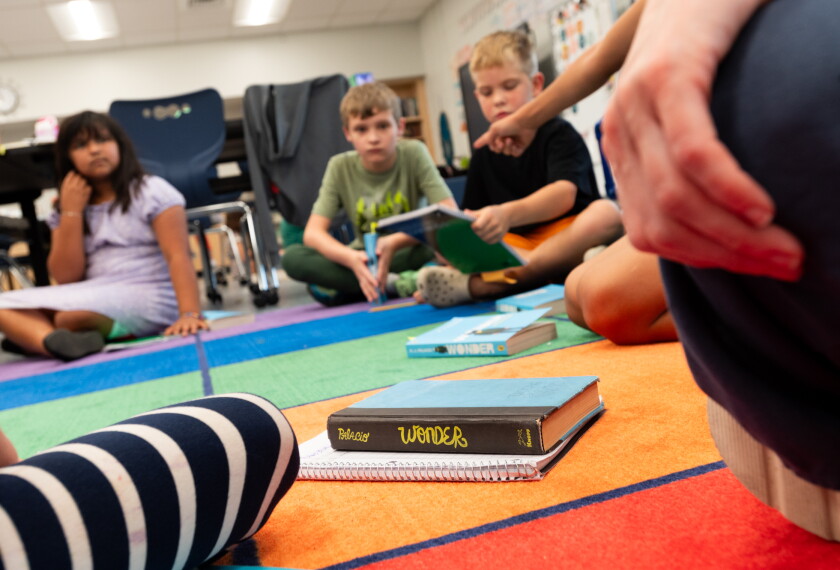
Students in Tools classrooms plan and act out roles and scenes based on, in preschool, everyday experiences like dining out, and, in kindergarten, fairy-tale literature and chapter books aligned with common standards. Students first draw and later write out descriptions of what they plan to do during play, and then review what happened during the play session. During play sessions, they must work with other children and focus on their own roles.
Growth Seen
“One of the things I hope people take away is it’s not an either-or: You can have really good, complex vocabulary, and really rigorous math in a play-based format,” said Clancy B. Blair, a developmental psychologist and principal investigator in New York University’s Neuroscience and Education Lab, who led the evaluation with C. Cbele Raver, NYU’s vice provost for research and faculty affairs.
The researchers randomly assigned 29 schools with 79 kindergarten classrooms in Cape Cod and Lynn, Mass., and throughout the western Massachusetts, central Massachusetts, and greater Boston areas, to either implement the regular district curriculum or the Tools curriculum. Mr. Blair and Ms. Raver tracked 759 children in two cohorts from kindergarten into 1st grade, conducting multiple sets of both academic tests and assessments of students’ working memory, cognitive flexibility, and inhibitory control.
Students in Tools classrooms saw more growth in early literacy, as measured on the Woodcock-Johnson vocabulary tests, letter-word recognition, and applied problems. They also showed faster reaction time, better ability to switch between different sets of rules, and stronger overall working memory than students who did not participate.
Different Findings
“The ability to shift and focus attention is a foundation for executive function,” Mr. Blair said. “That’s exactly what those classrooms seem like: Those kids are really focused on activities. What we’re seeing is, the kids in the Tools of the Mind classrooms are more similar to the kids in the well-off schools [in executive functions] than to their peers in higher-poverty schools in the control group.”
The new findings run counter to previous research on the curriculum’s effects in preschool classrooms. Three separate studies, of preschoolers in five states, including Massachusetts, also showed significant differences in how the Tools classrooms operated and how students in them played in comparison to control classrooms, but that didn’t translate into better academic performance for the younger students.
In fact, “we actually see some concerns that emerge in kindergarten and 1st grade for children who participated in preschool,” said Dale C. Farran, an education and psychology professor and senior associate director of the Peabody Research Institute at Vanderbilt University in Nashville, who conducted an earlier evaluation and is now doing follow-up studies.
Ms. Farran was not surprised that the kindergarten curriculum is having better effects—both because it is geared to slightly older children and because it was tweaked based on those earlier negative reviews.
“The enforced pretense in pre-K was too difficult for the children to comprehend,” Ms. Farran said. “Even if they have been in a restaurant, that doesn’t mean they are able to take the perspective of a waiter.”
Teachers more frequently had to demonstrate how children should act out roles of a waiter or customer, which could make it less likely that a student would become self-directed. By contrast, children were more familiar with fairy-tale scenarios, Ms. Farran said. “Who wouldn’t rather be a princess than a waiter? There’s no right or wrong pretending to be a princess or a knight or a dragon.”