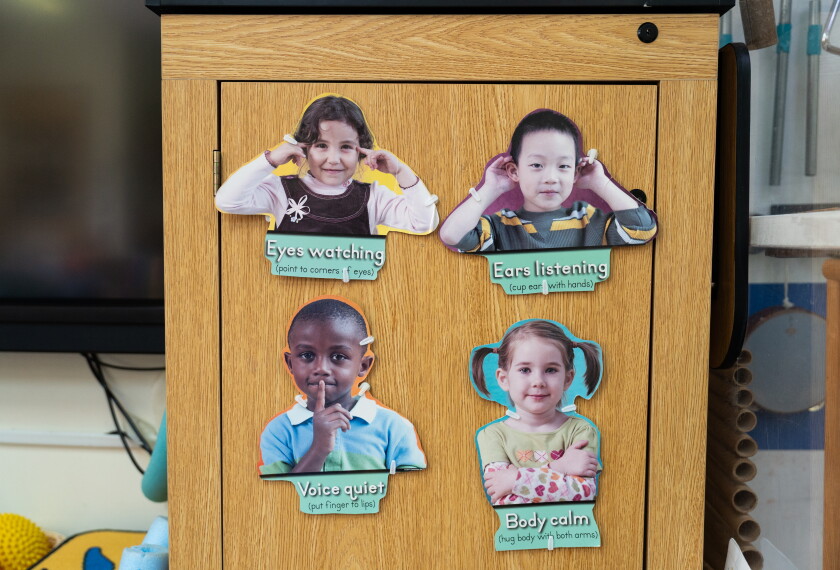
Being polite, taking turns, and demonstrating other appropriate behavior can be difficult for many preschoolers, but even more so for children with autistic spectrum disorders.
One fledgling early-childhood initiative is finding that getting classmates involved in assisting peers who have autism can help boost the social skills of all children in the classroom.
The Learning Experiences Alternative Program for Preschoolers and their Parents, or LEAP, immerses children with spectrum disorders into classes with typically developing children who have been trained in ways to communicate and work with their challenged peers. While the research underlying the program has evolved over 30 years, it has been gaining in popularity recently—roughly 100 preschools across the country now use it—in part thanks to positive results from a study that met the stringent criteria of the federal What Works Clearinghouse.
“Social relationships—the lack of them—are a defining characteristic of kids with autism,” said Phillip S. Strain, a professor of educational psychology and the director of the Positive Early Learning Experiences Center at the University of Colorado at Denver, who developed the program. “Young children have a powerful influence on each other. We’re leveraging that natural inclination to teach young, typically developing students to be persistent in their social overtures to autistic classmates.”
Help From a Script
Paul S. Haughey, the director of student services for the 1,950-student Blackstone-Millville regional school district in Massachusetts, sees that firsthand. The district implemented LEAP two years ago for its three preschool classes for 3- to 5-year-olds.

Of the 67 pupils in the district’s morning and afternoon sessions, 33 have mild to severe disabilities, including five with autistic disorders. The teachers work to ensure each preschool group includes an equal number or more of typically developing peers.
The program requires children with disabilities to be placed with a majority of typically developing classmates. Teachers train all of the youngsters in specific routines to be used to get someone’s attention, give or request an item, offer an idea for play, and give a compliment.
“When we began, the scripts scared us: How do you make natural dialogue with a script?” recalled Kathy Boisvert, a Blackstone-Millville teacher, “but then we found the scripts made a bridge to natural language. Some of the children didn’t know how to begin to approach their peers, so they never started, and the scripts gave them a place to start.”
The teachers delegate most tasks during the day to pupils, to add opportunities in which they must interact with each other: One child may remind classmates to clean up and prepare to change to a new activity; another may ask each child what he or she has brought as a snack and then retrieve it for that classmate.
Rotating the responsibility for those roles, and making the basic speech cues universal, rather than only for children with disabilities “changes everything,” Ms. Boisvert said. “It makes it a social opportunity as well as a learning opportunity, and that’s critical for children with autism. They know how someone is going to get their attention, and that not only do I have to communicate, but I have to look at you and think about the social dynamics.”

Jillian Burr, a preschool teacher in the 120-student Uxbridge, Mass., school district, said adopting the program six years ago has changed the way she and other teachers approach everything during the day—to the point that they purposely give pupils fewer art materials so that they have to share with each other and communicate more.
“Before we became a LEAP program, everything was teacher-facilitated: all discussions led by the teacher, the teacher setting up every play scenario, and then playing with the kids,” Ms. Burr said. “Now I feel I could walk out of the room and no one would notice, because everything is so child-driven.”
LEAP in Action
For example, Blackstone-Millville 3-5 teacher Susan Colgan recalled one little boy with autism who initially reminded teachers of the “Energizer bunny”—always running, hitting, grabbing things from other children’s hands, and yelling. Other pupils wouldn’t play with him or invite him to parties, and often called on the teacher to intervene.
Now, several months later, the boy is calmer, regularly plays with classmates, and “when there’s a problem, they have learned to work out a solution on their own,” Ms. Colgan said. “I heard a girl turn to the other child yesterday and say, ‘You’re being too rough.’ For her to do that, and for him to say, ‘Oh, OK, I won’t do that,’ without involving the teacher is great.”
In the 1970s, the Denver researchers started studying ways to teach autistic students social skills to students with autism using “wonderfully trained and experienced adults” who could lead students to change their behavior in the short term. But Mr. Strain said the results were neither sustainable or scalable.
Students whose behavior initially improved in the program fell back into old habits in other social situations at home or in public, and even the program improvements faded over time. Moreover, most schools did not have the resources to provide specially trained teachers doing extensive one-on-one interventions with each autistic student who has autism.
“There will never be enough adults in the world highly trained to work with kids with autism. But if you have 15 kids in the classroom and 12 are typically developing and familiar with interacting in a therapeutic way with their classmates with autism, you get a different equation.”
Looking at Results
In their 2011 randomized, controlled trial, Mr. Strain and co-author Edward H. Bovey, the University of Colorado center’s assistant director, found that after two years in the program, preschoolers on the autistic spectrum had made significantly more progress in cognitive, language, and social development; had fewer behavior problems; and showed fewer symptoms of autism than pupils in a control group.
The control group students were also in classes with typically developing children but their teachers had standard district training. The control-group teachers received LEAP program manuals, but did not get the 23 days of teacher training provided to the schools fully participating in the program.
The children’s improvement was not related to their socioeconomic levels or the severity of their symptoms at the start of the program.
Moreover, in an ongoing longitudinal follow-up, Mr. Strain and Mr. Bovey are finding a significant portion of pupils from the original intervention group have continued to progress in later grades.
“Their developmental level has continued to accelerate—on language levels, social levels, IQs, they are really doing extremely well,” Mr. Strain said. “A large fraction of preschool-intervention follow-up studies have not resulted in a good follow-up picture, so we’re pretty tickled.”
The program has also been easier to sustain, Mr. Haughey said, than one-to-one services, for which the district pays $18,000 to $40,000 per child annually. By contrast, it has spent $20,000 for two years of teacher training and materials for LEAP, which is about average for the program’s implementation in schools nationwide.
A separate study by the same research team also found the typically developing classmates participating in LEAP had fewer behavioral problems at the end of the year than similar children who had not participated in the program.
“It offers a way for a child to get truly integrated in a classroom, as opposed to ‘mainstreamed,’ ” Ms. Colgan said. “I’ve had children who were in the [integrated] classroom, but whether they were really participating remained to be seen.”