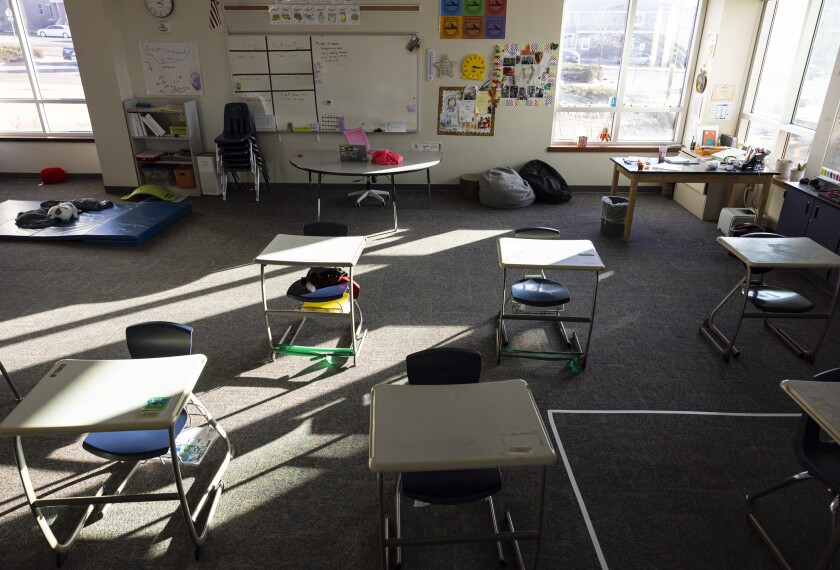
“Half of life is just showing up.” I once loved repeating that to my students who were regularly absent from school. Like all good quotes, it owns a perfect blend of simplicity, adaptation, and sublimity. I used to love saying it, that is, until a young child curtly responded, “Sometimes I can’t find a way to show up.” I wasn’t sure if he meant that, or if he was attempting to create his own unique axiom, but it certainly struck me. After all, if he cannot find a way to show up to school, how can we expect him to succeed?
Chronic absenteeism—missing more than 10 percent of school a year—occurs at rates three to four times higher in high-poverty areas, according to a study of six states conducted by Johns Hopkins University in May of last year. In these low-income communities, it is normal to find a quarter of the class missing every day, with some students missing 30 to 40 days a year—a fact that, as an inner-city English teacher, I regularly witness firsthand.
The most alarming part is that multiple studies across various states show kindergartners to have the highest rate of absenteeism outside of high school students. Educators and policymakers have known for years that falling behind before 3rd grade has a high correlation not just with high school dropout rates, but with incarceration rates as well. Children this young are not playing hooky or uninterested in learning—five minutes alone with any 1st grader yields more questions than you can answer without jumping on Wikipedia. The reasons these children stay home can all be traced to poverty.
An overwhelming majority of chronically absent kids are impoverished, dealing with such daily stresses as caring for siblings, high rates of disease, violence in the community, and frequent familial moves to find employment. I’ve spent many nights meeting with these children’s parents—themselves products of failed educational and social systems. They do not recognize the long-term harm of missing school. There is a divergent culture not entirely known to many Americans, one consistent with the worst ills that poverty can beget, in which these children suffer. The prevailing attitude within these communities is about survival, not school attendance.
Some might take these observations as a myopic argument that blames the poor for their own hardships. However, understanding these family structures requires a view of poverty that cannot be seen from the isolation of a suburban community. These recurrent ills are the basis of generational poverty—the type of impoverishment that is cyclical and offers little escape because of the conditions that someone is born into, and which society, willingly or unwillingly, continues to precipitate.
There is no policy to cure generational poverty. Ten years of teaching has given me more questions than answers in this regard. What I do know, however, is the degree of risk inherent in not attending school, and it must be addressed. In high-poverty communities, the difference between escaping an undeniable fate and staying put can be found inside the classroom.
In high-poverty communities, the difference between escaping an undeniable fate and staying put can be found inside the classroom.
The current solutions for absenteeism revolve around the local department of human services and truancy courts. They continue to fail because they do not address the root familial causes; instead, they treat school attendance as a court-mandated punishment. As more policymakers recognize the need for improved solutions to chronic absenteeism that do not involve court systems, they have turned to new models.
Baltimore’s School Every Day is a joint initiative between the city’s public schools and community, alumni, and faith-based volunteers who visit the homes of truant children of all ages. Volunteers take to the streets prepared to provide parents with personal advice and resources—from alarm clocks to umbrellas to information on immunization centers—covering all the possible reasons for absences. The University of Pittsburgh has developed a comprehensive, yet playful, Ready Freddy program complete with a frog mascot, geared toward children entering kindergarten. The program brings together schools, parents, and children to ease the transition from home life to school entry. In over four years, it has more than tripled first-day attendance rates in participating schools.
Even more expansive is President Barack Obama’s early-childhood-education initiative, which he announced in his recent State of the Union address: to expand federally funded, rigorous pre-K programs for children from low- and middle-income families. Most importantly, it includes a program for home visits by health professionals and social workers to families of pre-K children most at risk of not attending school. It’s a start (and an acknowledgment), on a federal level, that treating the causes of absenteeism now prevents problems later.
Naturally, these programs and ideas require a commitment from schools, communities, Congress, and taxpayers in order for them to translate into success for our students. Naysayers quick to point out the expense of these services should be reminded of the long-term societal costs high school dropouts place on cities, to say nothing of the moral obligation we owe innocent children. Every option must be used to curb this absenteeism epidemic, even temporary removal from parents, should it come to that.
Education has long been considered one of the few opportunities for American society that everyone enjoys, and it remains the most dependable way to break the cycle of poverty. If we still believe this, then the issue of school attendance in poverty-stricken communities must be moved to the forefront of our national education discussion. The road to success, and failure, starts earlier than you think.