
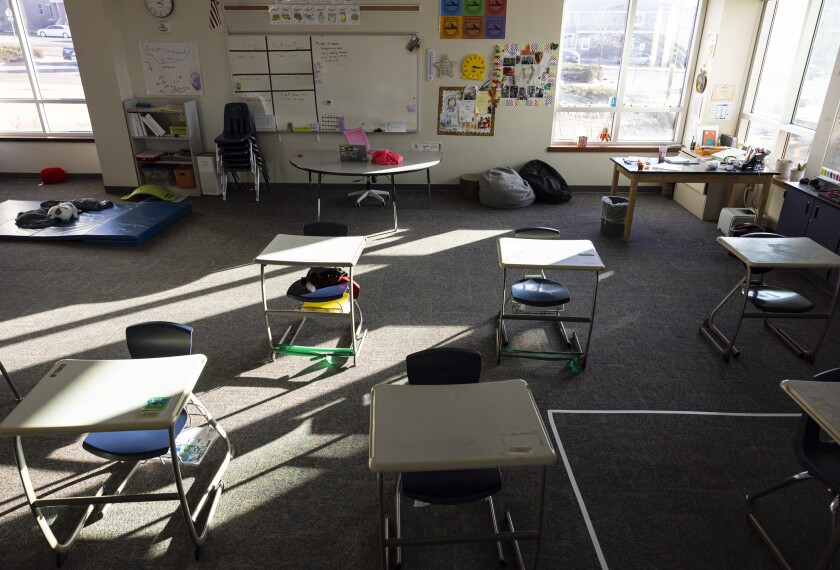
Absenteeism rates, which spiked during the pandemic, still haven’t fallen back to previous levels.
A new study adds to the evidence base that suggests these absences are a persistent barrier to growing students’ reading and math scores.
The report, from the testing group NWEA, compared scores on the company’s grades 3-8 math and reading achievement tests with rates of chronic absenteeism across 2,000 districts between 2019 to 2024.
Districts with consistently high chronic absenteeism during those years—defined as having 20% or more of their students missing 10% or more of the days in the school year—made less academic recovery by 2024. The report defines recovery as a return to pre-pandemic achievement levels, measured in 2019.
The effect was more pronounced in math, where high chronic absenteeism districts were about 50% further from recovery than in reading.
Attendance seemed to matter the most in the highest-poverty districts, where the gap in recovery between districts with high rates of absenteeism and districts with low rates was bigger than in middle- and low-poverty districts.
“This research indicates that states should be really targeting additional resources for high-poverty districts to combat absenteeism,” said Megan Kuhfeld, the director of growth modeling and data analytics at NWEA, and an author on the brief.
NWEA’s data only shows a relationship between absenteeism and less progress in student test scores; it doesn’t prove that one caused the other. There are countless other factors, too, that have shaped districts’ academic trajectories in the post-COVID landscape.
But the findings add to a growing body of evidence connecting missed school time to slower academic recovery.
In May, new data from the Educational Opportunity Project at Stanford University found that each additional day in student absences during the period between 2022-2024 was associated with slower growth in reading and math.
If chronic absenteeism remains at current levels, it will be hard to regain the ground students lost during the pandemic—especially in math, which is more sensitive to school disruptions than reading, said Thomas Kane, the director of the Center for Education Policy Research at Harvard, in an interview with Education Week in May.
“Absence rates hurt even the kids who aren’t absent,” he said. “If there’s a different group of kids missing every day, and teachers are having to constantly reteach the same material, there’s pre-pandemic research that suggests peer absences hurt everyone in the class.”
How are schools tackling the problem?
But chronic absenteeism has proved an especially sticky problem.
It peaked in the 2021-22 school year at 29%, according to an analysis from the American Enterprise Institute that examined data from 39 states and the District of Columbia. Absenteeism rates have slowly declined since then, falling to 26% in 2022-23 and about 23% in the 2024-25 school year, but are still about 50% higher than before the pandemic.
Schools and districts have tried a variety of strategies in the pandemic’s wake, with mixed results.
Frequent, personalized interventions—like home visits and tailored text messages—saw the most success in a recent study from researchers at Wayne State University. Addressing barriers to getting to school, like transportation and homelessness, was also effective.
Another recent study from a parent-school communications company, SchoolStatus, found similar positive results from digital messages to families of students at risk of becoming chronically absent.
While these interventions aim to change parents’ and students’ behavior, some districts have also retooled the school calendar in the hopes of encouraging better attendance patterns. Strategically scheduling breaks, spirit days, or teacher workdays on days that families might be inclined to skip can make it more likely students will attend class consistently the rest of the year, the theory goes.
“We need more coordinated data on what’s working and not working,” Kuhfeld said, citing AEI’s new working group on chronic absenteeism as one example of efforts to find effective solutions.
Whatever approaches schools use to fight absenteeism, they should understand attendance and academic improvement as pieces of the same puzzle, rather than separate issues, the NWEA authors write.
That might look like ensuring early warning systems bring together attenance and academic data in the same place, Kuhfeld said. “That’s something we would recommend—building these systems that can keep track of whether the students who are missing school are also the ones falling behind.”


