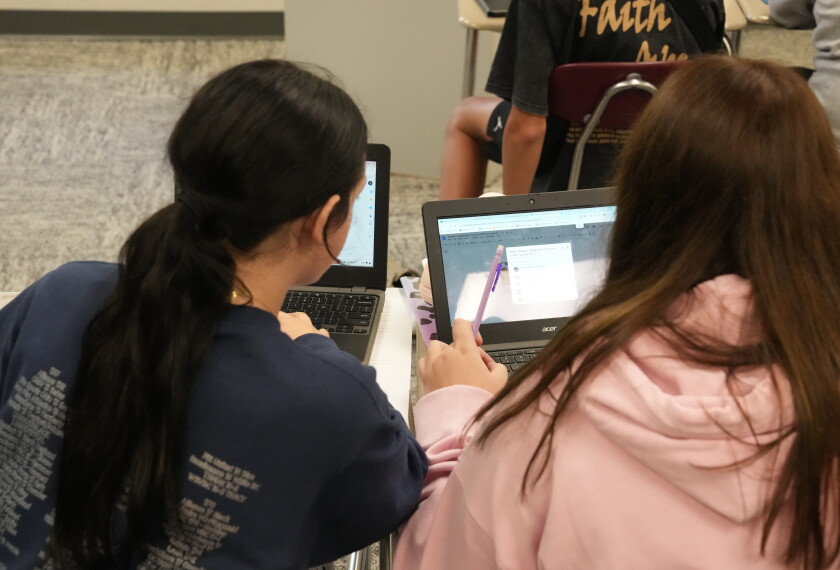
Colleges and universities are learning lessons as they design online courses to meet a growing demand for e-learning driven largely by student desire for scheduling flexibility and access to coursework not otherwise available. High schools, too, are building a framework of best practices for online-only courses and for hybrid classes that blend online and face-to-face learning, especially for students at the lowest and highest ends of the academic spectrum.
But what about students on the younger end of education? What lessons have been learned about how best to tailor online courses for the early grades?
“Certainly, I think you’re seeing it’s more and more common for online learning [to take hold in] elementary and middle school,” said Matthew Wicks, the vice president of strategy and organizational development for the Vienna, Va.-based International Association for K-12 Online Learning, or iNACOL. “It is some of those same motives, but it has a different flavor and some different labels.”
To begin with, experts say, elementary online learning necessitates more parent involvement, and the educational and social needs of elementary pupils are different from those of high school or college students. Ultimately, they add, understanding the parallels and differences between online learning in the higher and lower grades is essential to creating elementary online courses and curricula that work.
Personalizing the Curriculum
To help build elementary courses that make sense to parents and students, the 9,000-student Pennsylvania Cyber Charter School, based in Midland in the western part of the state, offers two curricula to students in grades K-2, said Andrew Oberg, the school’s executive director. Parents can choose from the Little Lincoln Curriculum offered by the National Network of Digital Schools, which was designed originally for online learning, or from the Calvert School, a longtime provider of home school curricula that has adapted its materials for online delivery and is somewhat less interactive, Mr. Oberg said.
“We want to give our families the choice in which instruction in that family is delivered,” said Mr. Oberg, who added that part of what should drive the choice is how great a parent’s familiarity is with a particular academic subject. The less knowledge the parent has in the subject, the more interactive and supported a curriculum he or she should pursue, he said.
“There’s a certain level of comfort you have when you go through primary grades,” Mr. Oberg said. “My breaking point was about 4th grade math.”
At the 4,500-student Arizona Virtual Academy, based in Phoenix, the lead master teacher, Kayleen Marble, said the focus is not so much on providing options as it is on offering outlets for expression. Teachers who direct classes through live Elluminate webconferencing sessions, and parents who aid in their elementary students’ learning, are encouraged to make the experience as communal and active as possible.
“I just think [you do] anything you can do to keep them busy,” said Ms. Marble. “You’ve got to have real teacher-student interaction going on.”
To begin coursework with the Arizona Virtual Academy, she said, the school leads meetings with parents to emphasize their role in ensuring that student work is completed, helping their children use the technology, and making sure children have at least one live adult to turn to throughout the day. That role is potentially more easily filled by a stay-at-home parent.
“It’s just to help them understand what they’re in for,” Ms. Marble said. “It’s a great fit for many people, but let’s face it, it’s not for everybody.”
Challenging High Achievers
Advanced students, in particular, are one group educators say are increasingly turning to online elementary education.
Some parents and students have turned to specific programs in gifted education, such as those offeredby Johns Hopkins, Northwestern, and Stanford universities.
At Hopkins and Northwestern, those programs evolved from established endeavors in gifted education that either involved summer residency or other forms of distance learning. Some students enroll in courses for pleasure, some to gain credit from their local school districts, and some to complete them as part of a home school curriculum.
“We have a family that has their children in twenty-some of our courses,” said Paula Olszewski-Kubilius, the director of Northwestern University’s Center for Talent Development, based in Evanston, Ill., which runs the Gifted LearningLinks program catering to elementary and secondary students. “Their parents are looking for challenges. They’re looking for their kids to meet other kids.”
Patricia Wallace, the senior director of Johns Hopkins’ CTYonline program, an extension of the university’s Center for Talented Youth Program, which has about 10,000 enrollments, agreed that students are often as much in search of social peers as academic challenges. In that way, the very online learning some worry can be socially alienating is actually the opposite.
But course design for precocious elementary pupils offers a particular challenge, Ms. Wallace said. Literature classes, for example, must present advanced texts that contain only themes suitable for younger readers.
“They may not be socially or emotionally advanced,” Ms. Wallace said of elementary students. “We’re always trying to introduce challenging material, but in a way that is appropriate.”
Helping Struggling Students
But just as often as some students turn online to be challenged, an increasing number of elementary students who are struggling to learn are turning to virtual education programs for help.
“We do have a huge at-risk population,” said Ms. Marble. “I think most virtual schools would probably say that, because people are looking for an alternative for a reason.”
At the Arizona Virtual Academy, she said, even elementary students must demonstrate mastery at subject checkpoints before progressing to the next section of a course. When they don’t, the school asks the students to virtually attend remediation sessions on top of their scheduled online classes.
Jessie Woolley-Wilson, the chief executive officer of Seattle-based DreamBox Learning, which creates online supplemental math programs for students in grades K-3, suggested that online remediation may be more effectively executed discretely, and not in a synchronous or scheduled classroom fashion.
Ms. Woolley-Wilson, who serves on the board of Editorial Projects in Education, the nonprofit corporation that publishes Education Week, said adaptive-learning programs that identify student problem areas and adjust interactive lessons until the student demonstrates mastery of a concept could be a crucial step toward ensuring later success in the upper grades.
“Sometimes, students stop working because repetition is so boring,” said Ms. Woolley-Wilson. “One of the things about the adaptive model is you can almost camouflage repetition.”
But, while that approach is the basis for DreamBox’s math programs, it could be a barrier in other subjects, especially if early reading-comprehension skills haven’t yet been developed.
“I think at the later elementary school level, that asynchronous [anytime, anywhere] learning is easier to do,” said iNACOL’s Mr. Wicks. “I think a lot has to do with a student’s reading ability. Much of that asynchronous ability is going to have to do with reading level.”