The Dearborn, Mich., school district’s superintendent moved quickly to clarify the system’s language policy last week after a consultant said officials should “prohibit the use of any language other than English,” except when necessary for communication with parents, at a high school with many students of Arab heritage.
“To do otherwise reinforces a perception by some that [Fordson High School] is an Arab school in America rather than an American school with Arab students,” said the report, posted on the Dearborn public schools’ Web site earlier this month.
Superintendent Brian Whiston said in an interview last week that it was unfortunate that the report on high school operations, which he had commissioned from the Michigan Leadership Institute, an educational consulting firm based in Mission, Mich., singled out the Arab population and Arabic language.
“They were responding to things they heard—I would not have singled out one language,” Mr. Whiston said of the consultants.
Mr. Whiston, who became the superintendent of the 18,200-student district in July, said the district doesn’t have any intention of restricting the use of languages other than English among students. But he said that he agrees that faculty and staff members should be reminded to speak English when they are with other adults who speak only English.
“It’s OK to speak in your native language, but when other people are there who speak only English, you should speak in English,” he said.
Some Offended
Imad Hamad, a regional director of the Arab-American Anti-Discrimination Committee and a parent of a freshman at Fordson High, was offended that the report referred only to Arab students, when the school district enrolls students of many different ethnic and language backgrounds.
“To single out the Arabic language—and that Fordson High School is perceived as an Arab school—is a political statement,” he said. “It’s not an objective recommendation.”
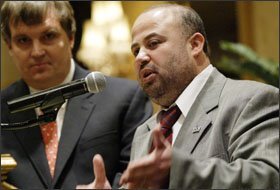
He added that being able to speak one’s native language “is a basic constitutional right, and no one can prohibit the students from this basic right.”
Dearborn has long had a Middle Eastern and Arab component to its population. Henry Ford recruited Lebanese workers for his automobile factories there as early as the 1920s. Waves of immigration in recent decades have brought people from Yemen, Iraq, and the Palestinian Territories, as well as Lebanon, to Dearborn.
About 40 percent of students in the Dearborn school district are of Arab descent, and the district is participating in a grant from the U.S. Department of Defense given to Michigan State University to create a K-16 program in Arabic. The courses are aimed at students of Arab heritage who already speak English.
‘Distrust and Suspicion’
In their report, the consultants write: “While unintended, the use of languages other than English contributes to an atmosphere of distrust and suspicion on the part of English-only speaking adults in the school.”
It also recommends that the school district “include [English-language-learner] students in general education classes as quickly as possible.”
The report says that “it is our belief that the use of languages other than English slows the process of students” being acculturated into the school and American society in general.” It recommends that “the use of Arabic in the instructional program be only used out of necessity.”
Mr. Whiston acknowledged that the report’s authors did not include any educational data to back up their statement that the use of students’ native languages slows the integration process.

He noted that district data show that the district’s programs for ELLs, which include bilingual education, are succeeding. He said most students in Dearborn are English-language learners only for about three or four years before moving to regular classes, while research shows it can take an average of five to seven years to learn English.
Mr. Hamad said he is glad that Mr. Whiston clarified that the school district will not ban the use of languages other than English, including Arabic. He supports the district’s bilingual education programs.
“Having bilingual programs among our student population, and having the students able to speak other languages, is a plus to our education system and America over the long term,” Mr. Hamad said.


