A unanimous state board of education in Texas has endorsed the concept of teaching evolution by way of adopting 11 new biology textbooks, all of which cover the politically sensitive topic.
|
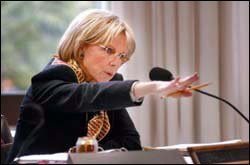
Texas board of education President Geraldine Miller moderates a meeting to discuss the adoption of textbooks. She received thousands of e- mails about biology texts that incorporate evolution. |
Though four of the 15 board members strongly objected to how nine of the books portray the theory of evolution, they sided with the board’s majority in the final vote Nov. 7.
Advocates on both sides of the issue, from within and outside Texas, had lobbied the board for months.
“Every time biology comes up, it is a very debated issue,” noted Geraldine Miller, the board president. Ms. Miller said she had received between 3,000 and 4,000 e-mail messages criticizing the books in the past couple months.
In a process that is closely watched nationwide, the Texas school board approves new textbooks for public schools every fall. Districts then choose their books from a list of those texts. The last time biology texts were adopted in Texas was in 1997; the new ones are expected to reach classrooms in fall 2004.
A review panel of current and retired biology teachers and members of the public recommended all 11 of the current titles to the board.
The selected high school books also had the blessing of the state’s chief deputy commissioner of education, Robert Scott, according to Debbie Ratcliffe Graves, a Texas Education Agency spokeswoman.
Texas has a long history of controversial textbook adoptions. This time, the issue of evolution pitted publishers and science educators against religious organizations and conservative groups that some have accused of trying to censor the content of the books.
“We’ve seen examples of this kind of attempted influence by far-right interest groups that want to edit the textbooks so they don’t conflict with their religious worldviews,” contended Casey Kaplan, the political director for the Texas Freedom Network, a grassroots organization that describes itself as a “mainstream voice to counter the religious right.”
Mr. Kaplan pointed to last year’s contentious adoption of history and social studies textbooks, during which, he said, the state board edited references to the Ice Age to say it had occurred “in the distant past,” as opposed to “millions of years ago.” (“Texas Board Adopts Scores of New Textbooks,” Nov. 27, 2002.) In the end, however, Mr. Kaplan said he was “extremely encouraged” by the board’s actions on the biology books.
Fixing Errors?
Still, some opponents of teaching Charles Darwin’s theory of evolution without including countering views also took aspects of the board’s decision to adopt the textbooks as a victory.
Bruce Chapman, the president of the Seattle-based Discovery Institute, praised the Texas board for removing diagrams, called Haeckel’s embryos, that compare human embryos and those of other species, from the textbooks. “Finally fixing these errors is an important step to improving the accuracy of science education about evolution,” he said in a press release.
“This is real progress in the cause of science education reform,” said Mr. Chapman. His group promotes the theory of “intelligent design,” which attributes certain forces of nature, including evolution of species, to the work of a higher power.
Under state law, board members may revise textbooks only to correct factual errors.
Just last month, a national public-interest law firm, Trial Lawyers for Public Justice, sued former and current state board members for rejecting an environmental-science textbook in fall 2001 that the state education commissioner had recommended and that was later found to be free from error by the state’s review panel.
The book, Environmental Science: Creating a Sustainable Future (6th Edition), was rejected because of political pressure from outside groups that viewed it as “anti-Christian” and “anti-free enterprise,” the lawsuit charges.
Because Texas is one of the largest markets in the country, the decisions made by its state board have a “ripple effect” on the rest of the country, the suit says.
Texas law requires science texts to spell out strengths and weaknesses of all scientific theories discussed in them, and all textbooks must undergo a months-long review process, said Ms. Miller, the state board president.
In contrast to the controversy surrounding the biology textbooks, the board approved with little fanfare new textbooks for English-language learners and for career and technology classes.


