Ed-Tech Policy News in Brief

Technology Giants, Startup Give Millions for Devices, Training, and Supplies

By Sarah Schwartz & Alix Mammina — April 10, 2018 1 min read
  • Save to favorites
  • Print

Verizon Innovative Learning pledged more than $200 million last week to furnish technology, teacher training, and internet connectivity in K-12 schools.

With the new funding, Verizon plans to expand the number of in-school programs from 100 to 200 by the end of 2020.

Also last week, Amazon announced it would put $50 million toward online Advanced Placement computer science courses, college scholarships, and student internships.

Only the week before, cryptocurrency startup Ripple gave $29 million to finance every open education campaign on the crowdfunding platform DonorsChoose.org—benefiting nearly 30,000 teachers and approximately 1 million students across the country.

The donation will fulfill teachers’ requests for books, lab equipment, art supplies, and more. Founded in 2012, Ripple uses blockchain technology to help banks and financial institutions make global payments.

A version of this article appeared in the April 11, 2018 edition of Education Week as Technology Giants, Startup Give Millions for Devices, Training, and Supplies

Events

This content is provided by our sponsor. It is not written by and does not necessarily reflect the views of Education Week's editorial staff.
Sponsor
Student Absenteeism Webinar
Attendance Isn't an Attendance Problem
Boost attendance by strengthening relationships, belonging, and support with practical strategies from Doug Fisher & Nancy Frey.
Content provided by Corwin
This content is provided by our sponsor. It is not written by and does not necessarily reflect the views of Education Week's editorial staff.
Sponsor
Classroom Technology Webinar
Screen Time and AI: An Evidence Playbook for School Leaders
Get a clearer picture of the current policy landscape, a framework for evaluating new tools, plus language to use in the next board meeting.
Content provided by Instructure
This content is provided by our sponsor. It is not written by and does not necessarily reflect the views of Education Week's editorial staff.
Sponsor
School & District Management Webinar
The Principal's Role in Collective Efficacy and Student Outcomes
Learn practical strategies that help principals translate their confidence into stronger collective teacher efficacy and student outcomes.
Content provided by Otus

EdWeek Top School Jobs

Teacher Jobs
Search over ten thousand teaching jobs nationwide — elementary, middle, high school and more.
View Jobs
Principal Jobs
Find hundreds of jobs for principals, assistant principals, and other school leadership roles.
View Jobs
Administrator Jobs
Over a thousand district-level jobs: superintendents, directors, more.
View Jobs
Support Staff Jobs
Search thousands of jobs, from paraprofessionals to counselors and more.
View Jobs

Read Next

Ed-Tech Policy ‘Essential Infrastructure’: Education Groups Raise Concerns About FCC's E-Rate Review
The FCC might limit or end the program that subsidizes broadband connectivity for schools.
4 min read
Fifth and second grade students work together using Magic School AI to build presentations during class at Galileo STEM Academy in Eagle, Tuesday, Feb. 24, 2026.
Fifth and 2nd grade students work together using Magic School AI to build presentations during class at Galileo STEM Academy in Eagle, Idaho, on Feb. 24, 2026. Education groups are raising concerns that the FCC's review of a program that helps fund school internet connectivity could lead its demise.
Sarah A. Miller/Idaho Statesman via TNS
Ed-Tech Policy RFK Jr. Calls for Children to Have 'Less Screen Time and More Real Life'
Speakers at an event hosted by the Department of Health and Human Services discuss the harms of student screen time, and possible solutions.
4 min read
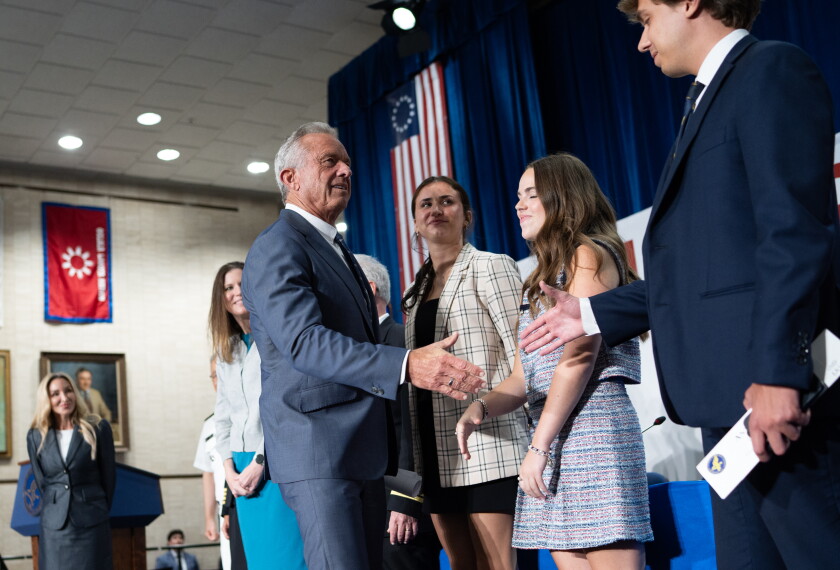
Robert F. Kennedy Jr., Secretary of Health and Human Services, shakes hands with the organizers of the event at the Hubert Humphrey Building in Washington on Sept. 1, 2026.
Robert F. Kennedy Jr., Secretary of Health and Human Services, shakes hands with the organizers of an event focused on the harms of student screen time at the Hubert Humphrey Building in Washington on Sept. 1, 2026. The symposium is part of HHS’s Live Real Life campaign, a national effort aimed at helping families, schools, and communities reduce harmful screen use and create more opportunities for children to engage in real-world experiences.
Sarah L. Voisin For Education Week
Ed-Tech Policy Opinion Is the Backlash Against Tech in Schools Going Too Far?
As schools rethink their relationship with tech, there are questions they should be asking.
Lina Eroh
5 min read
Photo illustration of an elementary-aged Caucasian boy with outstretched legs and a laptop on his lap. He is sitting on a very large cellphone propped up by four orange construction cones. The background is a montage of overlapping rectangle shapes with some ghosted images of young elementary students using a variety of tech (headphones and cellphones).
Photo illustration by Gina Tomko/Education Week + Canva
Ed-Tech Policy FCC Launches Review of E-Rate Program Amid Screen Time Debate
The end of the E-rate program would be an "existential threat" for schools, advocates say.
4 min read
Debbie Castlen, a bus monitor for Daviess County Public Schools, sits in front of a parked school bus outfitted with wifi in the parking lot at Russell Shifley Park, Wednesday, Aug. 26, 2020, in Owensboro, Ky. Castlen was working a 4-hour shift at the bus, which enables students without wifi at home to download their school assignments as the new school year begins with students working remotely.
Debbie Castlen, a bus monitor for the Daviess County public schools, sits outside a school bus equipped with Wi-Fi at Russell Shifley Park in Owensboro, Ky., on Aug. 26, 2020, where she worked a shift helping students without home internet download assignments as the school year began remotely. The setup reflects the kind of connectivity effort now under scrutiny as federal officials review the future scope of the E-rate program.
Greg Eans/The Messenger-Inquirer via AP