Two thousand fifteen was a big year for personalized learning. Nearly every ed-tech pitch to my venture capital fund opened with a black-and-white image of a 1950s one-size-fits-all classroom, and proceeded to tell the story of how Startup X would fix schools through personalization. In a world where we expect our Starbucks drinks customized, gifts recommended by Amazon.com, and music playlists tailored to our tastes, why should our education be any different? Personalization seems like a natural target for the educational pendulum to swing to after decades of factory-model schooling.
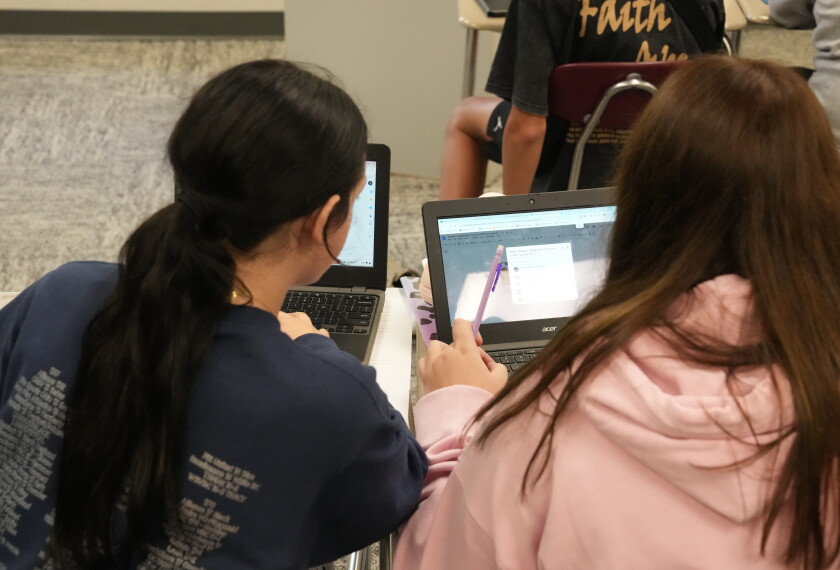
With all the investment hype and entrepreneurial frenzy, I worry that some might view personalization as yet another silver bullet for education. Or worse, if we mistake personalization as the ultimate goal and combine it with the (over)promise of adaptive technology, we risk transforming our classrooms from the outmoded factory model into tech-supported cubicles where kids sit alone for a majority of the day.
This image may seem extreme, but we see similar things all around us, like families out to dinner with faces in their phones rather than looking at each other. I, too, struggle to find quality, tech-free family time. Technology is immersive, and all the more so when personalized. However, when applied thoughtfully, it is a powerful strategy for connection, integration, and growth. In fact, the impetus behind the personalization movement was inclusion, not isolation.

Despite claims to the contrary, the shift from one-size-fits-all to a more personalized approach to learning began with teachers, not techies. Personalization has its roots in gifted and special-needs classrooms where educators had to get creative and innovate beyond traditional teaching methods in order to teach unconventional learners. Some of these students had learning disabilities like dyslexia or dyscalculia, while others were advanced or bored by content learned years earlier. These extreme cases demanded new, personalized teaching strategies and were then often codified into a child’s individualized education program.
Soon, differentiation became “a thing” and was further popularized in the 1990s by University of Virginia researcher Carol Ann Tomlinson. Its popularity among educators really took off as various court rulings throughout the 1990s fleshed out the Individuals with Disabilities Education Act’s core principle of “least restrictive environment” that requires schools to make every possible effort to integrate students with special needs into the mainstream classroom.
What happened next was exciting: With the inclusion of these students in the regular education classroom came their innovative and personalized strategies, breaking the calcified mold of the one-size-fits-all class. As it turned out, these strategies proved promising for all students by enabling more access points for learning. So began the shift toward greater personalization.
In a world where we expect our Starbucks drinks customized, ... why should our education be any different?
To this day, differentiation is among the most requested topics of interest by teachers for professional development, according to ASCD’s Educational Leadership 2015 Readers Survey. Great teachers know that instruction designed around the individual ought not be isolating but engaging, purposeful, and multimodal. The personal interaction and idea-sharing that drives greater understanding and empathy offers more-powerful learning. A great example is the ed-tech startup Newsela—in which my fund invests—which enables all children in a class to engage in a debate around a single news article. Instead of dividing children into groups based on their reading levels, which is stigmatizing to struggling readers, or keeping students together but giving them different reading material, the tool provides five versions of the same article, allowing the whole class to join in one conversation.
This type of integration is important not only because it enables deeper learning and collaboration, but also because our schools were founded with an important civic function, and a democratic society expects much more than individual achievement. It asks us to prepare graduates who exhibit sound character, social conscience, and critical-thinking skills; a willingness to make commitments; and an awareness of global problems. If our schools are truly microcosms of our society, as
John Dewey articulated, then our classrooms must foster caring relationships between students. This necessitates teaching children how to interact in a kind and empathetic manner, while still giving them an education tailored to their needs.
The most promising new school models use personalization to help achieve a constellation of goals aimed at serving the larger democratic society.
Keeping these goals in mind, I’m as excited as anyone about personalization. The old model left far too many kids behind.
But personalization does not mean isolation, and it doesn’t mean sitting our students down in front of laptops all day. Personalization is a strategy that allows us to adapt to the needs of all children, preferably after giving them a powerful, shared learning experience that motivates them to dive deeper. The best schools and ed-tech companies understand that technology and personalization are not the ends of education, but that they are merely means to help achieve higher goals—goals on which the health of our society and democracy depend.