Editor’s Note: This is part of a series on the practical takeaways from research.
The times have dictated school closings and the rapid expansion of online education. Can online lessons replace in-school time?
Clearly online time cannot provide many of the informal social interactions students have at school, but how will online courses do in terms of moving student learning forward? Research to date gives us some clues and also points us to what we could be doing to support students who are most likely to struggle in the online setting.
The use of virtual courses among K-12 students has grown rapidly in recent years. Florida, for example, requires all high school students to take at least one online course. Online learning can take a number of different forms. Often people think of Massive Open Online Courses, or MOOCs, where thousands of students watch a video online and fill out questionnaires or take exams based on those lectures.
In the online setting, students may have more distractions and less oversight, which can reduce their motivation.
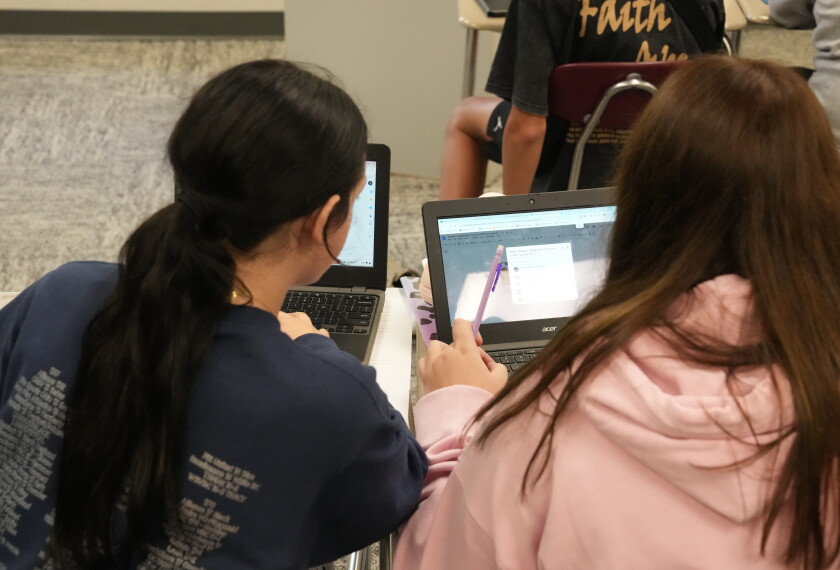
Most online courses, however, particularly those serving K-12 students, have a format much more similar to in-person courses. The teacher helps to run virtual discussion among the students, assigns homework, and follows up with individual students. Sometimes these courses are synchronous (teachers and students all meet at the same time) and sometimes they are asynchronous (non-concurrent). In both cases, the teacher is supposed to provide opportunities for students to engage thoughtfully with subject matter, and students, in most cases, are required to interact with each other virtually.
Online courses provide opportunities for students. Students in a school that doesn’t offer statistics classes may be able to learn statistics with virtual lessons. If students fail algebra, they may be able to catch up during evenings or summer using online classes, and not disrupt their math trajectory at school. So, almost certainly, online classes sometimes benefit students.
In comparisons of online and in-person classes, however, online classes aren’t as effective as in-person classes for most students. Only a little research has assessed the effects of online lessons for elementary and high school students, and even less has used the “gold standard” method of comparing the results for students assigned randomly to online or in-person courses. Jessica Heppen and colleagues at the American Institutes for Research and the University of Chicago Consortium on School Research randomly assigned students who had failed second semester Algebra I to either face-to-face or online credit recovery courses over the summer. Students’ credit-recovery success rates and algebra test scores were lower in the online setting. Students assigned to the online option also rated their class as more difficult than did their peers assigned to the face-to-face option.
Most of the research on online courses for K-12 students has used large-scale administrative data, looking at otherwise similar students in the two settings. One of these studies, by June Ahn of New York University and Andrew McEachin of the RAND Corp., examined Ohio charter schools; I did another with colleagues looking at Florida public school coursework. Both studies found evidence that online coursetaking was less effective.

This essay is the fifth in a series that aims to put the pieces of research together so that education decisionmakers can evaluate which policies and practices to implement.
The conveners of this project—Susanna Loeb, the director of Brown University’s Annenberg Institute for School Reform, and Harvard education professor Heather Hill—have received grant support from the Annenberg Institute for this series.
To suggest other topics for this series or join in the conversation, use #EdResearchtoPractice on Twitter.
It is not surprising that in-person courses are, on average, more effective. Being in person with teachers and other students creates social pressures and benefits that can help motivate students to engage. Some students do as well in online courses as in in-person courses, some may actually do better, but, on average, students do worse in the online setting, and this is particularly true for students with weaker academic backgrounds.
Students who struggle in in-person classes are likely to struggle even more online. While the research on virtual schools in K-12 education doesn’t address these differences directly, a study of college students that I worked on with Stanford colleagues found very little difference in learning for high-performing students in the online and in-person settings. On the other hand, lower performing students performed meaningfully worse in online courses than in in-person courses.
But just because students who struggle in in-person classes are even more likely to struggle online doesn’t mean that’s inevitable. Online teachers will need to consider the needs of less-engaged students and work to engage them. Online courses might be made to work for these students on average, even if they have not in the past.
Just like in brick-and-mortar classrooms, online courses need a strong curriculum and strong pedagogical practices. Teachers need to understand what students know and what they don’t know, as well as how to help them learn new material. What is different in the online setting is that students may have more distractions and less oversight, which can reduce their motivation. The teacher will need to set norms for engagement—such as requiring students to regularly ask questions and respond to their peers—that are different than the norms in the in-person setting.
Online courses are generally not as effective as in-person classes, but they are certainly better than no classes. A substantial research base developed by Karl Alexander at Johns Hopkins University and many others shows that students, especially students with fewer resources at home, learn less when they are not in school. Right now, virtual courses are allowing students to access lessons and exercises and interact with teachers in ways that would have been impossible if an epidemic had closed schools even a decade or two earlier. So we may be skeptical of online learning, but it is also time to embrace and improve it.