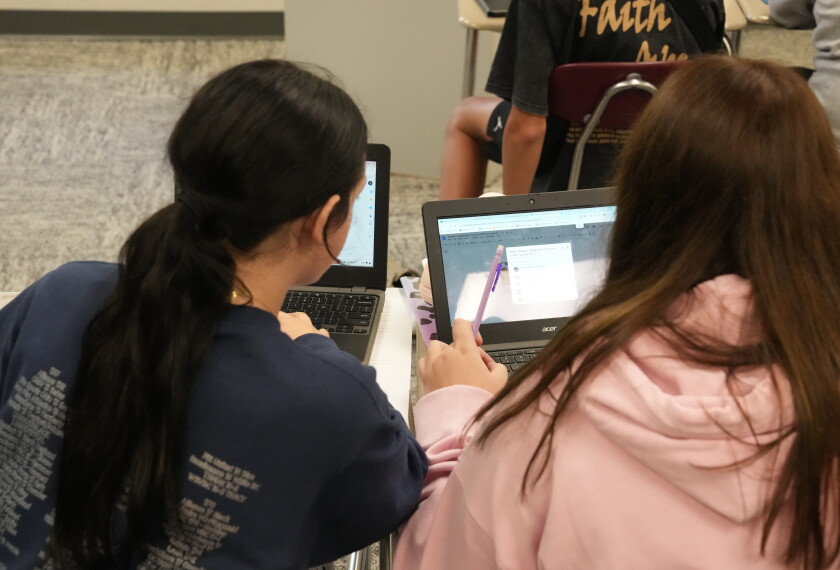
Thousands of public high school students in New Orleans received their own laptop computers this month—part of a $53 million technology initiative by the Recovery School District that aims to modernize some of the nation’s most rundown classrooms and improve achievement in a city where most students struggle to meet basic academic standards.
For the past two weeks, education officials issued laptops to nearly 4,000 students in the 9th through 12th grades in the recovery district’s eight high schools. Several hundred more laptops will go to 8th graders who failed Louisiana’s high-stakes exam last spring and were not promoted to 9th grade, said Paul G. Vallas, the superintendent of the state-run district.
The laptop program—which is costing the Recovery School District $1.67 million to lease the computers and software from Dallas-based Epic Learning for this school year—is remarkable for a city where, for decades, students in many struggling public schools did not even receive their own textbooks, officials say.
“We are doing several things with this laptop program for our high school kids, not the least of which is telling them that we have confidence in them, we trust them, and we want them to have this educational tool,” Mr. Vallas said in an interview this month.
Some Are Skeptical
Most students and teachers have embraced the program enthusiastically. But it has also encountered skepticism from some teachers, who question the wisdom of issuing expensive equipment in a high-poverty city such as New Orleans, and who doubt that students will get much educational benefit from the computers.
A handful of school districts around the country have recently begun to abandon their laptop programs as repair costs to the computers have escalated and significant academic gains among students using the machines have failed to materialize.
Mr. Vallas, a veteran urban schools chief who has been in charge of the state-run district here since July, said the laptops are part of a broader effort to introduce academic reforms, improve instruction, and raise expectations for the roughly 13,000 students in the 33 schools that he directly oversees.

Many students now enrolled in the recovery district already lagged academically before Hurricane Katrina struck in late August 2005. And many fell even further behind after the storm displaced them and their families and, in some cases, kept them out of school for weeks or months.
Mr. Vallas has emphasized technology as one way to improve the post-Katrina academic environment, spending tens of millions of dollars to wire school buildings, install interactive whiteboards in most classrooms, and lease the laptops and software for students in the upper grades.
“These are kids who’ve only ever been to schools that operate in an environment of low expectations,” Mr. Vallas said. “What we are telling them now is that we have high expectations for them, that they have to step up.”
At John McDonogh High School earlier this month, Nikole Wells, the school’s educational technology coordinator, organized the distribution of nearly 500 laptops in one day. As students arrived at the school’s cavernous auditorium in groups of 30 or 40, Ms. Wells sat them down and explained that the computers are “your responsibility.”
“Think of them just like your textbooks,” she said. “You must take them home every night to do your homework and bring them back every day for class.”
Before the students received their computers, every laptop had been personalized with their names, student-identification numbers, and academic courseware installed to match their class schedules, said Kamala Baker, the educational technology coordinator for the Recovery School District. She is in charge of overseeing the laptop program and the RSD’s other technology initiatives.
Students will have limited access to the Internet, Ms. Baker said, and the district has installed filters to keep them from using the laptops to surf Web sites such as the social-networking site MySpace and the popular video-sharing site YouTube.
“What these laptops have on them are lessons and further instruction for them in their core courses,” Ms. Baker said. “The software is meant to be a supplement to the state’s high school curriculum.”
In Algebra 2 courses at John McDonogh, students will use their laptops to “get help with lessons they might not have understood in class,” said Edith Jaynes, a mathematics teacher who started teaching at the high school before the hurricane. “There is a program for Algebra 2 that will reteach the day’s lesson to kids.”
Students will also complete their Algebra 2 homework on their laptops and must submit it to Ms. Jaynes via the Internet. Grade books for each of her classes are downloaded onto her laptop. She and most of McDonogh’s other teachers have been learning to use their own laptop computers since the beginning of the school year.
Security Concerns
Most students at McDonogh appeared to be thrilled with the laptops. They immediately pulled the machines from black computer bags to boot them up. But several said they were worried about losing them, breaking them, or, most especially, having them stolen.
“If any of you are worried about taking these home because you live with someone you don’t trust, we can make arrangements for you to leave your laptop here at school,” Ms. Baker told the students.
Two other teachers at McDonogh High, who declined to give their names because they were being critical of the program, said the students’ concerns were legitimate in post-Katrina New Orleans.

Education Week’s 2007-08 project on the New Orleans schools includes many online-only features, including archives, links, feature stories, photo galleries, Q&As, and more. Learn more about the series.
Many families here are still living in trailers provided by the Federal Emergency Management Agency and other temporary housing in neighborhoods where violent-crime rates are high.
Both the teachers also said that many students at McDonogh have more pressing needs than laptop computers.
“These are kids with a lot of very basic needs at school,” said one of the teachers, both women. “Some of them are way below grade level, and I’m not sure how giving them these laptops is the best investment toward helping them read and do math better.”
Tieasha Sims, an 18-year-old junior who was still dressed in a blue smock for her cosmetology class when she came to get her laptop, said the responsibility for taking care of the computer is worth the risk.
“This is really going to help me, because everything isn’t always in a book, and our teachers can’t always make it easy to understand,” Ms. Sims said. “Kids in rich school districts get all of this stuff. We deserve to have it, too.”
Ms. Jaynes said many of her students didn’t believe her when she told them they would all be getting their own computers. Their reaction, she said, is a legacy of going to public schools in a city that historically has spent very little on basic supplies, much less technology.
“These kids would never expect something like this,” she said. “We are talking about kids who weren’t used to even getting their own textbooks to take home before Hurricane Katrina.”