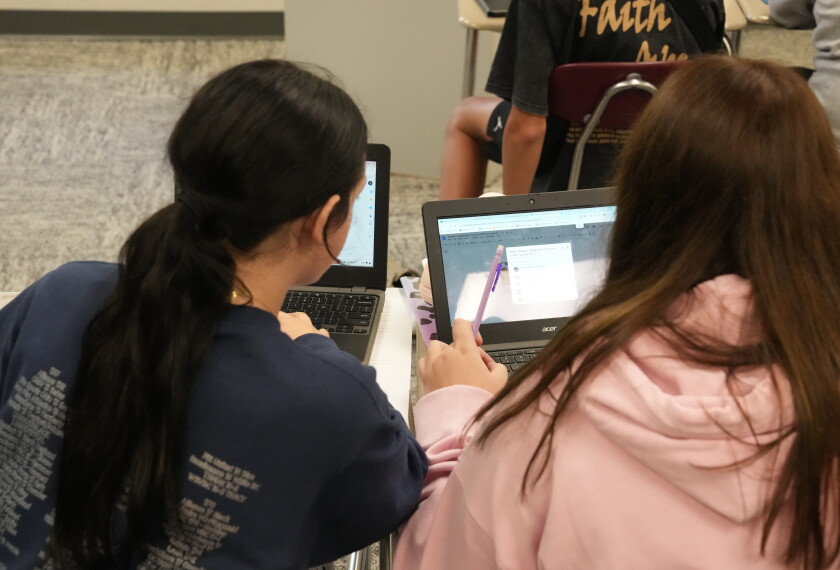

A good chunk of the activities students and teachers do in class happen online, as digital learning materials and online testing have become the norm.
But a growing number of educators, parents, and even students are souring on the ubiquitous presence of technology in schools, citing concerns that too much screen time could be partly to blame for rising behavioral and mental health problems, as well as declines in academic achievement.
Some schools and districts in response are trying to find ways to address those concerns.
Join us at ISTE+ASCD
Heading to Orlando for the ISTE/ASCD conference? Be sure to attend The Ed-Tech Backlash Is Here. How Should District Leaders Respond? on Monday, June 29, 1-2 pm ET. Join EdWeek Assistant Editor Alyson Klein, EdWeek Research Center Director Holly Kurtz, and a panel of district leaders to understand what’s fueling the ed-tech pushback, get practical takeaways on how to respond to community concerns about screen time, and more.
Join us >One way is by educating teachers on what the research says about how screens affect young people’s brains and giving them ideas on how to break up or limit screen time, said Jeremy Sullivan, the director of innovative learning and student supports for the North Kitsap school district in Washington state.
Sullivan is scheduled to present a session on how adolescent brain development and screen use shape attention, behavior, and motivation at the ISTELive 26 + ASCD Annual Conference 26 to be held in Orlando, Fla., from June 28 to July 1. Education Week interviewed Sullivan ahead of the conference to discuss screen time concerns.
This interview has been edited for length and clarity.
What should educators take away from existing research on adolescent brain development and screen use?
[Our brains have an] executive state, emotional state, and survival state, and learning happens in our executive state. When we put kids on a screen for a longer period of time, we actually move them from the executive state into the emotional state, because the engagement [with the screen] is releasing more and more dopamine. It’s creating heightened levels of excitement.
How can we keep kids in that optimal space for learning, where they can reflect, where they can reason, where they can problem-solve, where all of those things can exist? And it’s hard. We’ve always seen at the secondary level that engagement data is much lower than at the elementary level, but now we’re even seeing elementary engagement data starting to drop down. The correlation belief is that it’s tied to technology.
Just because your resources are online doesn’t mean that students have to be on them all the time. But if they do, and if that’s the reality, then how do you break it up, so they stay engaged with your content, and so you’re keeping their brain primed for learning, instead of it slipping into disengagement?


What are some ways teachers can break up or limit screen time during lessons?
If you’ve got your kids on technology doing something for 10 minutes, take a break. Even just a 30-second break for kids is huge for their brains.
You can do an accountability check: “This is what we’re doing. We have a two-tab count on the board. How many tabs do you have open right now? You got four tabs. Let’s scale back—you got off track there for a little bit.” You can use it as a meta moment to help them reflect on their own practices.
You can just get them up and do something else to give their brains a quick break from the screens. Have them talk to each other. Kids never talk to each other enough anymore in the learning process.
What else should teachers consider when designing lessons with or without technology?
The first question I always ask is: who’s doing the most work in the classroom at that moment? When you’re designing a learning moment, who is the one actively engaging in work? A lot of times the answer is the teacher. It’s the teacher presenting direct instruction, and I’m not trashing direct instruction. Direct instruction is amazing and has a place. But if you only have 50 minutes with your students and 30 minutes of that are you, then you cannot be surprised that your students are disengaged.
Kids never talk to each other enough anymore in the learning process.
Because so many of our resources are online, we have to give a kid the device to help them gain access to those resources. It’s the responsible thing to do, because technology is a part of their real world, and schools are best positioned to help them handle it responsibly. No matter what, we still have to give them that [access to technology] that then can lead to disengagement or other struggles. If we’re giving them that, we’d better be purposefully thinking about how we’re using it.
Do you have advice for school and district leaders navigating screen-time concerns?
The first thing you have to do is quantify your own problem or quantify your environment. There is so much misinformation out there, and we are seeing such a fast pendulum shift against technology. Instead of reacting to what you’re hearing out there, go on a tour of your buildings, get into your classrooms, look at the platforms that you have usage data on, and quantify what your world looks like. You’re never going to know how to get where you’re going unless you know where you’re starting from.

Once you can get the lay of your land, then it’s figuring out what system do I need to shore up? What’s my end goal? Who needs to be at the table? And then you start having your conversations.
What I think we can’t do right now is, I don’t think we can just rest on the statement that I hear too often: “Well, this is just how school is. The kids are on Chromebooks, the kids are on devices, they don’t make textbooks a whole lot anymore. So, there’s not a whole lot we can do about it.” To me, that removes all of our collective efficacy as an education system. We absolutely can address it. We absolutely can make it right for kids. Just because we did something one way last year doesn’t mean it’s what we have to do next year.

What challenges are educators facing as they navigate this pendulum swing?
The biggest challenge is time. My curriculum has provided me with a daily activity for my students. It’s always there for them, it gives me actionable data with the click of a button, so I can either just click that button, give that assignment to them, put them on that device, and have them do that every single day. Or I can look at the learning outcome for the day, and instead of having them just click on this activity, I’m going to move it into an active, collaborative activity. It takes time to do those planning shifts.