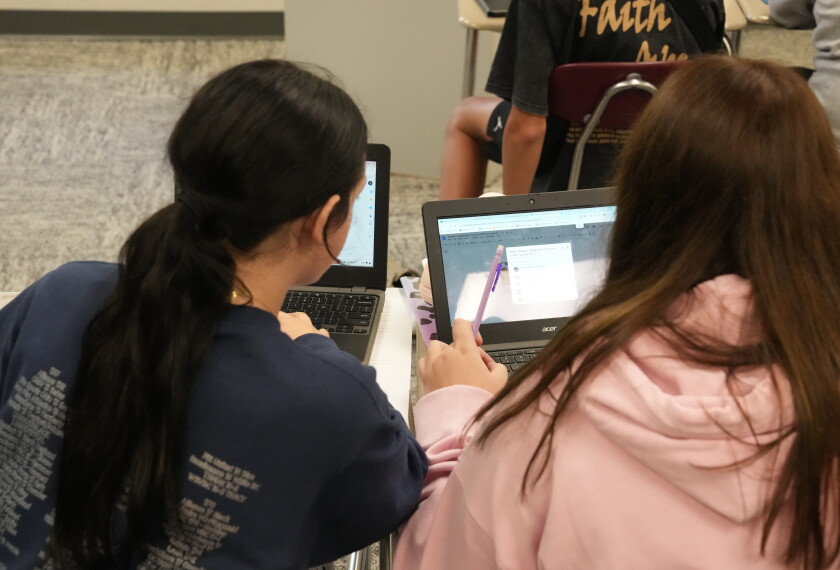
With more standardized tests going digital, including most recently the College Board’s Advanced Placement exams, more schools are investing time and resources into keyboarding instruction, particularly in younger grades.
“Nowadays, there is even a higher need for that skill than there used to be when not everybody was using some type of keyboarding skill, even in school,” said Denise Donica, professor and chair of the department of occupational therapy at East Carolina University.
While the need for instruction on proper typing techniques has grown and more states have set standards around keyboarding instruction, it’s still not a guarantee that all schools teach keyboarding, Donica said.

In an October EdWeek Research Center survey, most school and district leaders said their school or district teaches keyboarding in some capacity. But a minority of students are learning in dedicated keyboarding classes.
Eight percent of administrators said their school or district taught keyboarding as a standalone class, while another 11 percent said their school or district taught the skill both as a standalone class and in the regular classroom. Half of school and district leaders said students learn to type as a skill in the classroom.
These findings don’t surprise Andrew Kohl, the director of educational technology at the Northbrook-Glenview school district in the Chicago area.
“Instructional time is so precious that, particularly the elementary grades, trying to find a standalone time for a keyboarding class would be really challenging,” he said. His district offers a web-based keyboarding program, and students in grades 3 and 4 take a keyboarding unit.
Asked when students learn keyboarding, school and district leaders’ responses suggested an emphasis on grades 3-5 and 6-8.
That breakdown made sense to Donica. When she was growing up, she took a keyboarding class in middle school—but now she’s seeing children interact with computers at the preschool level, increasing the demand for an early introduction to computer and keyboarding fundamentals.
It’s promising to see an emphasis on younger grades, said Carol Parker, assistant principal of Rockvale Middle School in Tennessee.
The earlier instruction can help students break their hunt-and-peck habits—searching for letters on the keyboard using their index fingers—earlier and move onto using the home row.
Parker has led keyboarding programs at her middle school outside Nashville but hopes more schools expand instruction into the younger grades.
Students in wealthier districts are more likely to receive early keyboarding instruction, survey data show.
Seventy-four percent of district and school leaders in more affluent systems—where fewer than half of students qualify for free or reduced-price lunch—report offering keyboarding instruction in grades K-2.
By contrast, 51 percent of leaders in less affluent systems—where the majority of students qualify for free or reduced-price lunch—report the same, highlighting a disparity in early access to keyboarding instruction.
Some districts introduce and teach keyboarding instruction only in 3rd grade, Donica said. She advocates for a more scaffolded approach that predates and continues beyond the 3rd grade.
The nationally representative EdWeek Research Center survey included responses from 236 district leaders and 168 school leaders. It was administered from Sept. 26 to Oct. 8.