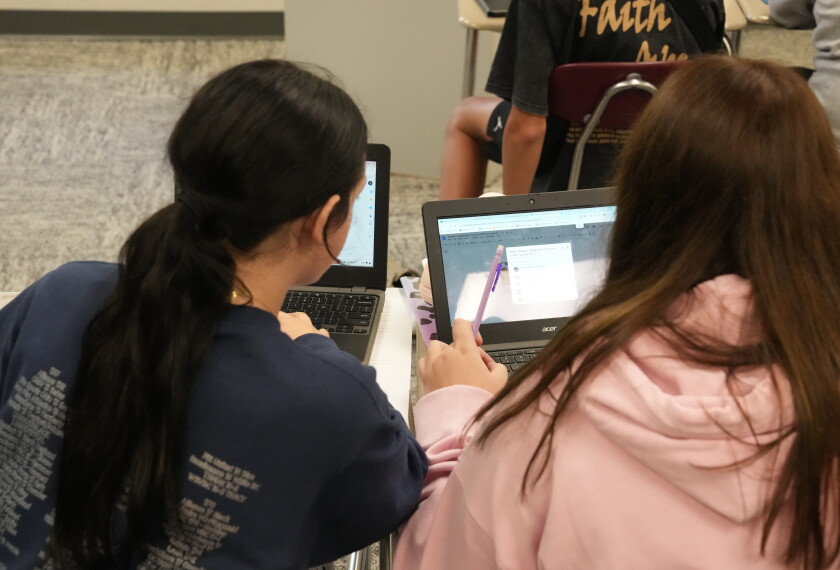
There was a new face at the table this school year as the Meriden public schools set out to evaluate digital curricula aligned to the Common Core State Standards.
In addition to supervisors for subjects like English and mathematics, the district created a new position to provide input: supervisor of blended learning.
Having someone with deep knowledge of technology involved in the curriculum-selection process was a must, said Barbara Haeffner, the director of curriculum and instructional technology for the 9,100-student Connecticut district. That was especially important, she said, given that the district has a relatively new 1-to-1 computing program at the high school level, a bring-your-own-device initiative in lower grades, and an emphasis on digital content for personalized learning.
“It’s changing the discussion,” Ms. Haeffner said. “Having someone with great technology expertise puts another lens on what we’re looking at.”
Many districts are searching for digital curricula that links effectively to the common standards, which are now in place in 43 states and the District of Columbia. But choosing a product is a complex and labor-intensive process that often varies from district to district. And it’s a choice that carries immense consequences for educators, said Nancy Gannon, the director of state and district instructional materials for the New York City-based Student Achievement Partners, a nonprofit organization that helps teachers and districts adapt to the new common-core demands.
“It’s probably the most expensive thing a district does in any given year beyond personnel,” Ms. Gannon said. “There’s anxiety about wanting to get it right for the kids, for the district budget, for taxpayers, and for teachers.”
Some common mistakes districts make when evaluating digital curricula include failing to determine whether it meets the district’s interpretation of the standards, and not looking at how digital material will work with existing district technology.
Considering the Options
So how are districts getting it right? Internally, they’re relying on layers of district reviews, teacher evaluations, and pilot projects. Externally, districts examine ratings and resources for product evaluations from a variety of organizations, as well as state review. For example, Washington state has set up a library of common-core-aligned open educational materials for students to use. Florida, in partnership with Florida State University, has developed cpalms.org, a website that collects educational resources, many digital, which are reviewed and vetted to ensure alignment to the common-core standards.
In California, the curriculum-review process for the 14,000-student, K-8 Lancaster district starts with the list of materials the state has already vetted. That vetting helps the Lancaster school system start one step ahead in the process, said Brenda Smith, the district’s assistant superintendent of educational services.
“California has very clear criteria the publishers have to meet before they go on the state adoption list,” she said. “We let the state look at 100 programs and then we look at the 14 they put on their list.”
One of the first priorities the district considers, Ms. Smith said, is whether digital curricula will fit with the technology available in Lancaster schools. “We want to make sure all of our students will have equitable access,” she said.
That means looking at all the digital learning devices used in the district, whether students have easy access to digital materials inside and outside of school, and whether content is accessed through an app or is Web-based. At the same time, schools should not be distracted by “shiny things” and must determine whether material will improve student learning, said Mary J. Cullinane, the chief content officer for Boston-based education publisher Houghton Mifflin Harcourt.
Districts need to be “very critical about what is being promoted as a benefit,” she said.
This school year, Lancaster educators piloted curricula from two publishers. The district had 60 teachers pilot one program for four weeks and then the other program for four weeks, Ms. Smith said.
Some back and forth took place between the district and the companies over questions and concerns, and students were surveyed. The district eventually chose a digital math curriculum from New York City-based McGraw-Hill Education. “We spent nearly the whole year doing this,” Ms. Smith said.
Time of Transition
The process is labor-intensive, but “there’s really no substitute for actually getting someone with expertise in your district to look closely” at prospective digital curricula, said Helen Soulé, the executive director of the Washington-based Partnership for 21st Century Learning, which promotes teaching students skills valuable in the modern workplace. “You need to make sure it matches your curriculum and your students, the characteristics of your community. It could match with the standards, but be really wrong for your community and culture.”
Publishers play an increasingly active role starting with developing standards-aligned digital curricula.
For DreamBox Learning, an online learning math-curriculum provider based in Bellevue, Wash., that means educators hired by the company work backward to identify standards, and then design lessons, tools, and manipulatives that align to those standards, said Jason Bedford, the senior vice president of client engagement and success. Like other ed-tech companies, DreamBox has a third party vet the material to ensure alignment.
But other factors are just as important as common-core alignment, particularly in the digital world, Mr. Bedford said, including the blueprint of a course and how students progress through it. “The instructional design [of the course] behind the work should carry equal, if not more weight, than the standards alignment,” he said.
Bethlam Forsa, the president of learning services for New York City- and London-based education publisher Pearson, said she sees district curricula evaluation changing as educators adapt to digital offerings. She’s noting district technology leaders front and center in the process.
“Historically, the decisions around curriculum and technology used to be separate, and instruction was the driver,” she said. “Districts realized that they have to look equally at the implementation and technology required.”
For the 110,000-student Baltimore County district in Maryland, in-house educators there write all the district’s curricula. However, it buys content—both digital and print— from commercial publishers, said Stefani Pautz, the district’s coordinator of curriculum development.
“We use their resources and then write our own curriculum,” Ms. Pautz said. A central-office team makes sure content is common core aligned. To start, the technology team is the first hurdle. “At the moment of a request for information, the hardware and software compliance is built into the RFP,” she said. Products “have got to meet those requirements first.”